Carl Andre,
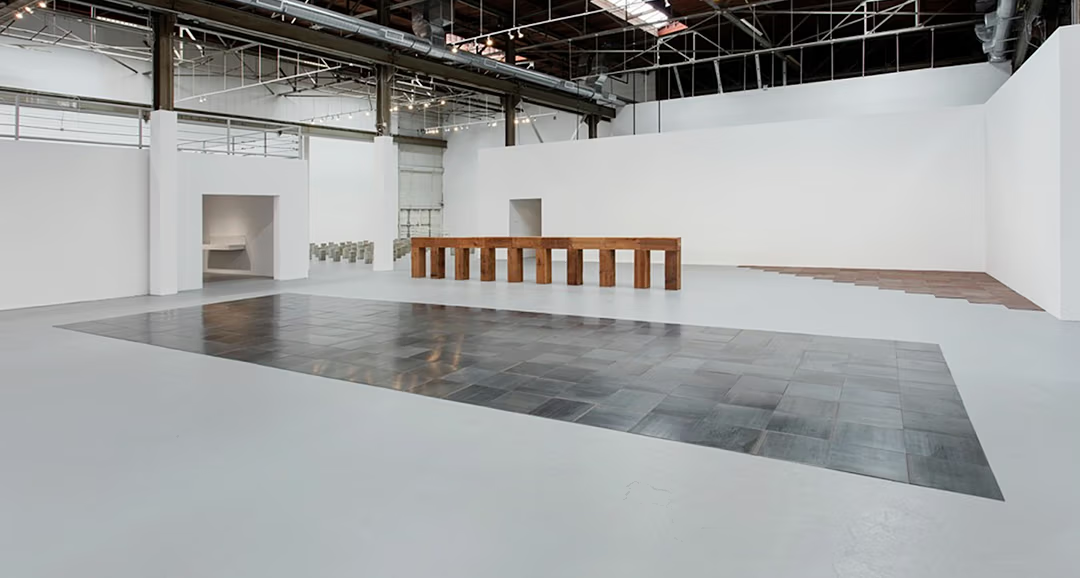
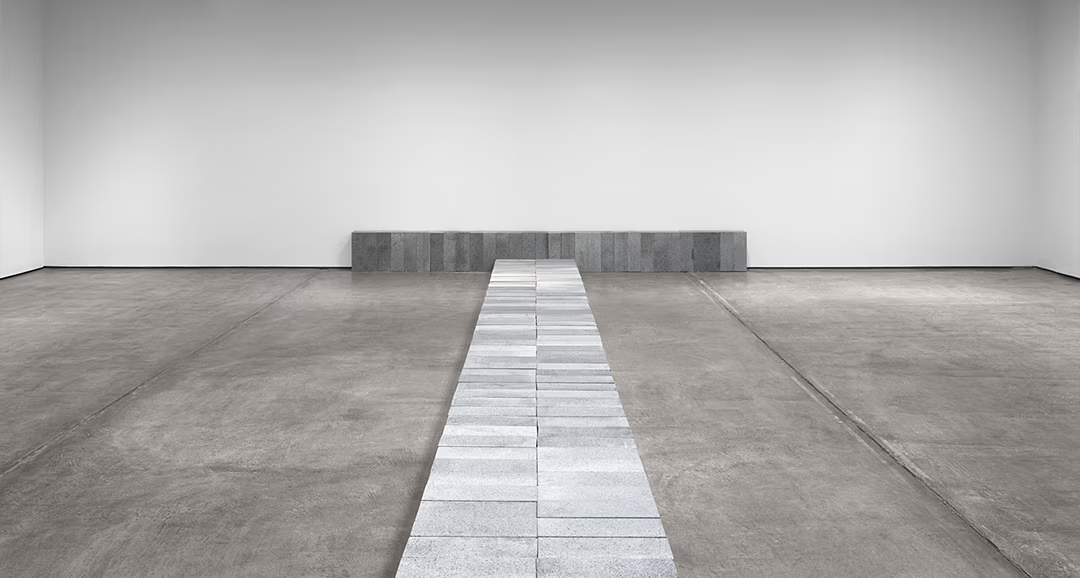
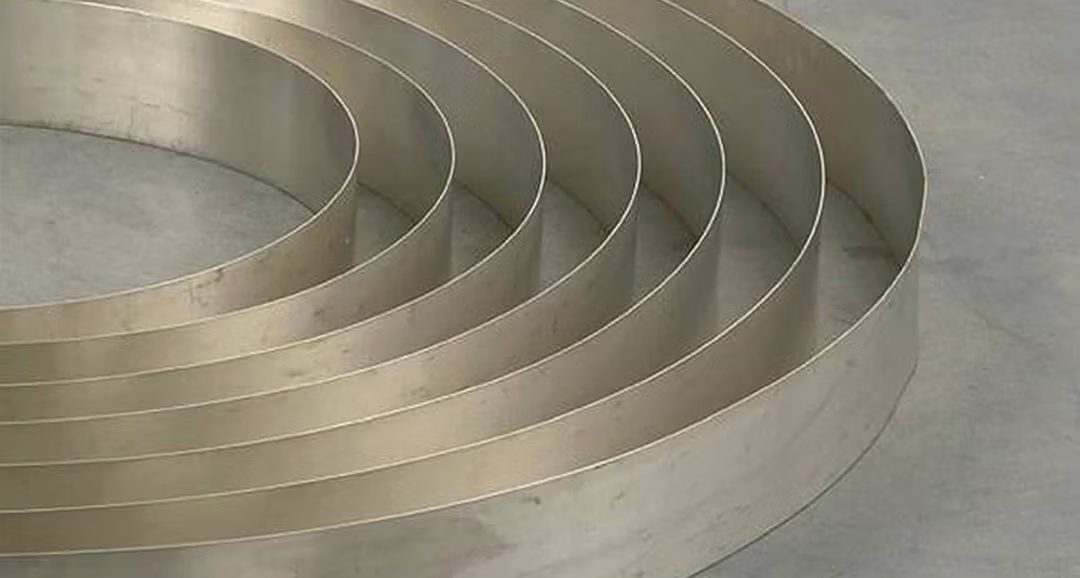
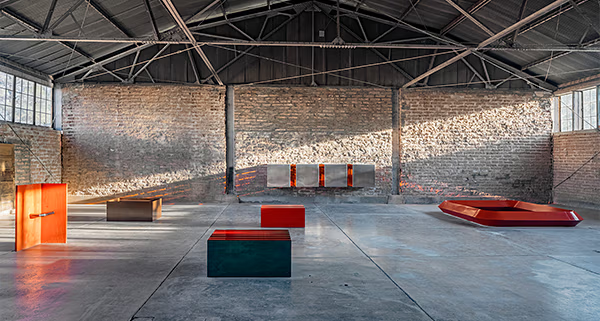
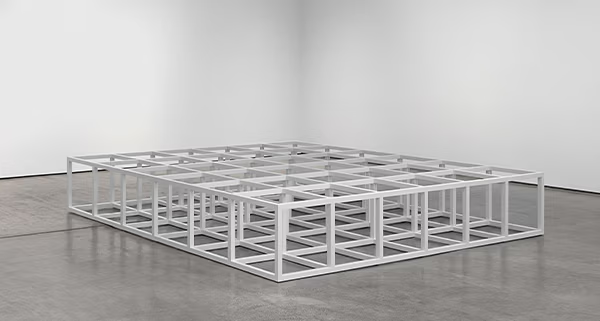
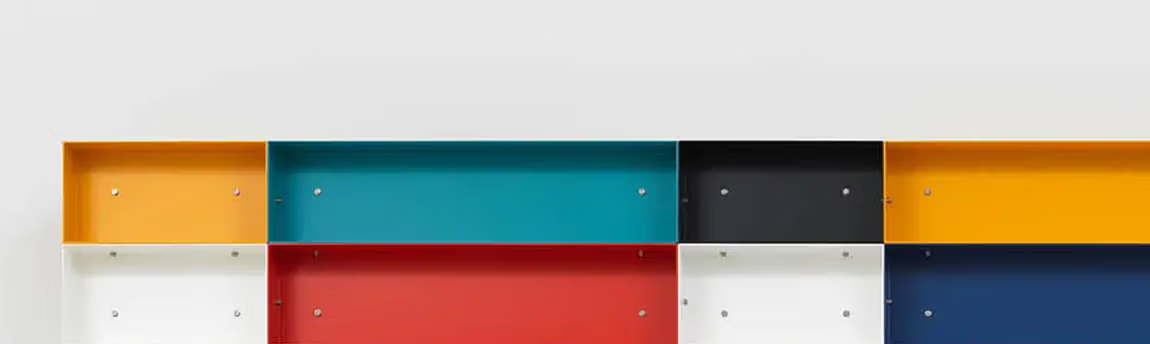
6ALINCU18, Glarus, Switzerland, 2001, Detail, Copper and aluminium, 5x400x150 cm. 24-unit rectangle on floor, 5 x 50 x 50 cm (each), (Galerie Greta Meert)

MINIMALISM

1960’lı yıllarda minimal sanat hareketi, modernizmi tamamlayan ve bir bakıma parçalayan salt biçimci bir model olarak gelişir. Sonraki yıllarda özellikle yeni dışavurumculuğu kapsayıcı ve öncü gösterebilmek adına yoğun biçimde eleştirilmiş, indirgemeci ve eski bir anlayış olarak nitelenmiştir. Günümüzde ise minimal sanat; hem geç-modern hem de avangard sanatla kurduğu diyalektik bağlar nedeniyle, sanatın aşkınsallığını ihlâl eden deneysel, kuramsal ve kışkırtıcı bir yaklaşım olarak değerlendirilmektedir.

1960’lı yıllarda minimal sanat hareketi, modernizmi tamamlayan ve bir bakıma parçalayan salt biçimci bir model olarak gelişir. Sonraki yıllarda özellikle yeni dışavurumculuğu kapsayıcı ve öncü gösterebilmek adına yoğun biçimde eleştirilmiş, indirgemeci ve eski bir anlayış olarak nitelenmiştir. Günümüzde ise minimal sanat; hem geç-modern hem de avangard sanatla kurduğu diyalektik bağlar nedeniyle, sanatın aşkınsallığını ihlâl eden deneysel, kuramsal ve kışkırtıcı bir yaklaşım olarak değerlendirilmektedir.

COLLECTION EXHIBITION

EXHIBITION CATALOGUE

Minimal, Editor: Jessica Morgan, Contributors: Emma Lavigne, Jessica Morgan, Jean-Pierre Criqui, Frances Morris, Alexandra Bordes, Clara Meister, Teresa Kittler, Nicolas-Xavier Ferrand ve Alexis Lowry, Pinault Collection & Éditions Dilecta, Paris, 2025. 

MINIMALIST ARTISTS 

CARL ANDRE

Carl Andre (1935-2024) Works composed of stone and wooden blocks or metal squares and placed on the gallery floor in repeating units are considered early examples of minimalist sculpture. These arrangements, characterized as a conscious expression of the space they inhabit, are actually created in an objective silence. They also highlight concepts and situations such as balance, symmetry, and order as indicators of a rational approach. Andre insists that his works exist solely from their own materials, devoid of any spiritual or intellectual qualities, and are nothing else. Carl Andre’s sculptural practice is an effort to develop a sensitivity to raw materials through transformations carried out in the context of material-object and space, and through multi-unit/object arrangements. In this approach, where time and perception are concretized, a spiritual dimension, with its hidden depth and internal order, is made meaningful through a paradox that evokes a sense of ordinariness. The artist, who thus aligns the idea of sculpture with a sequential and variable relationship between surface and material, develops this approach as a radical and infinite solution strategy. (See. :https://www.tate.org.uk/art/art-terms/m/minimalism 

DONALD JUDD

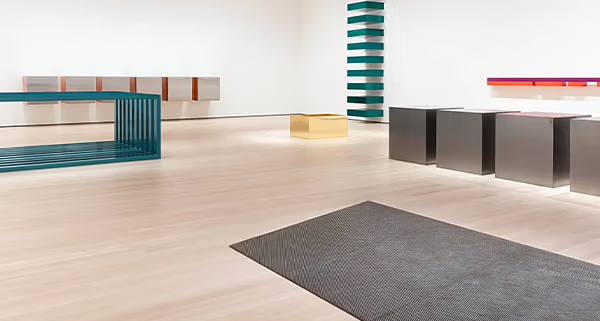
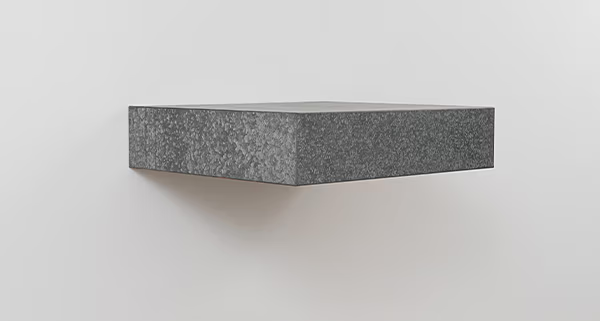
Donald Judd, Untitled, (Detail), 1965, Galvanized steel Dimensions, 297,7 × 101,6 × 76,2 cm NMSK 1927 Collection Materialitet, Art © Donald Judd Foundation/Bildupphovsrätt 2026, Sweden/VAGA, New York

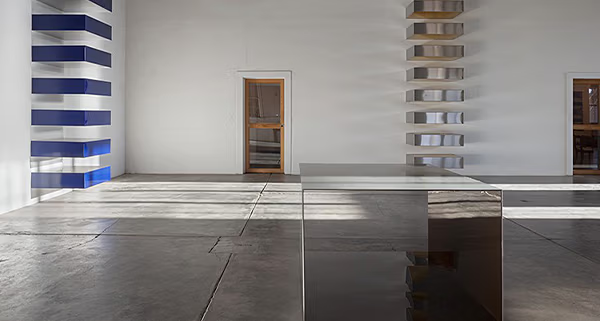
Donald Judd (1928-1994) describes his series of works, which shifted from painting to sculpture and consisted of a few identical elements mounted on the wall through radical experiments, as “specific objects,” in accordance with the term he used in his 1965 manifesto. Judd’s works, created with an extremely simple and radical approach to abstraction, have a distant spatial effect. Conceiving his objects in an equivalent relationship with space, Judd envisions a minimalist and unsettling plane derived from form and structural formation. He thus spreads a spirit of minimal transcendence, legitimized by creating a potential for questioning the causality and uniformity of the perceptible, across the object and space. By withdrawing the sensory perception caused by things and thoughts in an abstract and ambiguous relational environment, he recreates the expanded rigidity emitted by the pure image within an aesthetic mise-en-scène. With his hard lines and angular boundaries, Donald Judd leaves nothing behind from the plane of perceived consistency and immanence in the context of constantly repeating new impossible forms.

MEG WEBSTER

minimal bourse de commerce coll 2

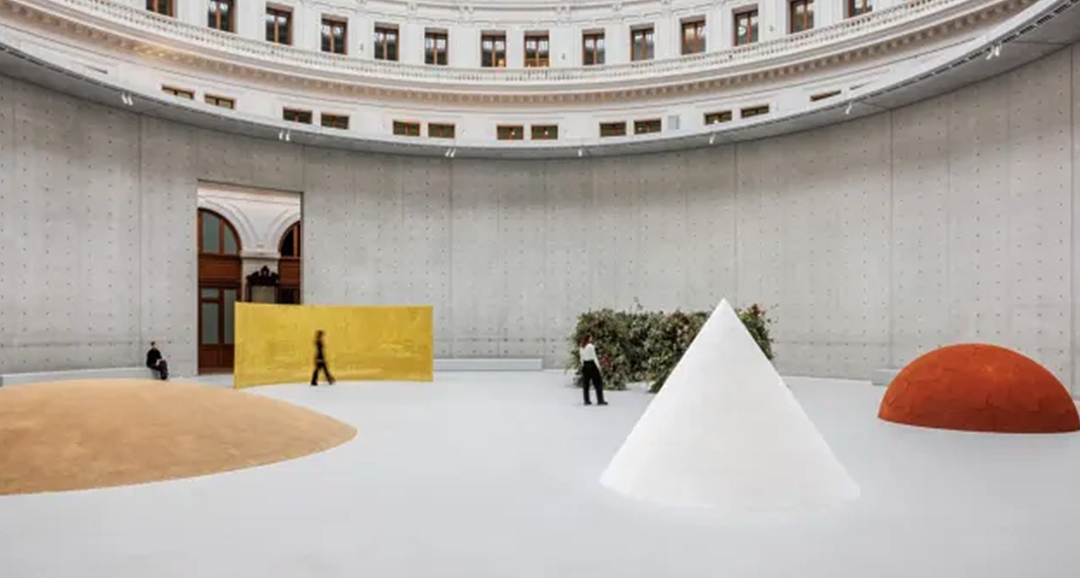
Meg Webster'ın eserlerinin yer aldığı“Minimal” sergisinden bir görünüm, Bourse de Commerce - Pinault Koleksiyonu, Paris, 2025. Fotoğraf: Nicolas Brasseur.

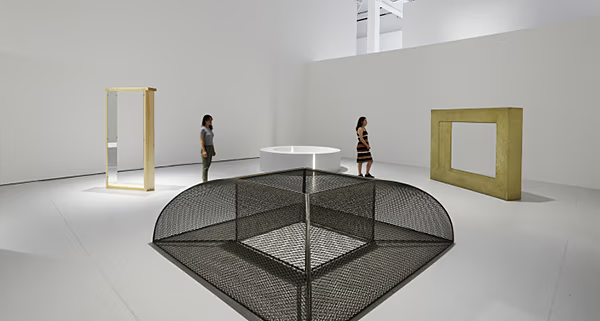
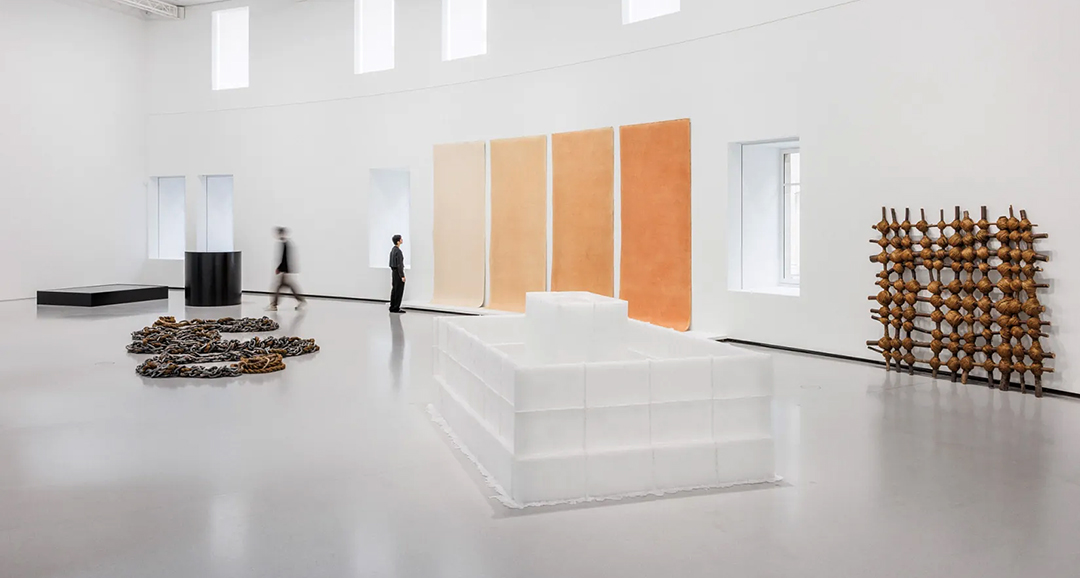
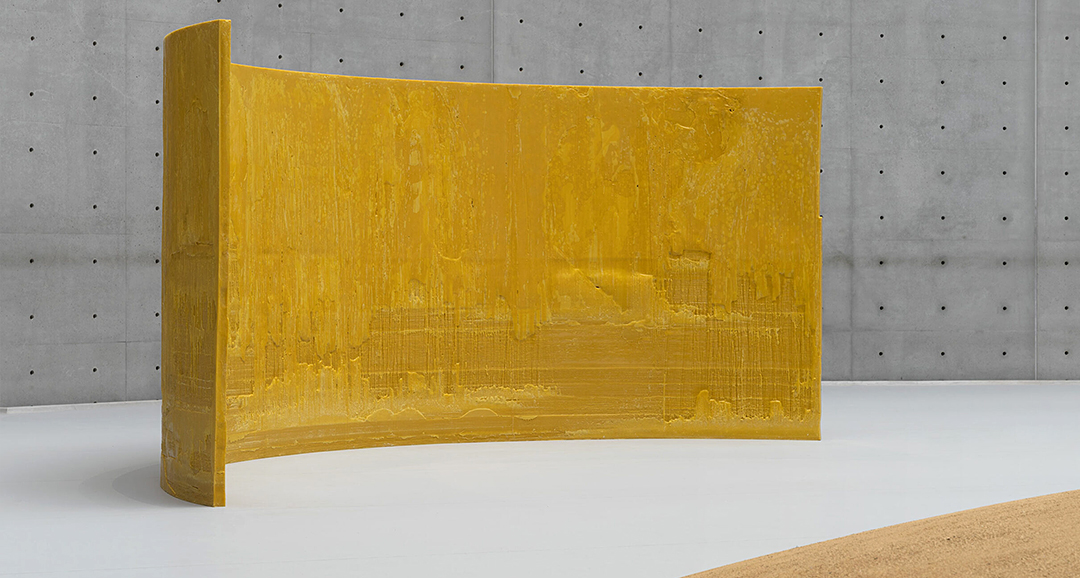
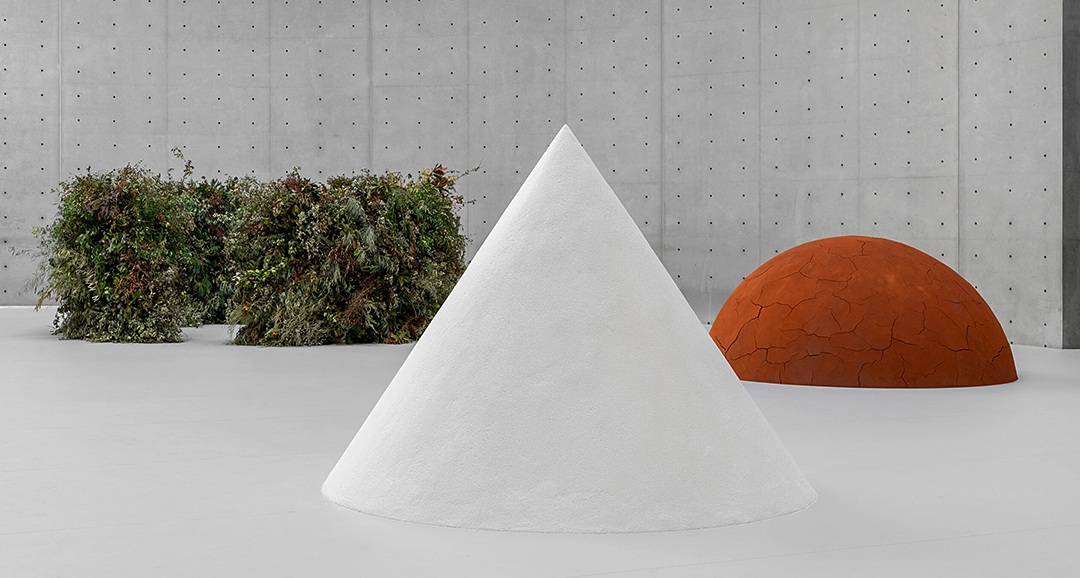
Meg Webster‘s three-dimensional works, composed of minimal geometric and monumental forms, also reference ecological concerns. Her installations, created from red ash piles shaped like hemispheres, white salt, and beeswax, alongside living plants, highlight ecological pollution threatening the natural world and the endangered cycle of organic components. Webster’s salt or clay clusters, which grow largely through the functional power of organic micro-arrangements, take on a meditative function that triggers a kind of sensory effort. Here, there is an extraordinary spiritual molecular mass where the body and sensations turn inward and layer perception thresholds. These minimal clusters, simple yet containing a multiplicity of sensations, carry the fragile yet complex dimension of the relationship established with the natural environment into a conceptual phase. Webster’s simple arrangements also solidify with the smooth boundaries of the material form, evolving into an experiential threshold and a powerful natural landscape that transforms its own perception order. With their simple forms, they are like an extremely powerful critical emotional response to the new world order. Or these minimal forms are, in a way, sensitive and interactive monumental metaphors for sensing the world. Gülay Yaşayanlar

ROBERT MORRIS

Robert Morris 1

Robert Morris, (1931-2018) He radically simplified and developed the concept of minimalism that emerged in New York in the early 1960s. Having begun his career as a painter, he adopted a new style consisting of sculptural installations and, through a series of published articles, helped to define the minimalist movement… In fact, his approach challenges traditional art-historical classifications and movements. It is evident that he views his artistic practice as a single, coherent work, an ongoing project, and a sustainable, philosophical-artistic experiment. All his works aim to create a complex, sometimes paradoxical space, independent of the medium used; and this space restores to the viewer processes of experience and perception that seem inaccessible today. In fact, these works, which concern the relationship between the visible and the known, are shaped by philosophical scepticism, prioritising a variable principle of representation based on experimental propositions. Despite his methodological rigour, Morris’s practice is therefore highly subjective, imbued with intense introspection and an emphasis on the quest for selfhood.

DAN FLAVIN

minimal bourse de commerce coll 53

Dan Flavin, Alternate Diagonals of March 2, 1964 (to Don Judd), (Detail) 1964, red and yellow fluorescent light, 365.8 cm (diagonal), Pinault Collection. © Dan Flavin / Adagp, Paris, 2025. View of the exhibition “Minimal,” Bourse de Commerce – Pinault Collection, Paris, 2025. Photo: Nicolas Brasseur.

Dan Flavin (1933–1996) is considered one of the pioneers of Minimal Art for his work with fluorescent light beams and his radical and innovative sculptures. In the early 1960s, he experimented with fluorescent light, a mysterious material that suggested simplicity and singularity, emphasized its form and therefore itself, and possessed independent qualities. With this material, he created radically simple and transformative light installations that led to a new breakthrough. His work to Don Judd (1964), found in the Pinault Collection, consists of neon lights arranged in an alternating cross pattern. Here, the cross pattern extending along the wall brings together industrial aesthetics, the sensuality of the material, and the intensity of the light, conveying a palpable sense of energy that alters the viewer’s perception of space and draws their gaze. This work is the first in which Flavin systematically used the wall sconces and standard fluorescent tubes found in stores. It transforms an everyday object into a work of art and reconfigures the spatial experience.

AGNES MARTIN

Installation view: Agnes Martin: Innocent Love, Pace Gallery, New York, 2025. Courtesy Pace Gallery. Photo: Pace Gallery. (https://brooklynrail.org/2025/12/artseen/agnes-martin-innocent-love/)

Agnes Martin (1912–2004) Martin’s square-format works lean on a dialectic of line, contrasting with the concept of order. Martin has actually transferred the effective conceptual elements of Minimal Art into a formable spiritual perception with her works, which exclude subject matter and exist within a rhythmic flow. She seems to define a manifesto of liberation on a grid plane carrying harmonious linear vibrations that are constantly recoded. On the other hand, Agnes Martin produces permeable and simple forms with a metaphor of social and intellectual exaltation that centers on humanity with a perfectionism that originates from herself. She appears to possess an effective minimal power with her ability to foresee, construct, and transform this unique mystical power of transmission into a power of contemplation that changes. Emotional thresholds without subject or form change the nature of visual arrangement each time and are positioned on a new grid plane. Therefore, the determination of the rhythmic structure using the visual field and homogeneous differentiation in Martin’s paintings undoubtedly creates the conditions for the potential for production. Therefore, in this environment where a deep spirituality meets a static and silent vibration, the transformation of forms of feeling woven from intuitive codes and layers, originating from an inner fusion, is narrated… Gülay Yaşayanlar

SOL LEWITT

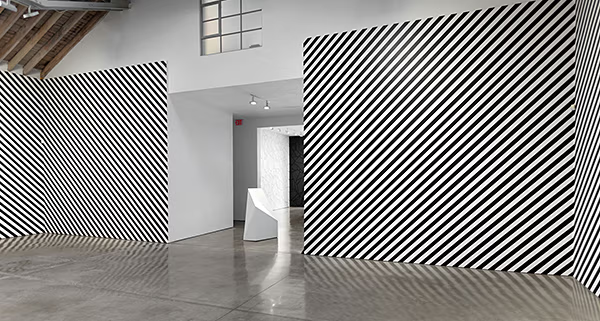
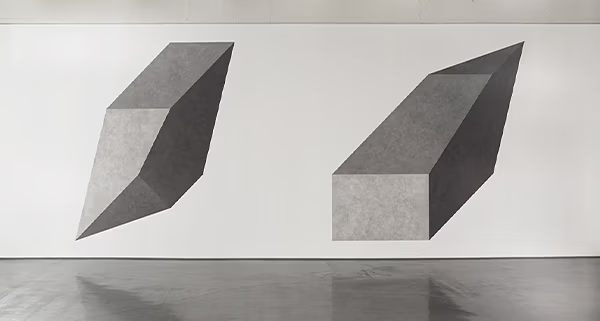
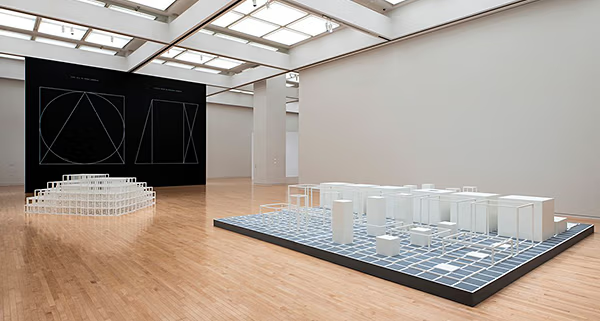
Sol LeWitt, Installation view, Paula Cooper Gallery, September 2016. [https://www.paulacoopergallery.com/exhibitions/sol-lewitt2#tab:slideshow]

Sol LeWitt (1928-2004) One of the leading figures of Minimal Art, LeWitt is known for his wall drawings or geometric sculptures, which he referred to as “structures.” By creating multiple variations of his structures, LeWitt explored a geometric and mathematical system using industrial materials such as aluminum, metal, or concrete. A key figure in the evolution of Conceptual Art, LeWitt insisted that the idea, the diagram, and the planning of these structures were the artwork itself. In doing so, the actual implementation of the sculptures—the objects themselves—was less important than the concept of the structure.

RICHARD SERRA

Richard Serra, Joe, 1999, (Detail) Weathering steel, Outer spiral approximately 163 x 576 x 480 inches © Richard Serra / Artists Rights Society (ARS), New York Courtyard, Photograph by Robert Pettus

Richard Serra (1938-2024) is one of the first Minimalist artists known for his monumental sculptures. He uses industrial materials such as steel to create simple, continuous surfaces that bend or curve in space. He attempts to influence our perception of space and dimension by compelling the viewer to enter the sculpture. The rusty textures that form on the plate surfaces lend a pictorial quality to the conceptual origins of his artistic practice. To the extent that he avoids ostentation, a monumental effect based on the structural and graphic integrity of the form is always present. That is why Serra’s metal plates have an extremely disturbing, metaphysical, and existential quality. Arrangements consisting of massive panels, especially flat walls or irregular rows or rising, falling, sloping narrow passages, resembling a labyrinth, take on a chaotic quality. They persistently make the viewer feel the threatening space of the sculpture. In this process, the aura of the sculpture enters into a psychological and intellectual concentration within the mediation of heavy mass reality.

ON KAWARA

minimal bourse de commerce coll 26

On Kawara, SEPT. 13, 2001, (Detail) 2001, acrylic on canvas, 25.5 × 34.3 cm. Pinault Collection © One Million Years Foundation.

On Kawara (1932-2014) Kawara’s works are conceptually defined and thus distinct from minimalism; however, the deliberately simplified form and style (or grammar) in works such as his History Paintings are distinctly minimalist. Like many conceptual artworks, Kawara’s paintings have adopted minimalism’s formal language as one of seriousness, reality, directness, and the language of truth. The Passage section displays numerous examples from Japanese artist On Kawara’s iconic Today series in corridors and display cases. Kawara’s works, markers of a universal and collective history, are presented within the museum’s circular architecture as a reminder of the relentless passage of time. Placed around the central area, each of these antique cabinets contains a single On Kawara Date Painting, with the date of the painting indicated in white letters and numbers. In a box beneath the painting is a page from the newspaper of the city where On Kawara painted that day. Beneath the painting dated October 5, 1982, a newspaper reports that Israeli planes attacked missile bases in Syria. Beneath the painting dated June 20, 1975, the box contains a full-page advertisement for the movie Jaws, which was released in US cinemas that day.

MINIMALIZM / 4 BOOKS

Minimalizm 1 Book 2

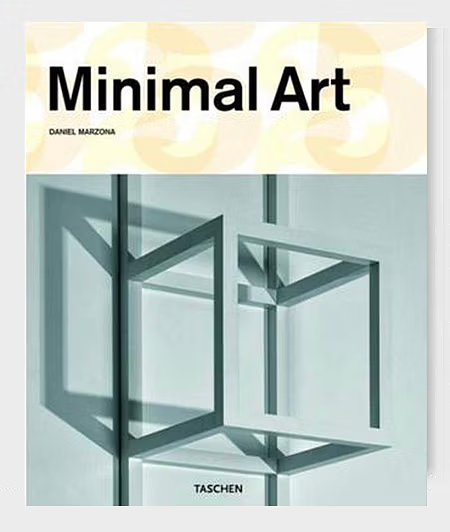
Daniel Marzona, Minimal Art, Tashen Deutschland, 25. Edition, German, Hardcover, 200 pages, 2009.

Minimalizm 1 Book 7

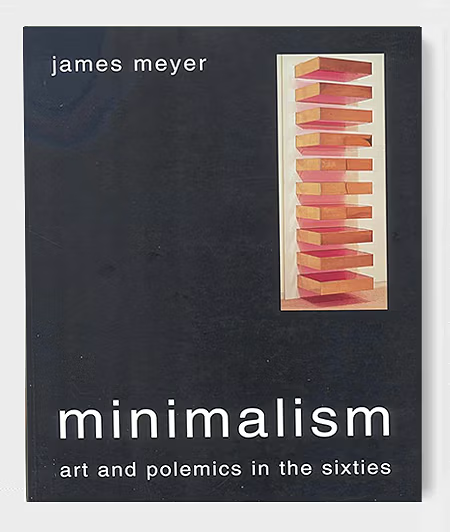
James Meyer, Minimalism / Art and Polemics in the Sixties, Yale University Press, English, Paperback, 340 pages, August 2004.

Minimalizm 1 Book 8

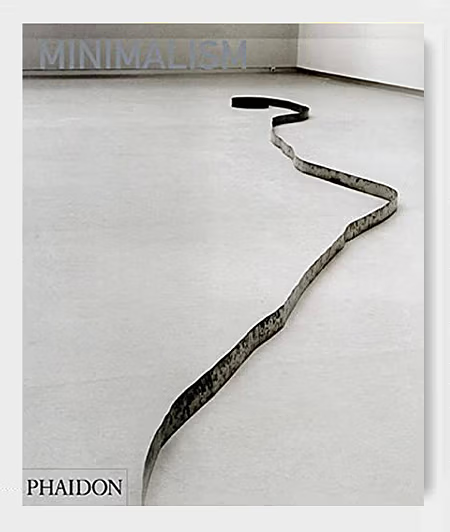
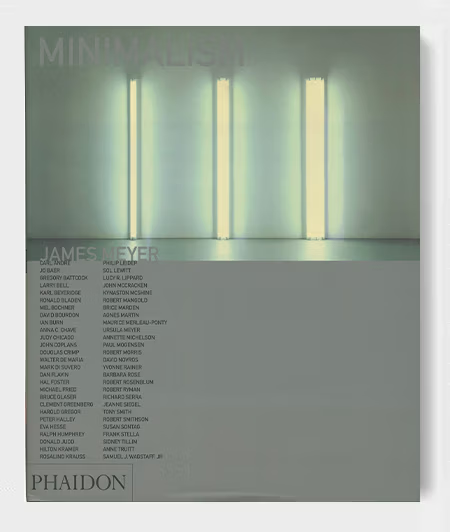
Minimalism, Edited by James Meyer, Phaidon Press, English, Soft Cover, 200 pages, June 2010.

Minimalizm 1 Book 9

Minimalism, Edited by James Meyer, Phaidon Press, English, Paperback, 304 pages, March 2005.

MİNİMALİZM / DAVID BATCHELOR

Minimalizm 1 Book DB

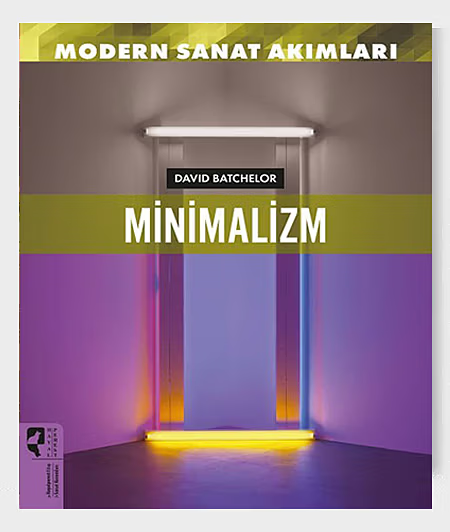
David Batchelor, Minimalizm (Modern Sanat Akımları), Translation: Tüles Üresin, Editor: Talha Lafçı, Powerback, 95 pages, Türkçe, Hayalperest Publishing, First Edition, March 2025, İstanbul.

First published by Tate Publishing in 1977, Minimalism was also published in Turkish by Hayalperest Publishing in 2025. (1) Written by the painter and author David Batchelor, this book is a highly compelling work that distinguishes itself from publications aimed at the general reader by examining the movement within the context of its overall development and its key figures. Minimalism, which has been examined in detail by art writers such as Hal Foster, Benjamin H.D. Buchloh, Rosalind Krauss and Michael Fried, proceeds through a two-part analytical framework in which David Batchelor adopts a distinct perspective, addressing contexts such as the establishment of visual quality and unity, and the representation and transformation of material or object. It evaluates the differences in approach among the five artists representing the movement -Carl Andre, Robert Morris, Donald Judd, Dan Flavin and Sol LeWitt- through a comparative analysis of the terms, concepts and principles of practice they established. Without shying away from tackling problematic areas such as meaning, emotion and psychological impact -which are particularly evident in definitions of minimalist art- it seeks to explain the images of identity and difference experienced during a brief yet enduring process through a discussion of causality. In the final chapter, titled ‘On Texts and Contexts’, the author examines the current state of the post-minimalist era, as exemplified by artists such as Richard Serra and Eva Hesse, and focuses on radical critiques of minimalist art, placing particular emphasis on the critical perspective offered by Anna Chave. (2) This study, which is supplemented by a bibliography surveying key publications on minimalism in art literature as of 1997, stands before us as a fundamental reference work thanks to its comprehensive content, fluid language, insightful observations and numerous high-quality visual aids.

1  David Batchelor, Minimalism (Movements in Modern Art), Powerback, 96 pages, English, Tate Publishing, First Edition, 1997, London.

2  See. Ann C. Chave, “Minimalism and the Rhetoric of Power”, Arts Magazine, Issue: 64, September 1990, pg. 44-63.

MINIMALISM / MINIMALIST SCULPTURE 

İZMİR - LONDON

saglamart; dinamik bir anlayış ile hareket eden, kültür-sanat ortamındaki olay ve olgulara, sanatçı tavırlarına, yapıtlara ve yayınlara odaklanan bağımsız bir yayın etkinliğidir. Tüm hakları saklıdır. Görüntü ve yazılar izinsiz kullanılamaz. / saglamart is an independent publishing initiative driven by a dynamic vision, focusing on events and developments in the cultural-artistic landscape, artist perspectives, works, and publications. All rights reserved. Images and texts cannot be used without permission.

Copyright ©
Can Sağlam - Gülay Yaşayanlar Mümtaz Sağlam, 2025.