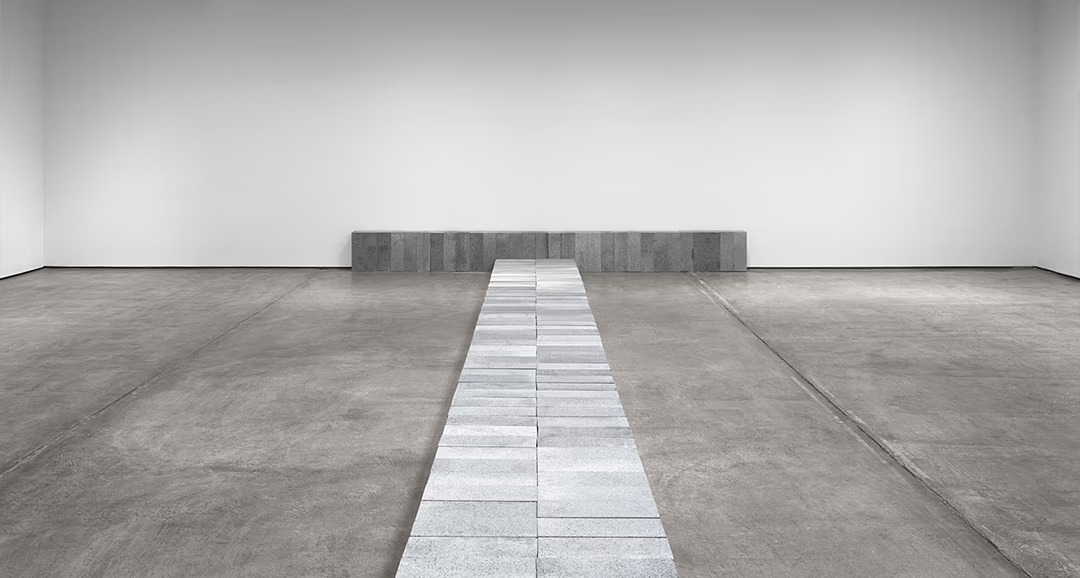
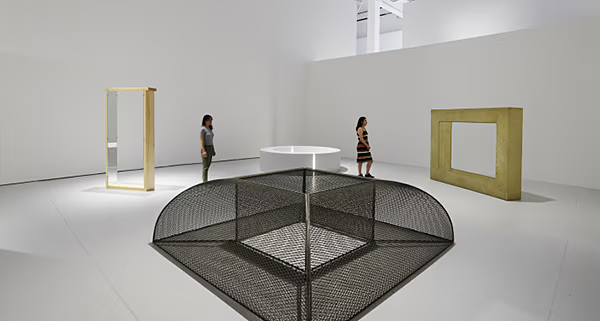
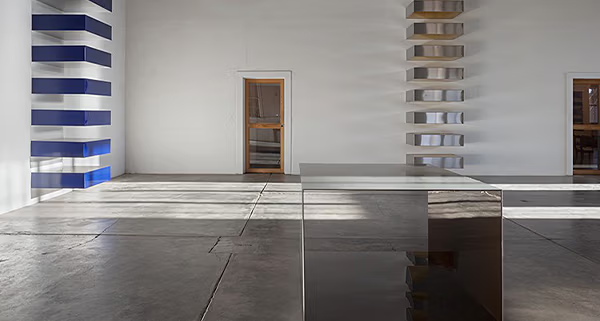
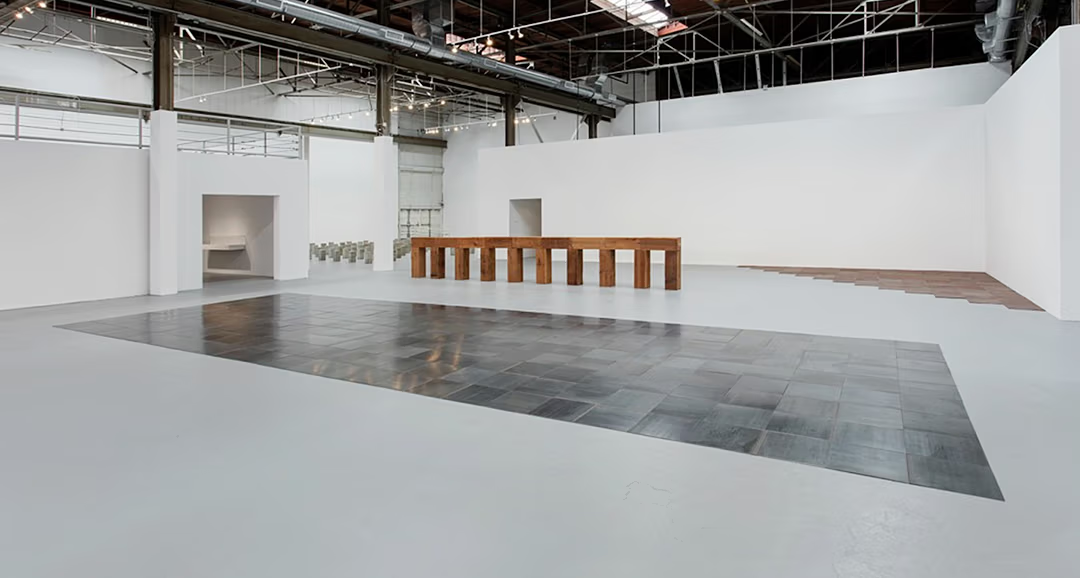
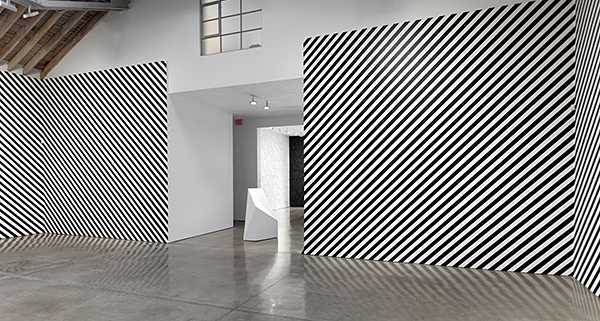
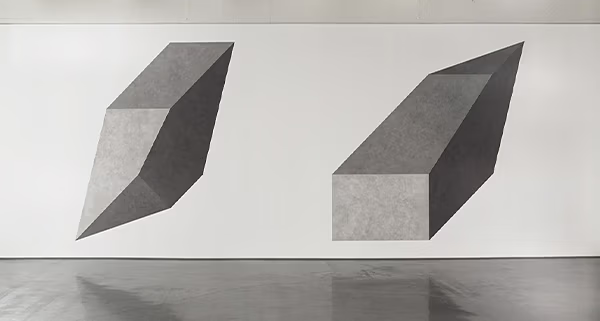
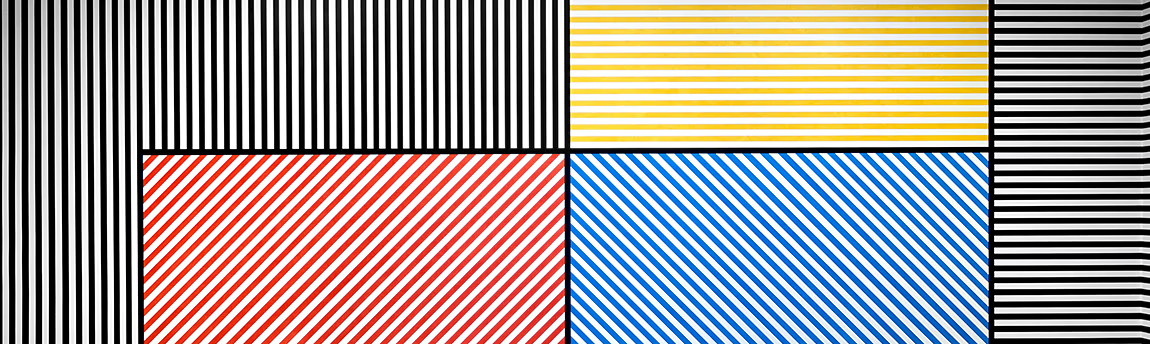
THE TRANSFORMATIVE EXPERIENCES OF SPACE AND VOID -CREATED BY THE METAMORPHOSIS OF GEOMETRIC FORMAL STRUCTURES ADDED TO AND IDENTIFIED WITH SOL LEWITT’S CONCEPTUAL FIELD-INVITE THE VIEWER INTO A PERFORMATIVE EXPERIENCE. AND THESE DISTINCTIVE PLANES OF REFLECTION, FORMED FROM THE IDEA OF A SIMPLE GEOMETRIC ORDER, TRANSFORM A CONCEPTUAL POWER INTO A MINIMAL LITERARY DISCOURSE THROUGH SUCCESSIVE FORMS. SOL LEWITT’S APPROACH, MOREOVER, IS BY NO MEANS PURELY FORMAL. THIS CONCEPT OF ARRANGEMENT, WHICH METICULOUSLY ESTABLISHES THE IMAGINATIVE CONNECTIONS BETWEEN THINGS, IS SIMULTANEOUSLY A REDUCTIVE REINTERPRETATION OF EXISTING KNOWLEDGE REGARDING THE ARTWORK.
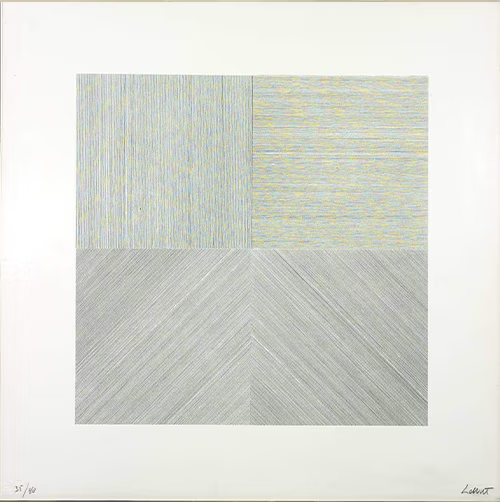
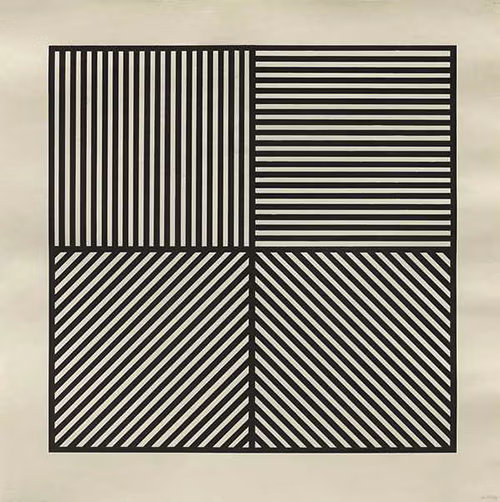
One of the pioneers of minimal and conceptual art, Sol LeWitt virtually redefines art itself, producing diverse works across a radical range of forms and concepts, among them geometric structures such as the square and the cube. Through his two-dimensional works, characterized by continuous repetition and modular multiplication, he examines various line and color systems charged with optical vibration and illusions of depth. Placing emphasis not on meaning but on the manner in which parts are joined together, he presents forms in a sequence of self-repeating arrangements on a surface devoid of depth.
Rosalind Krauss, who takes issue with the prevailing view of LeWitt as a rational and enlightenment-inflected apex of conceptual art, argues that the artist does not work with the disposition of a mathematician, as is commonly supposed. Contending that LeWitt operates within an excess, one that applies a rule visually until it collapses into chaos, she maintains that his works ought to be understood not as the point at which an existing order arrives, but as the implosion of a system upon itself. In other words, she insists that LeWitt’s art is not, in general, an expression of mental order, mathematical logic, or pure rationalism. What is decisive, in her view, is the peculiar state LeWitt inhabits in pursuing an idea to its very end, until it ceases to mean anything at all.
the uninterrupted rationality of geometric systems Indeed, Sol LeWitt brings together geometric structures and surfaces within a modernist context, side by side, on the basis of chance and yet with obsessive precision, in meticulous combinations, underscoring the divergences in the social and historical perception of painting. Yet it seems certain that this geometric and abstract, though equally fastidious, formal elaboration, which develops largely through the repetition of modular units, carries within itself an ongoing negotiation with order. The relational condition established between units, forms, and even surfaces, alongside a formalist will that governs freedom, is what determines this modernist interpretation and its experimental quality.
This visual form, situation, or act, which LeWitt rapidly transposed onto wall surfaces, is in essence synonymous with reproducing a pattern order grounded in unit and repetition. The grid-like discipline of arrangement that sometimes emerges likewise proves effective in conjunction with a nearly improvisational process, one embellished by chance. In sum, LeWitt, an artist who worked across different mediums and reduced art to its most elemental shapes and colors, constructing drawings and structures in the process, employed square and cubic forms in an effort to reinvent art. While many artists of his generation turned toward industrial building materials such as steel in the early 1960s, he concentrated on systems and concepts: sequential order variations capable of becoming actual sculpture, photography, or drawing; stasis; and irregularity. He produced his works with particular fidelity to the idea of transience, through patterns repeated along the uninterrupted rationality of geometric systems, and to a conceptual core rooted in chance.
The idea that crystallizes in Sol LeWitt’s approach is bound to a force of will that identifies the coordinates within space, disaggregating it into its constituent elements and reordering them in a more analytical manner. This geometric rigor is equally present in his wall drawings, where space is reshaped by a sparse network of perpendicular lines or deftly combined with the use of vivid color.
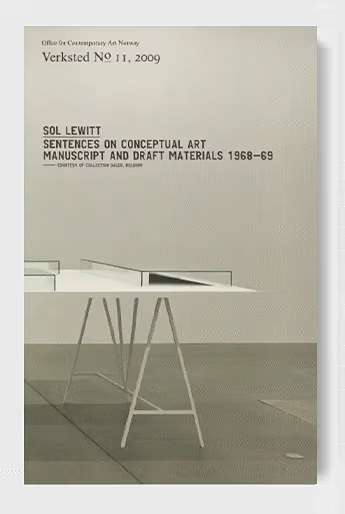
Sol LeWitt’s essay “Paragraphs on Conceptual Art”, published in the June 1967 issue of Artforum magazine, is one of the most important documents defining the fundamental principles of conceptual art and redefining art as an ‘idea’-centred process. LeWitt argues that the idea is the machine that makes art, proposing a mental process in which physical form becomes insignificant, and contends that the artist’s personal skill must be relegated to the background.
Sol LeWitt, “Paragraphs on Conceptual Art.” Artforum, vol. 5, no. 10, 1967.
♠♠
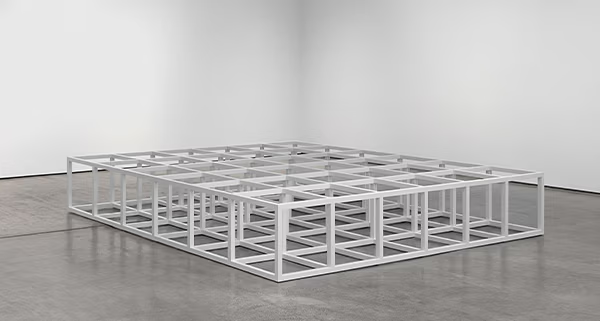
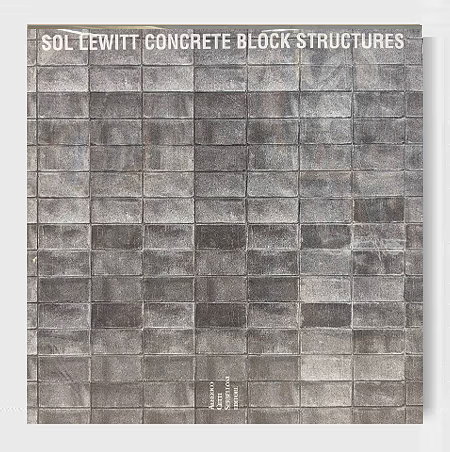
Sol LeWitt; after producing paintings in the Abstract Expressionist style for a brief period in the 1950s, he turned to a more minimalist artistic approach in the early 1960s, one that was less emotional yet still rich in complexity. He began working in series, focusing on sculptures composed of various grid-like arrangements of modular white aluminium, wooden or metal cubes.
WALL DRAWINGS
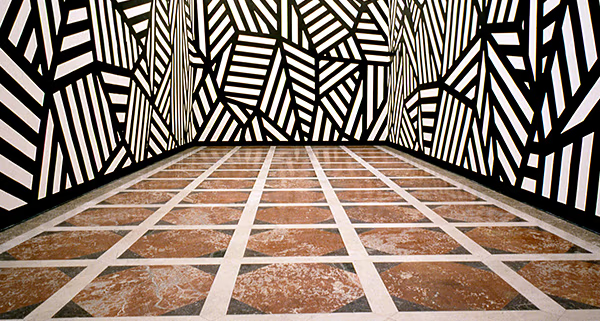
Sol LeWitt, Wall Drawing #565, Exhibition view, 1985 Salone dei Carmuccini, Museo di Capodimonte, Naples, Italy, Photo: Mimmo Jodice. https://www.lewittcollection.org/
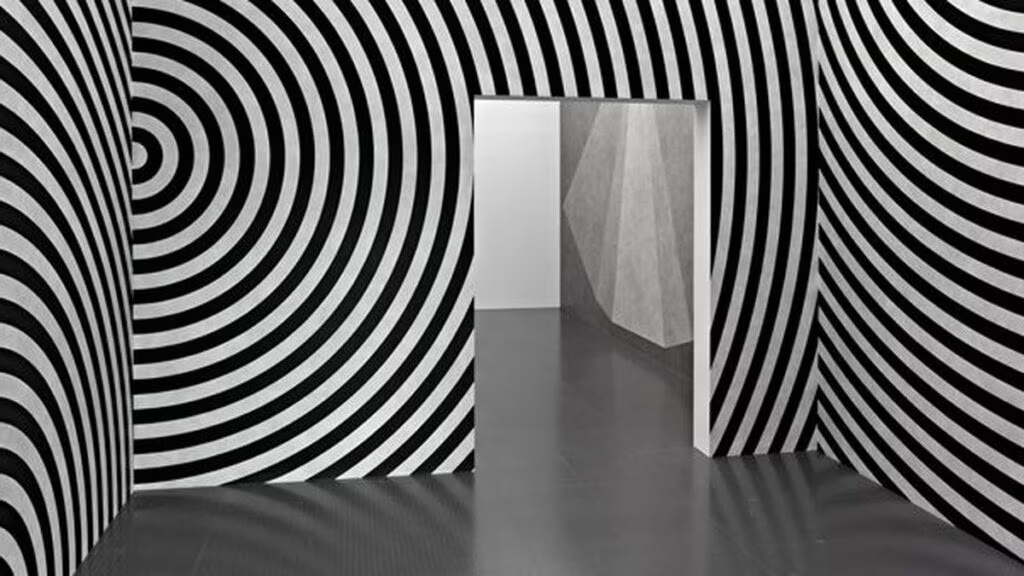
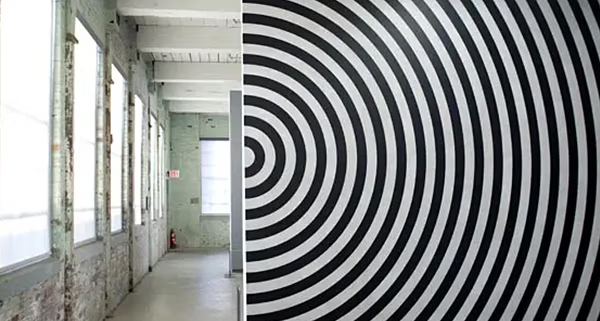
Sol LeWitt produced numerous works as part of his Wall Drawings series. Whilst some of these works may evoke wall paintings, over time he established his own distinctive tradition, based on simple, repetitive forms and defined rules. [...] Wall Drawings are, without a doubt, an effective means of subverting the concept of site-specific art by pushing boundaries and transforming the space into a dependent variable through the disruptive continuity of scribbles that etch and cover the walls. For here, it is evident that greater visual and spatial continuity is created through modular geometric drawings (structures) such as open cubes, pyramids or broken arches. The resulting optical illusion, however, is astonishingly surprising in its simplicity.
The grid is not merely a compositional tool in minimalist and conceptual art; it is also the formal expression of a worldview. The concept of the grid, which can theoretically expand infinitely, is the source of solutions that extend the traditional understanding of composition. Here, the artwork that breaks free from the frame transcends its boundaries, integrates with the architecture and becomes part of the space. Sol LeWitt also uses a grid system that is literally drawn as a support or framing device for his three-dimensional works. Consequently, his works appear to have risen from two dimensions to three due to their position within the grid. The density of horizontal and vertical lines produced by the grid plan appears strong and orderly, yet it also evokes a sense of chaos. The phenomenon of drawing-design, transferred to the wall and linked to a textual procedure (instructions), thus cannot escape oscillating between two- and three-dimensional effects. This is a fundamental characteristic of Sol LeWitt’s drawing practice, which reinforces effects of dimension and depth, and also enables the transition to the abstract and conceptual. (See David Batchelor, Modernism, Translated by Tüles Üresin, Hayalperest Publications, Istanbul, 2025, pp. 57–58)
The linear continuity that emerges here also results in LeWitt transferring the two-dimensional surface onto the wall. This drawing-based, intrinsic practice gradually evolves into a painting of a coloured, thickening field. In this way, it attempts to move beyond the physicality of a three-dimensional skeleton by reaching a transparent, purely abstract structure through drawing and number. This is a radical shift in understanding and an experience of distancing. Or, more clearly, it is an experience of developing a conceptual form that enables certain repeatable surface types. In this respect, LeWitt’s use of a grid to reveal a stripped-back structure in all its simplicity is, in fact, an avant-garde endeavour. LeWitt, who is concerned with the linear and circumferential state of modular quadrilateral forms in their grid-skeleton form, achieves an industrial and austere appearance through the application of paint. This three-dimensional construction-design phenomenon develops in an optical space of its own, with an abstract and geometric permeability devoid of interior space. Consequently, the three-dimensional structure is embedded within a dialectical discourse on space and depth that evolved in his early works. In the final phase, the elimination of the outer surface leads to a linear and continuous structure, resulting in formless, design-modular structural voids.
Two New exhIbItIons
Sol Lewitt: Open Structure, Exhibition Poster, Museum of Contemporary Art Tokyo, Operated by Tokyo Metropolitan Foundation for History and Culture With the Cooperation of the Estate of Sol LeWitt.
Sol Lewitt: Open Structure, Museum Exhibition, Curated by Ai Kusumoto, 25 December 2025 – 2 April 2026 Museum Of Contemporary Art Tokyo, Organized by Sol LeWitt: Open Structure, Museum of Contemporary Art Tokyo, Operated by Tokyo Metropolitan Foundation for History and Culture With the Cooperation of the Estate of Sol LeWitt.
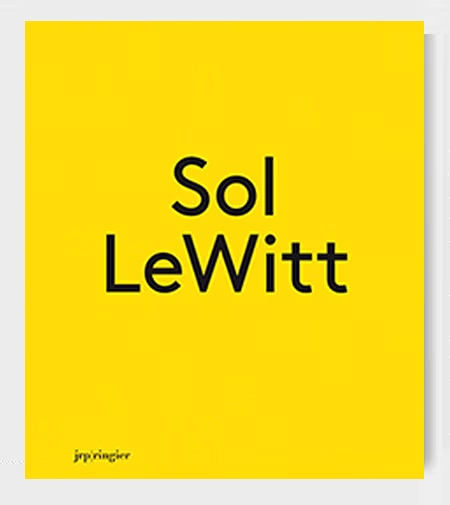
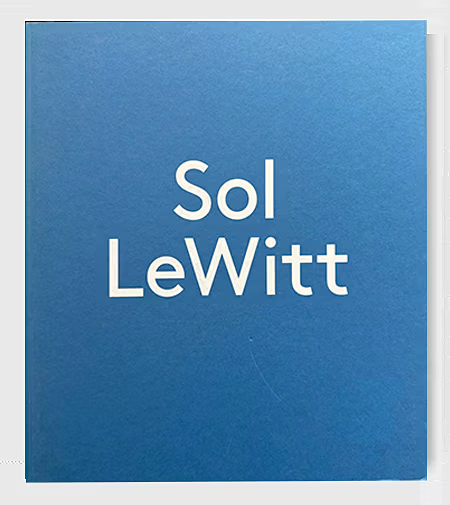
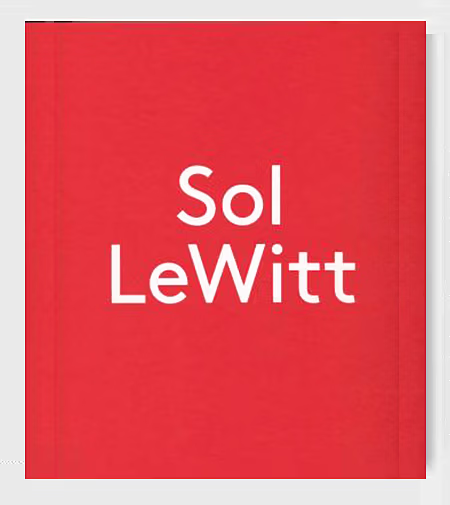
Sol LeWitt, (Monographs & Artist’s Books), 4 Books, Editor: Beatrice Gross, Contributors: Lucy Lippard, Rosalind Krauss, Mel Bochner, Dan Graham ve Robert Smithson, Publisher: Centre Pompidou-Metz, M-Museum de Louvain and JRP/ Ringier, 326 pages, English, Paperback, 2012-2013.
Produced to accompany the two exhibitions Sol LeWitt: 1968–2007 Wall Drawings at the Centre Pompidou-Metz and Sol LeWitt: Colours at the M-Museum in Leuven, this publication documents the most significant collection of LeWitt’s works ever exhibited in Europe. A seminal work in terms of its scope, design and scholarly depth, this book is also the first comprehensive monograph on LeWitt published posthumously. It brings together interview transcripts and numerous significant essays by artists and writers such as Lucy Lippard, Rosalind Krauss, Mel Bochner, Dan Graham and Robert Smithson.
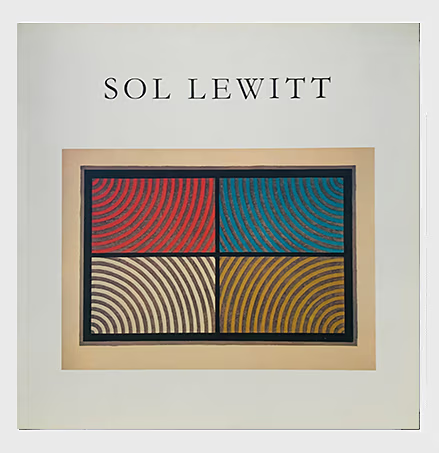
Sol LeWitt: Forms Derived from a Cube (Color), Catalogue for a suite of 12 silkscreen prints by Sol LeWitt, 20 pages, English, Softcover, Published by Edition Achenbach, 1991.
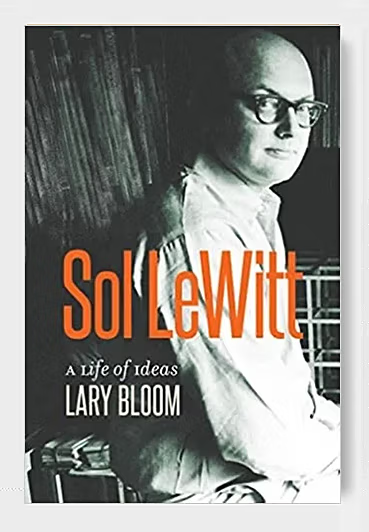
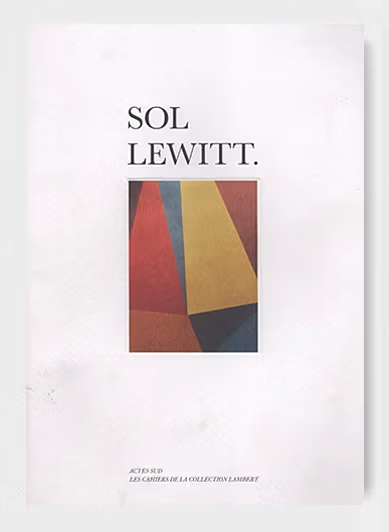
David S. Areford, Strict Beauty: Sol LeWitt Prints, Hardcover, English, 288 pages, Publishers: New Britain Museum of American Art; Williams College Museum of Art; and Yale University Press, 2020.
Sol LeWitt: Not to Be Sold For More Than $100, by Jason Rulnick (Introduction), Sol Lewitt (Artist), Veronica Roberts (Contributor), 240 pages, English, Radius Books, Hardcover – June, 2020.
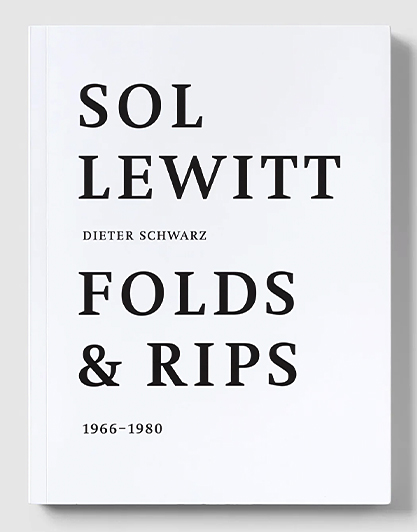
Dieter Schwarz, Sol LeWitt: Fold & Ribs 1966-1980, English, Softcover, 160 pages, Publisher: Walter König, 2020.
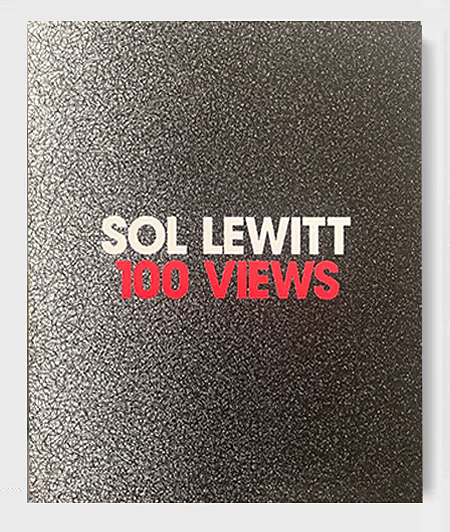
Sol Lewitt: 100 Views, Text by Susan M Cross, by Sol LeWitt (Author), Paperback, English, Yale University Press, Jun 2009.
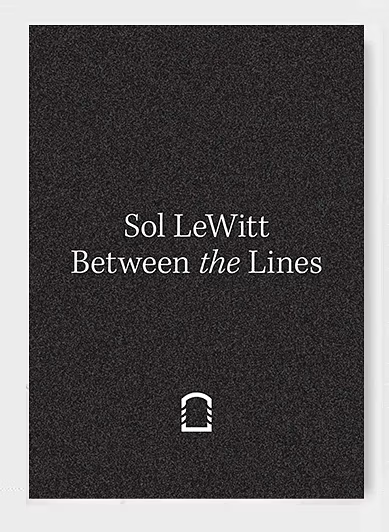
Sol LeWitt: Between the Lines, by Francesco Stocchi (Editor, Contributor), Sol Lewitt (Artist), Rem Koolhaas (Contributor), Adachiara Zevi (Contributor)320 pages, English, Publisher: Koenig Books, Paperback, June 26, 2018.
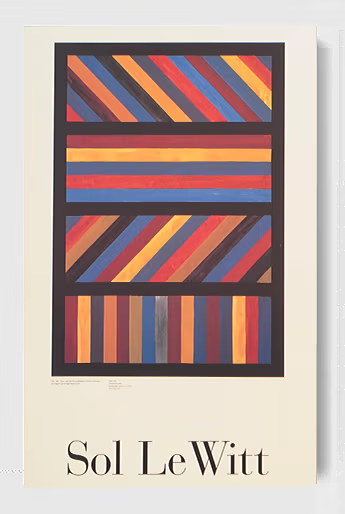
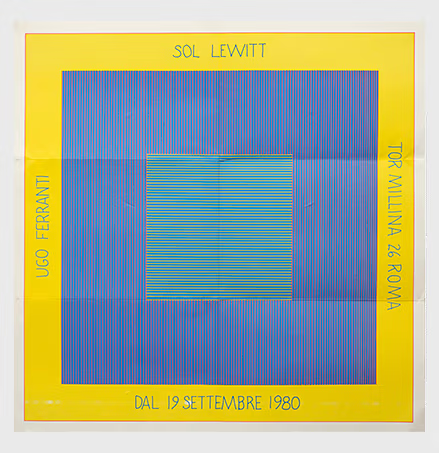
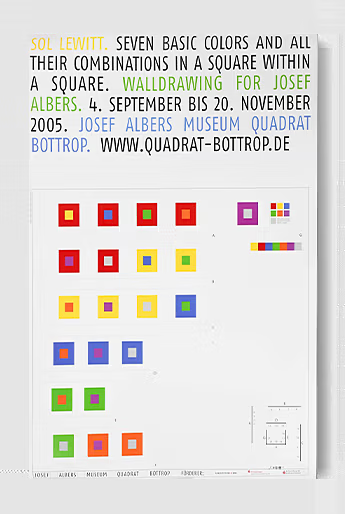
Sol LeWitt / Selected Prints 1970-1986, Original exhibition poster, Tate Gallery, Designer: Anon, Printer: Hillingdon Press, Publisher: Tate Gallery, Size: Double Crown (760 x 510 mm), 1986.
Sol LeWitt: Artist’s Books, Authors: Didi Bozzini, Cecilia Metelli, Marilena Bonomo, Editors: Giorgio Maffei, Emanuele De Donno, Sol Lewitt (Artist), 144 pages, English, Publisher: Edizioni Corraini, Paperback, February 28, 2010
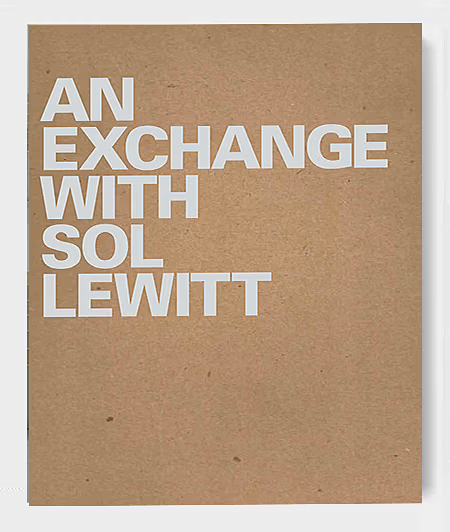
An Exchange with Sol LeWitt, Introduction by Regine Basha, Softcover, English, 192 pages, Cabinet Books, 2011.
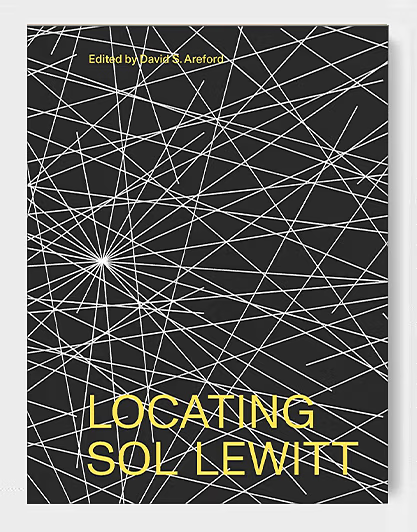
Locating Sol LeWitt, Edited by David S. Areford, Contributors: Lindsay Aveilhe, Erica DiBenedetto, Anna Lovatt, James H. Miller, Veronica Roberts, Kirsten Swenson, John A. Tyson, Hardcover, 288 pages, English, Yale University Press, March 2021.
SELECTED DOCUMENTS
BIOGRAPHY
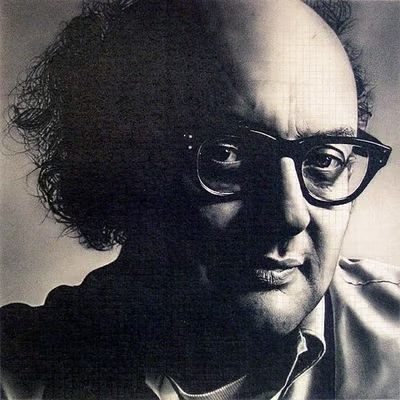
Sol LeWitt (1928–2007), one of the leading figures of Conceptual art and Minimalism, is renowned for his works that demonstrate that art can exist not only through the resulting object but also through the idea itself. Centring his works on the concepts of system, repetition, geometry and mathematical order, the artist invites the viewer to reflect on the production process and intellectual underpinnings of art. LeWitt positions the artist’s role not merely as an executor, but as the designer of an idea. Through his works exhibited in international museums and public spaces, Sol LeWitt has demonstrated that art can exist not merely as a physical object, but also as a system of thought. With his approach to democratising the creative process, the artist has played a significant role in the development of contemporary art by emphasising that art is both an intellectual and an experiential field.
saglamart; dinamik bir anlayış ile hareket eden, kültür-sanat ortamındaki olay ve olgulara, sanatçı tavırlarına, yapıtlara ve yayınlara odaklanan bağımsız bir yayın etkinliğidir. Tüm hakları saklıdır. Görüntü ve yazılar izinsiz kullanılamaz. / saglamart is an independent publishing initiative driven by a dynamic vision, focusing on events and developments in the cultural-artistic landscape, artist perspectives, works, and publications. All rights reserved. Images and texts cannot be used without permission.