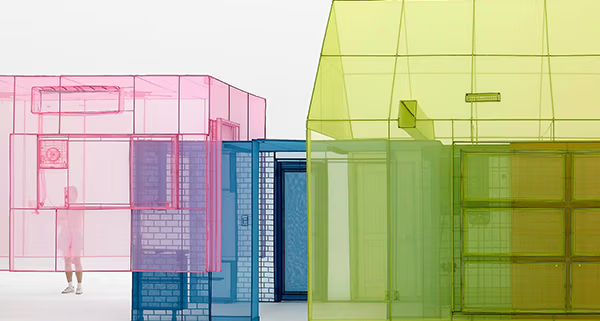
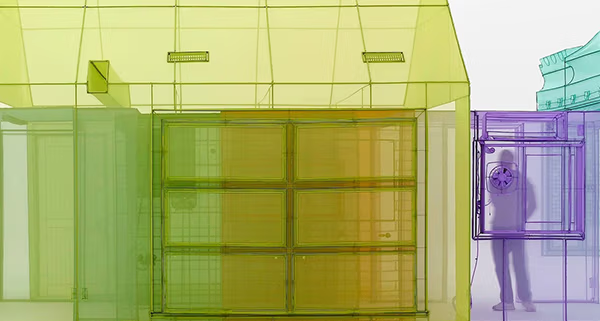
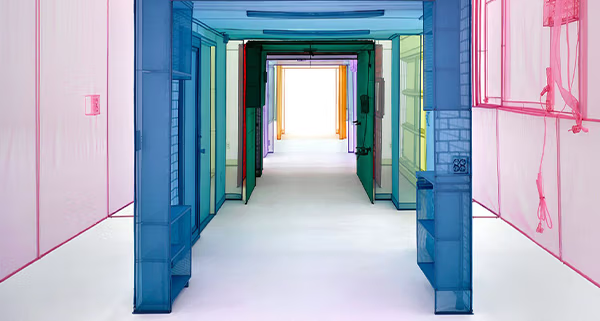
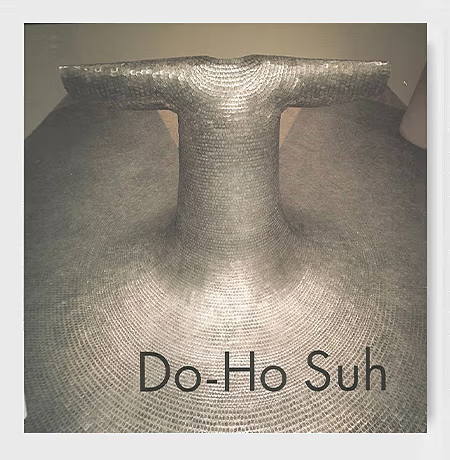
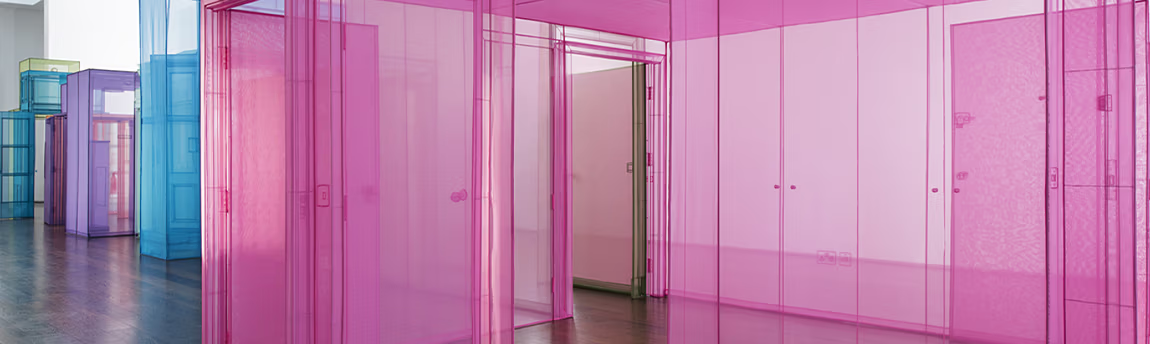
Do Ho Suh, Nest/s, (Detail) 2024, Polyester, stainless steel, 410.1 x 375.4 x 2148.7 cm. Courtesy the Artist, Lehmann Maupin New York, Seoul and London and Victoria Miro. Photography by Jeon Taeg Su, © Do Ho Suh

do ho suh

walk the house - 2025

"

It Is evIdent that Walk the House has brought new Intellectual meanIngs to Suh's ongoIng effort to capture and preserve hIs personal hIstory through the lens of domestIc experIence, evaluatIng It In the company of psychogeographIc dIscourse and narratIves of mIgratIon.

Do Ho Suh continues his large-scale installations constructed from semi-transparent colored fabrics that center on the idea of the home. His 2025 London exhibition, Walk the House, operates within this same framework, tracing the contours of a personal history and culture derived, once again, from the relationships between space, identity, and the body. In this way, Suh, who examines private living spaces on an intellectual plane, uses this exhibition to attempt to bring a new dimension to his architectural installations through multimedia works. (1)

The concept of home, which has long defined Do Ho Suh’s broader artistic approach, consists of works shaped by the intellectual and ironic weight of three-dimensionalized transparent space alongside the depth of memory and recollection. It is apparent, therefore, that Walk the House similarly turns toward new narratives that prioritize intimacy and moral complexity by directing attention to the contradictory conditions arising from the differences and relationships between cultures and geographies, through spatial arrangements in which personal stories become anonymized.

notlar

1    The Genesis Exhibition: Do Ho Suh: Walk the House, 1 May – 26 October 2025, Bankside, Tate Modern, London. / Walk the House can be described as a holistic structure comprising a life-size reproduction of a traditional Korean house featuring transparent spatial designs, documentation from a new project titled Bridge Project, and the arrangement of hundreds of transparent tulle objects – which might be described as images of memory.

a multidimensional site of reckoning: the home

Placed at the center of the exhibition, Nest’s (2024) creates a transparent passageway through a series of interlocking domestic rooms. (2In precisely this context, the work has been rendered into a multidimensional site of reckoning for the sense of privacy shaped by the paradox of interior and exterior. Here, it is as if the viewer is invited to reflect on this social and cultural phenomenon or problem in a way that develops a perceptual choice or proposition alongside our experiences and ideas about home. Thus, while the permeable and uncanny nature of the home’s traditional and fixed boundaries is underscored on the one hand, three houses are once again presented to us on the other, through a depiction of the home as an intimate and enigmatic civic space.

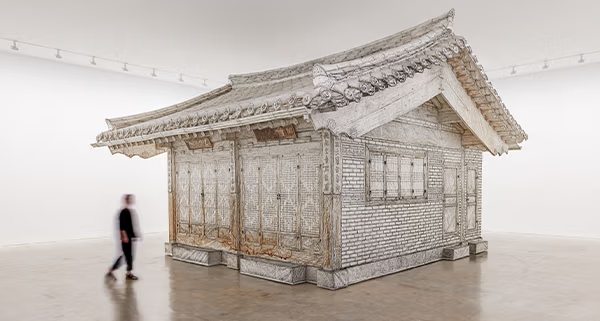
Spaces reconstructed at true scale contribute to debates around place, migration, and identity, mediated at times by an ostentatious engagement with history and culture, loss and memory, as testimonies to the haunting power of recollection. In this context, the Hanok house presented in the exhibition under the title Rubbing/Loving: Seoul Home is a replica reflecting traditional Korean architecture. (3Composed of carefully abraded and partially mold-stained papers, this house possesses a structure that can be disassembled, transported, and reassembled elsewhere. It is an emblematic structure concerned with the relationships between body, identity, and history; a metaphorical and psychological civic space.

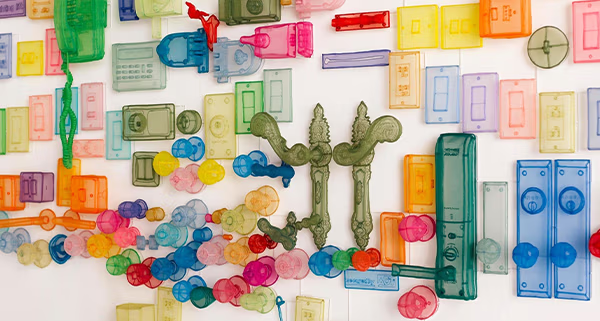
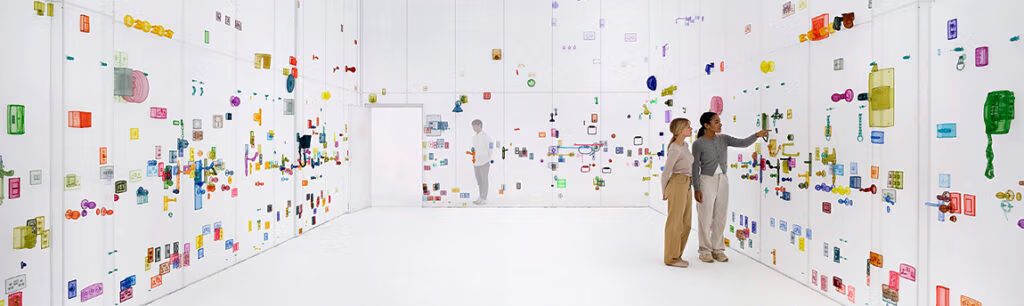
Within the visual whole of Walk the House, another large transparent field containing an array of mundane objects and furnishings that inhabit the home allows for an encounter with yet another dimension of this pursuit of innovation. Through the compelling installation titled Perfect Home: London, Horsham, New York, Berlin, Providence, Seoul, Suh transforms hundreds of semi-transparent fabric specters of meticulously rendered domestic interior elements into what are, effectively, striking works of art in their own right. (4)

Do Ho Suh Walk the House 2

beyond prevailing nostalgia

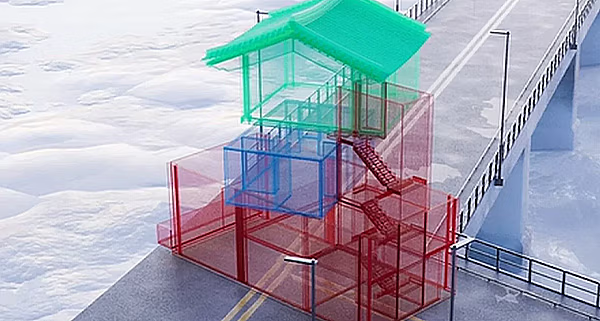
Walk the House is also a substantial production, completed by two of Suh’s video works and a documentary presentation of his ongoing latest project. Through dramatically flowing footage that gives concrete form to the transformations and weathered architectural remains of London’s residential architecture, Suh works to forge a new aesthetic relationship with the existing visual field through two large-screen videos, Robin Hood Gardens (2018) and Dong-in Apartments (2022), supported by cinematographic techniques. (5) These films, composed of imagery depicting derelict and demolished apartment buildings, carry an unsettling effect. At the same time, they occupy a position at some remove from Suh’s other works. The same can be said of The Bridge Project, which is developing through digital techniques and presents connections between a home and other homes as a fantastical or futuristic feat of engineering. Since The Bridge Project remains unfinished, it naturally figures in Suh’s inventory as a distinctive outlier, clearly far removed from the emotional register created by the compelling visuality of his fabric and plastic works. (6)

It is evident that Walk the House has brought new intellectual meanings to Suh’s ongoing effort to capture and preserve his personal history through the lens of domestic experience, evaluating it in the company of psychogeographic discourse and narratives of migration.

Prof. Mümtaz Sağlam  Copyright © April 2026, All rights reserved.

2  Do Ho Suh, Nest’s 2024, polyester and stainless steel, 410.1 × 374 375.4 × 2148.7 cm. Nest/s is a series comprising the transitional spaces of the four different homes in which Suh lived. Arranged perpendicular to one another as a single long corridor, the vast and striking transparent fabric architecture appears to have been conceived as an event of nothingness, situating the viewer within a sense of transitional and continuous space.

3  Do Ho Suh, Rubbing/Loving Project: Seoul Home (2013-2022), Installation view of ‘The Genesis Exhibition: Do Ho Suh: Walk the House, All images © Do Ho Suh, courtesy of the artist, Lehmann Maupin New York, Seoul, and London, and Victoria Miro. Photo by Jai Monaghan/Tate.

Do Ho Suh, Perfect Home: London, Horsham, New York, Berlin, Providence, Seoul, Installation view The Genesis Exhibition: Do Ho Suh: Walk the House, 2024, Polyester, stainless steel, 455 x 575 x 1237 cm, © Do Ho Suh

Do Ho Suh, Robin Hood Gardens, 2018, Video, colour and sound (stereo), 28 min, 33 sec. ve Do Ho suh, Dong In Apartments, 2022, Video, colour, no sound, 21 min. The photogrammetry technique used in both works is a detailed process that combines images to create a digital model of the physical world. Through this process, Suh aims to explore the built environment as a living organism -a place that bears witness to the traces left by its former inhabitants. In this attempt to recreate and recall elements of past and present homes, it demonstrates the impossibility of fully preserving a place or a memory. See https://www.meer.com/en/87286-the-genesis-exhibition-do-ho-suh-walk-the-house

Bridge Project: This conceptual project, on which Do Ho Suh has collaborated with architects and designers, comprises four proposals and designs for fantastical bridges linking Seoul, South Korea, with New York. It has evolved into a comprehensive project that brings the two cities together, aiming to bridge the spatial, temporal, psychological and cultural distances between them. See. https://www.lehmannmaupin.com/museums-and-global-exhibitions/do-ho-suh-a-perfect-home-the-bridge-project/press-release

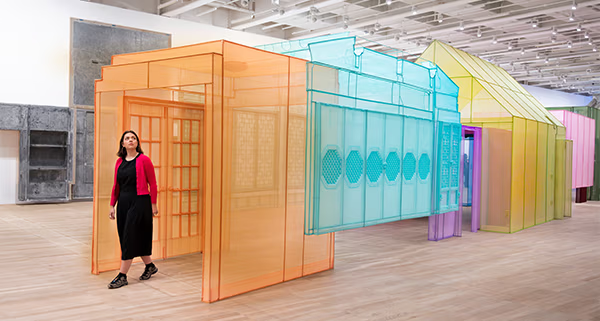
The GenesIs ExhIbItIon: Do Ho Suh: Walk the House / 2025

Do Ho Suh: WALK THE HOUSE at Saglamart.COM 

EXHIBITION CATALOGUE

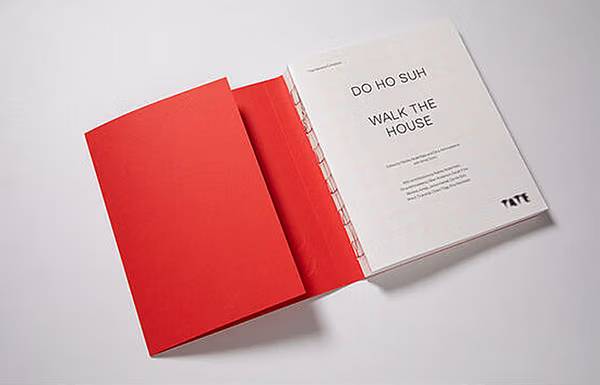
The Genesis Exhibition: Do Ho Suh: Walk the House, Edited by Nabila Abdel Nabi, Dina Akhmadeeva and Amie Corry, With contributors by Sean Anderson, Sarah Fine, Monica Junea, janice Kerbel, Do Ho Suh, Rirkrit Tiravanija, Dylan Tirgg, Kira Wainstein, Designed by Marwan Kaabour, Producted by Juliette Dupire, Tate Publishing, 192 pages, English, Softcover, May 2025, London.

NEW PROJECTS & NEW WORKS

Perfect Home: London, Horsham, New York, BerlIn, ProvIdence, Seoul

Do Ho Suh, Perfect Home: London, Horsham, New York, Berlin, Providence, Seoul, Installation view of The Genesis Exhibition: Do Ho Suh: Walk the House, 2024, Polyester, stainless steel, 455 x 575 x 1237 cm, © Do Ho Suh

Suh's most recent fabric architecture work. Its translucent outline takes the form of his present home in London, following his migration to the city in 2016. Inside, the structure is empty of the details of that space, filled instead with the architectural details, fixtures and appliances from past and present spaces Suh and his family have inhabited throughout their lives, folding multiple spaces, times and geographies into one. The walls are filled with objects such as light switches, doorknobs, telephones and plug sockets - seemingly negligible elements of our dwelling spaces which, over time, almost subconsciously, come to furnish our understanding of home. Suh refers to these wall-based objects as 'specimens', and colours them based on their location of origin, creating a cacophony of hues against the ghostly outline of his current home.

See. Kira Wainstein, "Perfect Home: London, Horsham, New York, Berlin, Providence, Seoul, 2024", The Genesis Exhibition: Do Ho Suh: Walk the House, Tate Publishing, May 2025, London, pg. 156.

RUBBING / LOVING PROJECT: SEOUL HOME, 2013-2022

Do Ho Suh

Do Ho Suh, Rubbing/Loving Project: Seoul Home, 2013-2022. Installation view at Museum of Contemporary Art Australia, Sydney, Australia.
Photography by Sebastian Mrugalski, Courtesy of the artist, Lehmann Maupin, New York, Seoul and London and Victoria Miro.
© Do Ho Suh.

Rubbing/Loving: Seoul Home 2013-22, which emerged decades after Suh’s move to the United States, is a 1:1 scale materialisation of the artist’s childhood home in Seoul; in the artist’s own words, a home that ‘has always followed her’. Suh covered the entire building in mulberry paper and rubbed graphite over it to reveal the surface beneath. This laborious process created a portable trace of the artist’s home; thus, he could pack it up, take it with him, and ‘erect’ it elsewhere on an aluminium frame. Suh’s childhood home is based on a nineteenth-century house. These traditional Korean houses, known as hanok, suffered widespread destruction in the twentieth century as a result of occupation, war and development. When Suh’s parents built their home in the 1970s, hanok were continuing to disappear to make way for apartment blocks. The title of the series in which this work is featured, Rubbing/Loving, refers to the intimacy of the rubbing process, which Suh describes as “a gentle gesture filled with love, compassion and care”.

See. Kira Wainstein, "Rubing/Loving: Seoul Home, 2013-2022", The Genesis Exhibition: Do Ho Suh: Walk the House, Tate Publishing, May 2025, London, pg. 46.

NEST’S 2024

Do Ho Suh Walk the House 2

Do Ho Suh, Nest/s, 2024, Polyester, stainless steel, 410.1 x 375.4 x 2148.7 cm, Courtesy the Artist, Lehmann Maupin New York, Seoul and London and Victoria Miro. Photography by Jeon Taeg Su © Do Ho Suh

Nests is based on an ongoing series of fabric architecture by Do Ho Suh, which he has titled “Hubs”. This series constitutes a form of impossible architecture, comprising a series of “nests” designed to draw inspiration from the various spaces Suh has inhabited throughout his life in Seoul, New York, London and Berlin. These structures are based on thresholds such as corridors or entrances; that is, they are transitional spaces that one passes through rather than remains within. Nests are designed as a passageway enabling visitors to move from one transitional area to another. (…) The use of fabric also highlights the relationship between clothing and architecture, which lies at the heart of Suh’s practice. (…) By using a readily available, semi-transparent polyester fabric -commonly employed in the production of traditional Korean summer garments today- he creates breathable, porous spaces that bring the surrounding architecture into the museum.

See. Kira Wainstein, "Nest's" 2024", The Genesis Exhibition: Do Ho Suh: Walk the House, Tate Publishing, May 2025, London, pg. 124.

BrIdge Project (Köprü Projesi)

Do Ho Suh. Untitled (Bridge Project), 2003-ongoing. Concept rendering. © Do Ho Suh. Courtesy of the artist; Lehmann Maupin, New York and Seoul; Victoria Miro, London/Venice.

The Bridge Project is a research initiative developed by Suh as he imagined his ‘perfect home’ at the central point of a bridge connecting London, Seoul and New York, exploring how this vision intersects with the social, political and ecological issues of the real world. The project dates back to 1999 and began with a work titled A Perfect Home, an ink and watercolour drawing depicting a house on the bridge. Since then, Suh has expanded the project’s interdisciplinary boundaries; she has collaborated with experts from various fields -including architecture, engineering, industrial design, philosophy, anthropology and biology- to reflect her own experience of migration. [...] Suh’s project, in which he imagines living alone in a location exposed to extreme weather conditions and almost inaccessible, reveals through its absurd tone the impossibility of a perfect home.

See. Kira Wainstein, "Bridge Project / 1999 - Ongoing", The Genesis Exhibition: Do Ho Suh: Walk the House, Tate Publishing, May 2025, London, pg. 164.

Do Ho Suh at Saglamart.COM (TURKISH-ENGLISH) 

do ho suh: yapıboumcu bir kışkırtma alanı olarak ev
do ho suh: itiraf odalarından oluşan düşsel bir yapı
rubbing/loving project-2016: anılara ve saklı zamana dokunmak
do ho suh: diyasporik deneyimin simgesel mekânı olarak ev
do ho suh’ta ev: kimlik ve farklılık bildiriminin bir gösterim alanı
rubbing/loving project-2016: geçen zamana ve hatıralara dokunmak
do ho suh: the house as an area of deconstructive provocation
do ho suh: home/an imaginary structure of confession chambers
rubbing/loving project-2016: touching memories and hidden time
do ho suh: the home as a symbolic locale of the diasporic experience
do ho suh: home / an area for declarations of identity and difference
touching bygone times and memories: rubbing/loving project-2016

Apartment A, UnIt 2, CorrIdor, and StaIrcase 

Apartment A, Unit 2, Corridor, and Staircase, 348 West 22nd Street, New York, NY 10011, USA. 2011 - 2014, Polyester fabric and stainless steel tubes, Apartment A: 245 x 430 x 690 cm., Unit 2: 244 x 580 x 1073 cm., Corridor and Staircase: 245 x 168 x 1240 cm. © Do Ho Suh, Installation view at the Museum of Contemporary Art San Diego, 2016. Photo by Pablo Mason.

place and objects

Do Ho Suh, Radiator, 2013, polyester fabric, 93.5 x 74.7 x 18.3 cm. from Specimen Series: 348 west 22nd street, New York, NY

Do Ho Suh’s poetic design narrative also joins itself to everyday objects present in the locations it depicts. It reflects the links and conflicts of everyday objects such as radiators, bathtubs, toilet seats, wash basins, showers and cabinets; with everyday life. By removing them from their everyday locations and contexts; Suh’s deconstructive approach further forces these objects into physically-perceivable, tangible, yet fetishized collaborations with the viewer. For example, the humble radiator becomes an attractive locus thanks to its engagement with colorful nylon strings. Secluded behind a virgin, translucent veil, the pink radiator becomes an ingrained, romantic object thanks to Suh’s play of distances – a solitary life-form fetishized and emotionally-charged in its graceful translucence. In this manner, the artist metaphorically filters narrative from his delicate sieve of veils, and constructs his own layered stories of compacted memories and layered time. The contribution provided by these sculptural, deconstructed appendant objects to a memory of repressed time, and a symbolism of locational belonging, is difficult to overlook. GY

selected exhIbItIons

Moody Center for the Arts, Houston

in process

Do Ho Suh: In Process, Moody Center for the Arts, Houston, Texas. September 6 - December 21, 2024

In Process creates a studio-like space that is structured beyond traditional gallery exhibitions and emphasises the artist's projects. And invites viewers to experience and question these complex themes through the principles or methods of visibility of his artistic practice.

DO HO SUH

rubbing/loving project: unit 2

Rubbing/Loving Project: Unit 2, 348 West 22nd Street, Apartment A, New York, NY 10011, USA, 2014.

Rubbing/Loving Project is a holistic work that transforms the difference of thought and lifestyle shaped in a single space into an installation practice. By covering an emotionally connected building, in which she has lived for a long time, with paper, Suh pursues a new psychic context through the contrast between decorative care and existing space.

Art Sonje Center

Speculations

Art Sonje Center, Seoul. August 17 - November 3, 2024. Curator by Sunjung Kim (Artistic Director, Art Sonje Center), Heehyun Cho (Head of Exhibitions, Art Sonje Center)

Do Ho Suh presents themes such as time, personal space, memory and movement, which he has continuously explored over the last 20 years, organised around the overarching concept of "speculation".

DO HO SUH / 4 BOOKS – 1 POSTER

Do Ho Suh

Do Ho Suh, Authors: Miwon Kwon and Lisa G. Corrin, English, Paperback, 48 pages, Publisher: Serpentine Gallery, April 2002.

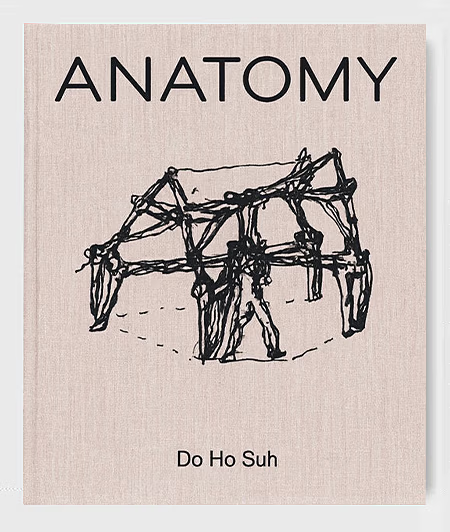
Do Ho Suh: Anatomy, Essays by R. Armstrong, D. Fogle, L. Tillman, R. Gladman, H. Brody, P. Haralambidou, A. Corry, and J. Woo, Conversation by T. Strachan, Hardcover, Publisher: Mackbooks, English, 504 pages, April 2025.

Do Ho Suh

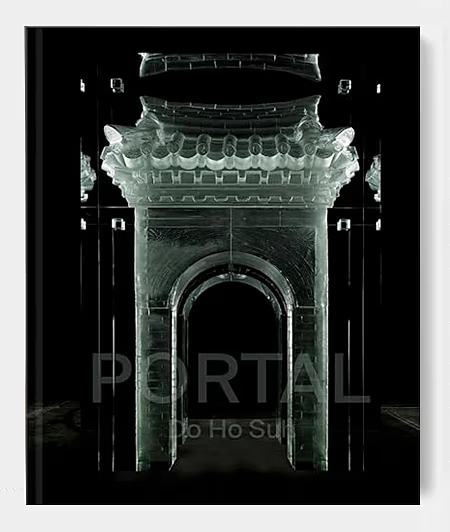
Do Ho Suh: Portal, by Amie Corry (Editor), Do Ho Suh (Artist), Contributors: Martin Coomer, Christine Starkman, Ron Elad and Jon Lash, English, Publisher: DelMonico Books, Hardcover, 104 pages, October 2022.

The Genesis Exhibition: Do Ho Suh: Walk the House, Edited by Nabila Abdel Nabi, Dina Akhmadeeva and Amie Corry, Tate Publishing, 192 pages, English, Softcover, May 2025, London.

Do Ho Suh

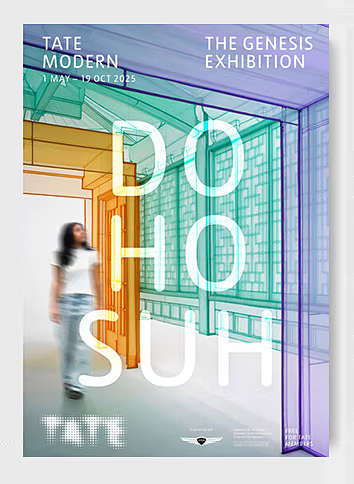
The Genesis Exhibition: Do Ho Suh, Exhibition poster, Tate Publishing, May 2025, London.

TATE MODERN / LONDON

bıography

Do Ho Suh was born in Seoul, South Korea in 1962. At the age of 29, he moved to the USA, where he studied painting at the Rhode Island School of Design. He later studied sculpture at Yale University. As a permanent migrant, she creates work that obsessively questions the meaning of home in relation to concepts such as borders, identity, belonging and personal space. Currently living and working in London, she is represented by Lehmann Maupin Gallery (New York, Hong Kong, Seoul) and Victoria Miro Gallery (London / Venice).

İZMİR - LONDON

saglamart; dinamik bir anlayış ile hareket eden, kültür-sanat ortamındaki olay ve olgulara, sanatçı tavırlarına, yapıtlara ve yayınlara odaklanan bağımsız bir yayın etkinliğidir. Tüm hakları saklıdır. Görüntü ve yazılar izinsiz kullanılamaz. / saglamart is an independent publishing initiative driven by a dynamic vision, focusing on events and developments in the cultural-artistic landscape, artist perspectives, works, and publications. All rights reserved. Images and texts cannot be used without permission.

Copyright ©
Can Sağlam - Gülay Yaşayanlar Mümtaz Sağlam, 2026.