IN ANDRE'S ARRANGEMENTS, WHICH CARRY A DISTINCTLY ANTI-EXPRESSIVE CHARACTER, THE POSITIONAL EXPERIENCES OF PERCEPTION THAT DEVELOP THROUGH THE FUNCTION OF MATERIAL, THE MODEL OF STACKING, AND ENVIRONMENTAL COLLABORATION ARE EQUALLY SIGNIFICANT. IT CAN THEREFORE BE ARGUED THAT THE WORK OF ART, AS A PRODUCT OF AN EXPERIENCE BOUND TO REPETITION AND RHYTHMIC ORDER AMONG GEOMETRIC FORMS AND OF AN INTERACTION WITH SPACE, IS LEFT TO BE DISCOVERED AS A MINIMAL LANDSCAPE. HERE IT BECOMES POSSIBLE TO LOCATE THE POINTS AT WHICH ANDRE'S ORGANIZED AND SYSTEMATIC VISION CRYSTALLIZES, AND TO UNCOVER THE POWERFUL COMPONENTS AND CONCEPTUAL DYNAMICS THAT RENDER THE WORK FUNCTIONAL WITHIN ITS SPATIAL CONDITIONS.
Carl Andre produces minimalist sculptures by employing construction materials to create geometric forms in a reductive and abstractionist manner. He presents these materials in sequences shaped according to space, grounded in simple yet disciplined repetition.
In Andre’s practice, the interaction established with space and the variable sequencing of form constitute the primary determinants of absolute meaning. These works, conceived with a minimalist sensibility and a predisposition toward simplicity, therefore place great importance on allowing the material to remain itself, in its purest state. They readily carry the reduced meaning and abstract character of a conceptual construction that enters into dialogue with space. Furthermore, these spatial arrangements seek to interrogate the abstract quality of radical form and logical order, a quality that in some sense also displaces meaning, along with its paradoxical counterpart in pure geometric forms. In accordance with this cycle, the works insist on a fragmented structuring and a disposition toward repetition. In order to transform the semantic elements of the resulting linguistic structure and shape the work within the context of spatial relations and conditions, a conceptual sensibility and approach are prioritized as an equivalent force. This preference is, without doubt, the foundational element that over time influences the development of minimalist language.
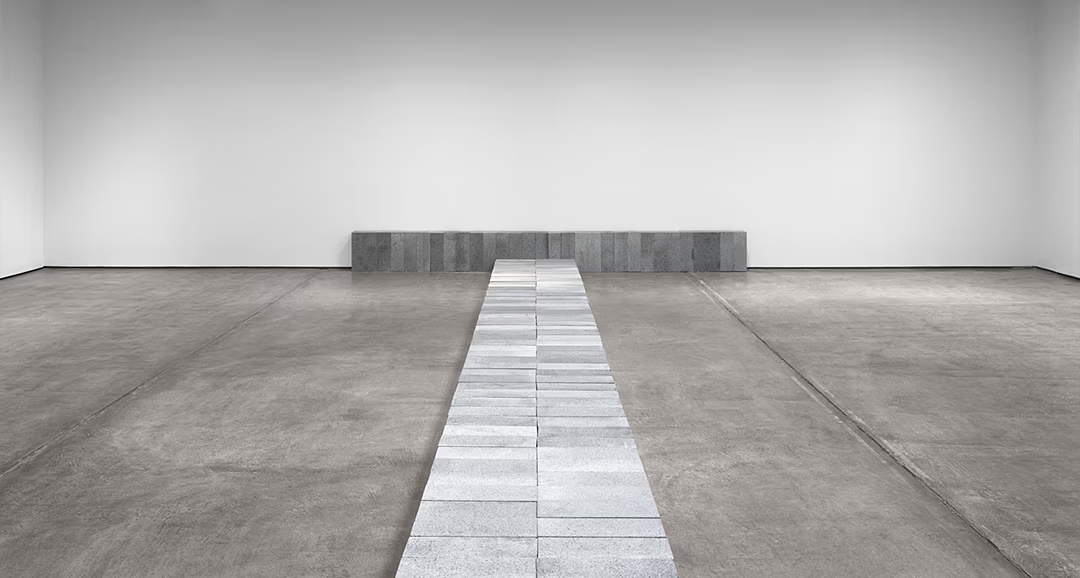
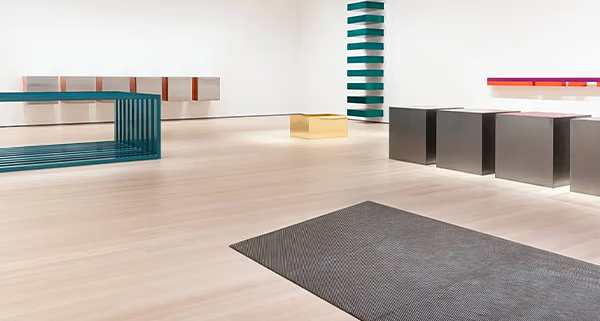
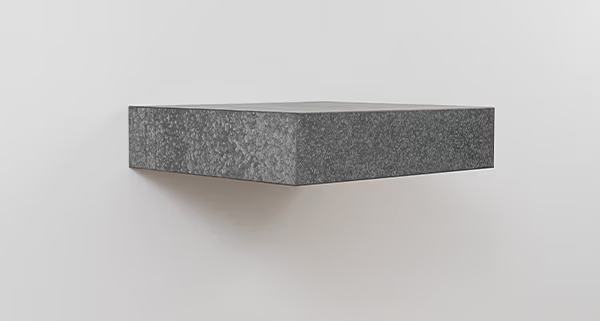
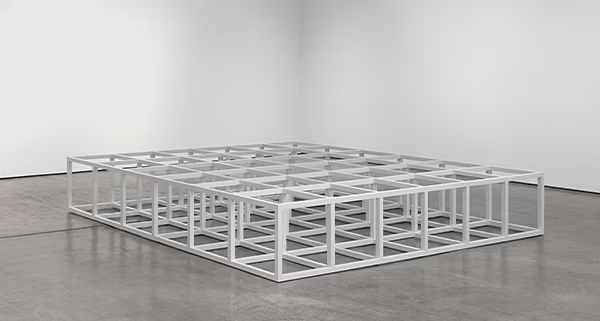
Carl Andre, 48 Bar Rectangular Fugune on 4 Ancient Metals, Copper, steel, lead and zinc, in 48 parts, each 1x15x30 cm. installation view, Executed in 1988. (Private Collection, New York)
minimal and rhythmic landscapes
Carl Andre’s site-specific formations constructed from simple materials resemble, through a uniformly structured sequential model, a structural arrangement that essentially renders meaning symbolic. In this regard, Andre holds that the block conception, clarified through the mediation of art object, space, and environment, gives rise to a qualitative obscuration through a provocative illusion that expresses a field of coexistence. This block construction takes shape around new possibilities of perception and the problematic of comprehension, forming a renewed perceptual capacity. Yet in every instance, it is evident that these geometric blocks, stripped of expressive qualities, become blurred within a fixed and reductive spatial system and generate new zones of obscurity.
Nonetheless, in Andre’s arrangements, which carry a distinctly anti-expressive character, the positional experiences of perception that develop through the function of material, the model of stacking, and environmental collaboration are equally significant. It can therefore be argued that the work of art, as a product of an experience bound to repetition and rhythmic order among geometric forms and of an interaction with space, is left to be discovered as a minimal landscape. Here it becomes possible to locate the points at which Andre’s organized and systematic vision crystallizes, and to uncover the powerful components and conceptual dynamics that render the work functional within its spatial conditions.
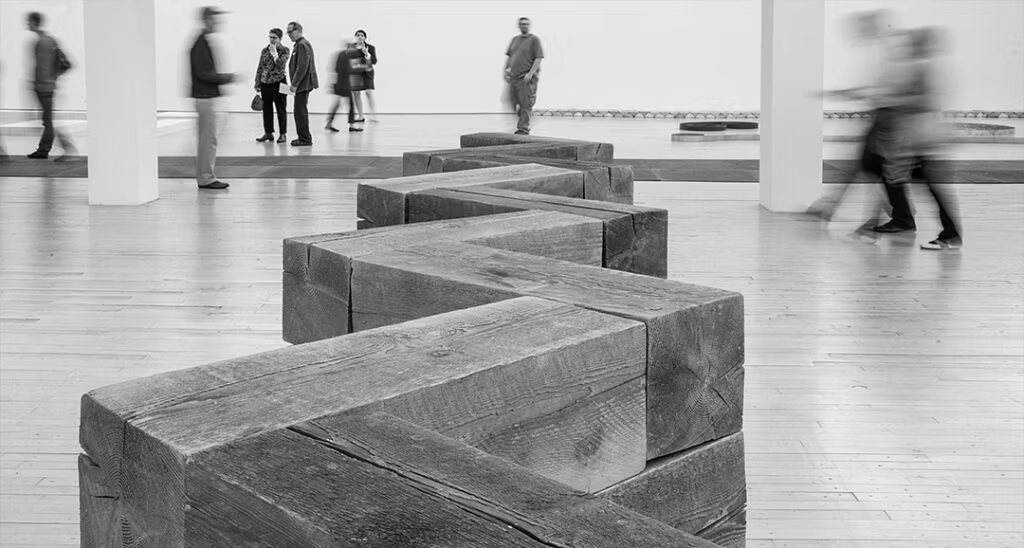
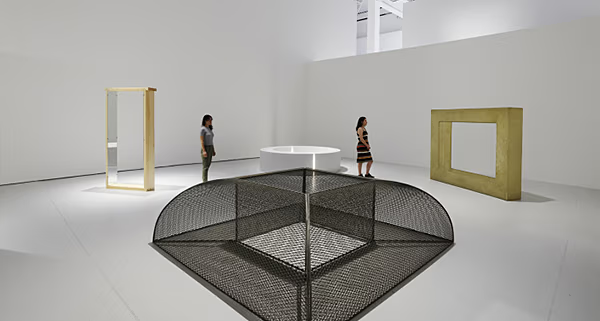
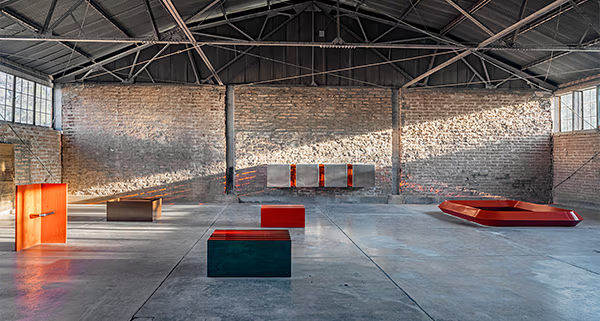
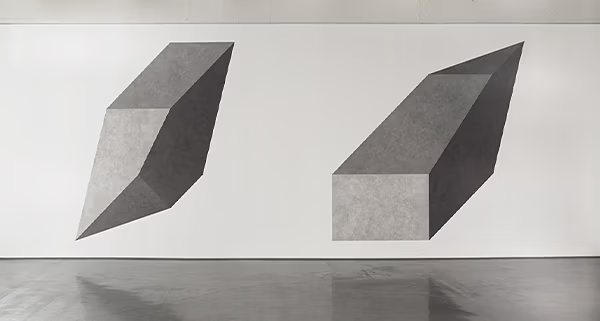
Carl Andre: Sculptur as Place 1958-2010, Exhibition View, May 5 - June 18, 2016, Hamburger Bahnhof - Nationalgalerie der Gegenwart, Berlin, Germany.
In Carl Andre’s minimal construction process, it is also noteworthy that each image organizes, as a distinctive force creating a layered effect, a structure that is interconnected and rendered incorporeal within space. There seems to exist a condition in which things are liberated, or in which thought itself becomes a distinctly visual force. It is therefore significant that geometric blocks, reflecting the modernist interior discoveries of a liberating spirit and products of a singular mode of thinking, are transformed into a structure that provokes space. Thought here adheres to a heap of geometric images, whether brick or floor tile, or becomes stacking constructions that emanate from a conceptual system. Indeed, the block structures that Andre produces as a kind of minimal excavation site activate a perceptual experience of feeling and touch. They seem to place at their center, and bring forth as an overarching theme and concept, the construction of an other-space in which material becomes incorporeal and even loses its function in this new state. It is therefore appropriate to regard the work of art and its spatial and environmental connections, thus clarified, as new tactile abstract alignments.
The grandeur of Carl Andre’s Minimalism draws its strength from a powerful linguistic response that emerges as the organic connection between the produced work and its exterior evolves into a conceptual structure of deeper and more essential determination. That this minimal and abstract perceptual deformation, affecting the entirety of space, is constructed on such peculiar ground and presented with a designation equivalent to a dissident consciousness, is itself a matter of considerable significance.
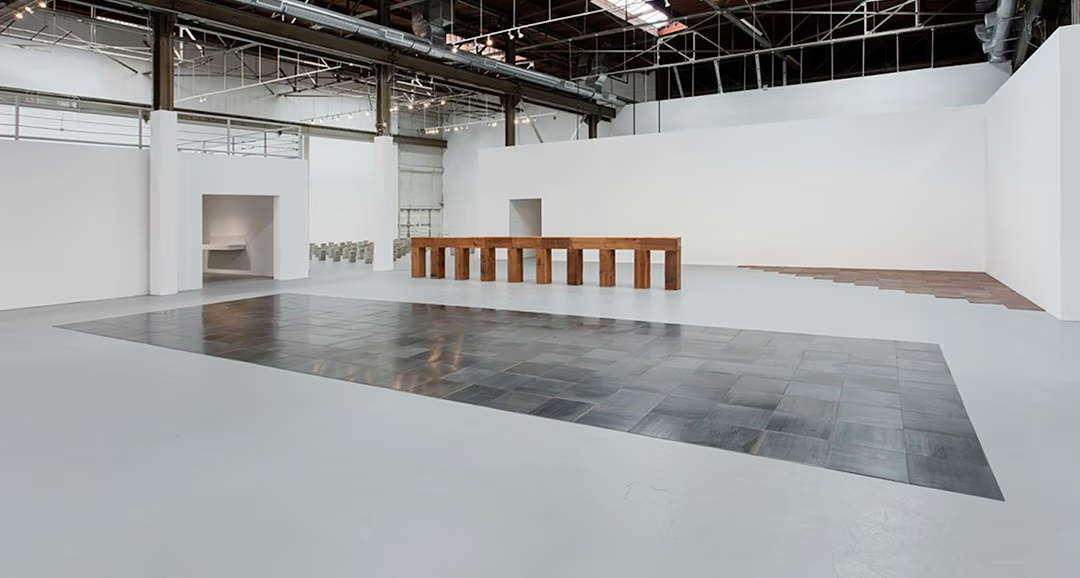
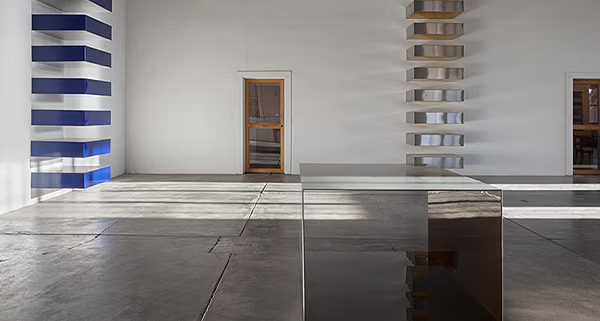
Installation view of Carl Andre: Sculpture as Place, 1958–2010, April 2–July 24, 2017 at The Geffen Contemporary at MOCA, The Museum of Contemporary Art, Los Angeles, photo by Brian Forrest
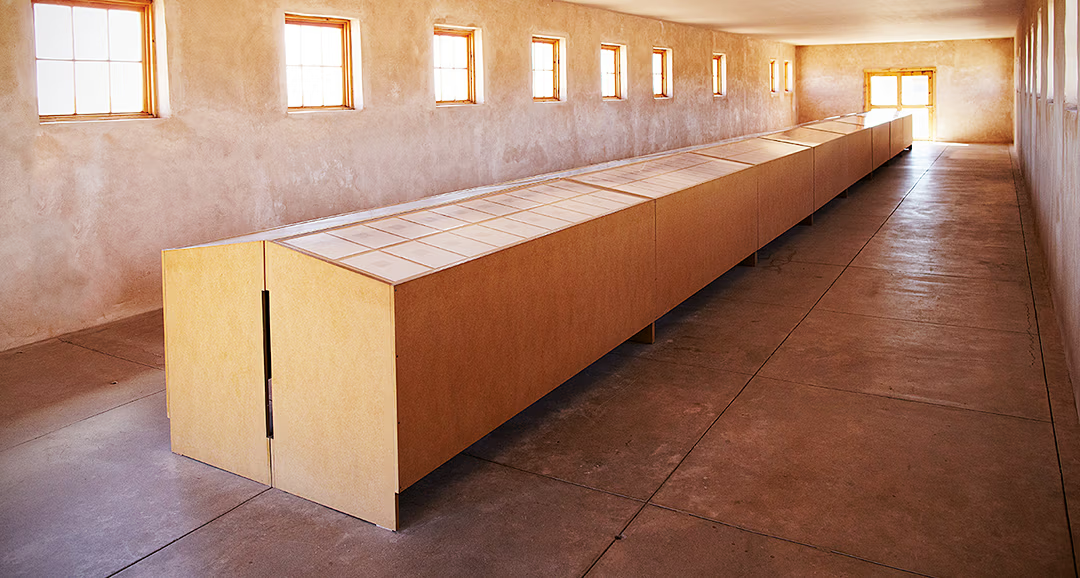
“While he is known primarily for his sculpture, Carl Andre also produced poetry from the early 1950s to the mid 1970s. Andre’s poems, which were typed on a manual typewriter or hand-written, can also be read as drawings. They relate directly to the artist’s three-dimensional work in that they incorporate the word as a compositional module, much like his signature use of bricks or metal plates. Loosely narrative in structure, the poems often include historical references and traces of autobiography. The poems obliquely evoke character and setting while incorporating various literary forms such as the sonnet, opera, or novel. Andre donated nearly 500 pages of his poetry to Chinati’s collection, and the work was installed in its own building, in vitrines designed by the artist, in 1995.” (https://chinati.org/collection/carl-andre)
“Chinati Thirteener was designed by Carl Andre for the courtyard of Chinati’s temporary gallery. It consists of 13 strips of hot-rolled steel plates, each 30.4x 91.4 cm, laid out in equal distances on a surface of gravel. These lines mark the rectangular area in loose relation to the vertical posts running along the porch. An interesting aspect is the alternation of smooth steel surfaces and rough gravel; the distinction between them will only be enhanced over time, as the steel plates will entirely rust and then show an even greater contrast to the pebbles. The piece was first installed at Chinati in 2010″ (https://chinati.org/collection/carl-andre)
4 BOOKS
Carl Andre: Sculpture 1959-1977, Carl Andre (Artist), English, Paperback, 88 pages, J. Rietman Publishing, First Edition, January 1978.
Carl Andre, Diane Waldman (Contribution), Carl Andre (Artist), Softcover, English,, First Edition, 84 pages, The Solomon R. Guggenheim Museum, New York, 1970.
Carl Andre: Between Sculpture and Poetry, English, Hardcover, 152 pages, Torch Press, First Edition, July 2024.
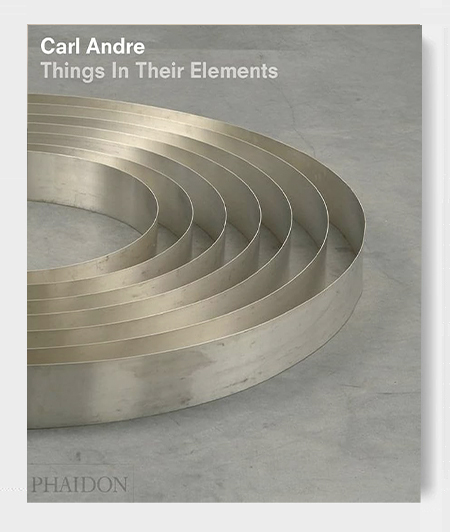
Carl Andre: Things in Their Elements, Alistair Rider (Author), Carl Andre (Artist), English, Hardcover, 272 pages, Phaidon Press, First Edition, June 2011.
BIOGRAPHY
Carl Andre (1935–2024) worked in the fields of sculpture and poetry. He served in the US Army between 1955 and 1956. In 1957, he moved to New York and worked for a publishing house. Between 1960 and 1964, he worked as a technical specialist for the Pennsylvania Railroad. His early works consisted of abstract sculptures and drawings featuring geometric forms made from Plexiglas and wood. During this period, he was influenced by Brancusi and his close friend Stella. His sculptures were first exhibited in a group show in 1964, followed by his first solo exhibition at the Tibor de Nagy Gallery in New York in 1965. In 1970, a major retrospective exhibition was held at the Guggenheim Museum in New York. Alongside floor sculptures created through simple arithmetic combinations of standard industrial units such as bricks or metal sheets, he experimented extensively with scattered blocks, bent pipe sections and the like. [Photo from the American Academy of Arts and Sciences website]
saglamart; dinamik bir anlayış ile hareket eden, kültür-sanat ortamındaki olay ve olgulara, sanatçı tavırlarına, yapıtlara ve yayınlara odaklanan bağımsız bir yayın etkinliğidir. Tüm hakları saklıdır. Görüntü ve yazılar izinsiz kullanılamaz. / saglamart is an independent publishing initiative driven by a dynamic vision, focusing on events and developments in the cultural-artistic landscape, artist perspectives, works, and publications. All rights reserved. Images and texts cannot be used without permission.