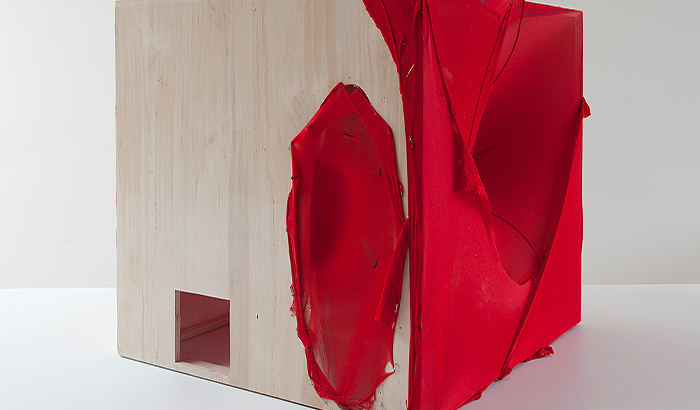
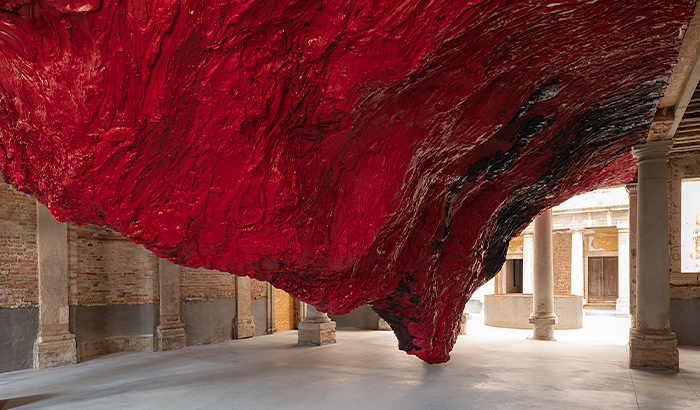
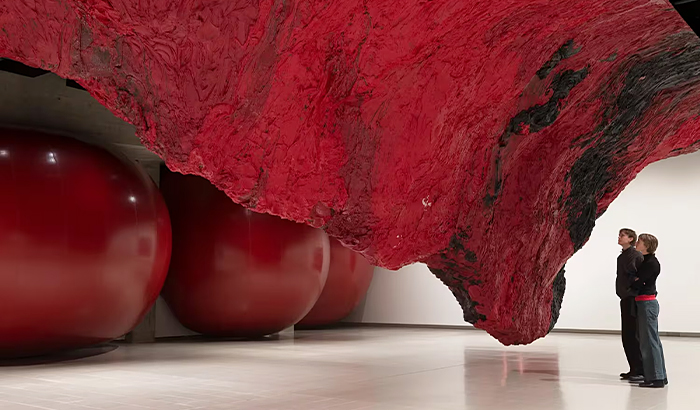
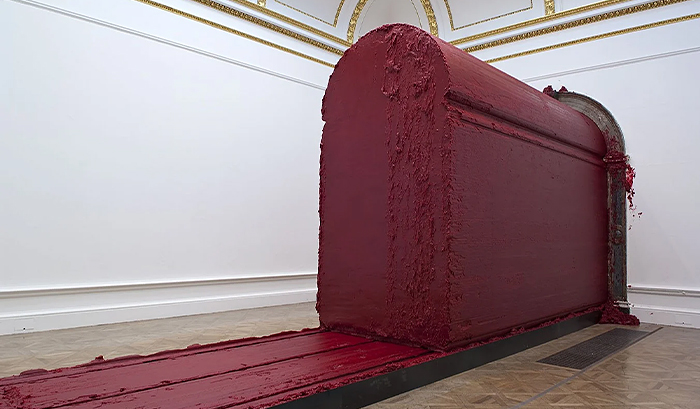
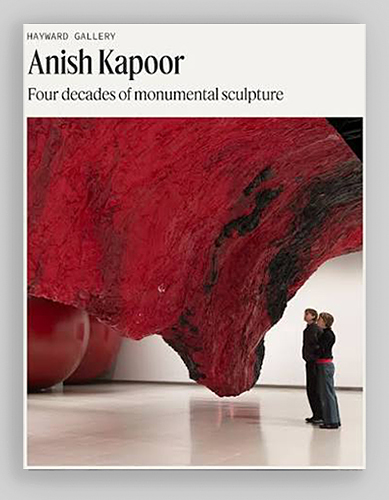
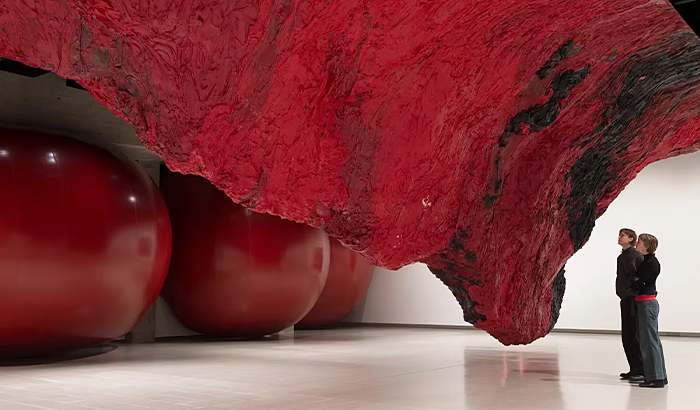
Anish Kapoor, Mount Moriah at the Gate of the Ghetto 2022, Installation view at Palozzo Manfrin, Mixed media 13.8x6.8x3.9 cm Photograph: Attilio Maranzano ©Anish Kapoor. All rights reserved, DACS, 2026

anish kapoor

mount moriah at the gate of the ghetto

GÜLAY YAŞAYANLAR

"

Mount MorIah AT THE GATE OF THE GHETTO, here becomes a representatIonal otherworld born of the conflIct of the space-object dCalectIc, now a utopan confIguratIon that breaks free of the determInants of an absolute cycle and sets perceptIon In motIon. It Is as though the summIt, saggIng toward the ground under a loaded weIght resemblIng an Inventory of anguIsh, were a monumental IllusIon harboring fragmented realItIes and devastated emotIonal clusters. And, as though akIn to spIrItual vIsIons, It rests on a strange InsIght that bends the space and renders It mysterious. It Is as though, through Its flowIng and drIppIng lIquIds envelopIng the unconscIous, It organIzes dIsparate sensatIons Into a narratIve order cloaked In red. It possesses an IntrIcate shell and appears, IncorrIgIbly, In a strIkIng red-black guIse.

Anish Kapoor Mount Moriah

Anish Kapoor, Mount Moriah at the Gate of the Ghetto, 2022 Mixed media / Karışık teknik (silikon, reçine ve yoğun kırmızı pigment), 13.8×6.8×3.9 cm. Photograph: Attilio Maranzano ©Anish Kapoor. All rights reserved, DACS, 2026.

Anish Kapoor’s recent monumental works present themselves, above all, as objects of excess: formal articulations of emphases bearing on existence itself. This mysterious accumulation of objects, arrived at through inner and intellectual contradictions, can be said to generate an existential world of its own making. Indeed, there is no doubt that these new things, produced through a revisionist architecture resting on unconscious intuitions by an artist long inclined to give form to emptiness, harbor a hedonistic intimacy and mystery that spreads through space and, further, compresses it. What must first be addressed here, then, is an installative order in which an expanded perception, one that deepens into detail, undergoes continual transformation through the relation between the space occupied by these scaled objects and the space itself.


a utopian configuration: mount moriah at the gate of the ghetto 

The representational force of red, a color fetishized in Kapoor’s work and elevated into an element of pleasure, turns into a spatial game, and it is clear that this force corresponds, at bottom, to new psychic landscapes bound up with a monumental imagining diagnosed in the unconscious. Rendered in wax, silicone, resin, paint and pigment on fiberglass, this depiction of a mountain, titled Mount Moriah at the Gate of the Ghetto (2022), assumes a disquieting form: a psychoanalytic construction of action articulated onto the physical structure of the space as a suspended architectural element hanging from the ceiling. Inverted and suspended, this monumental object disrupts the play of perception and intervenes in emptiness as an element of violence, descending nearly to the ground and producing tension through a sensation that narrows the gaze.

Kapoor, who knows very well how to play with spatial emptiness, here transforms this strange yet striking incongruity, produced through a spatial emphasis designed in opposition to the architectural structure of the space, into a sublime object brought forth almost as if by prophetic mission, while at the same time turning the space itself into a sacred ceremonial ground. The monumental red mass, which thus carries the character of a kind of manifesto of emptiness, is turned into the object of an intellectual experience constructed so as to compress the space. This sublime red mass, the structure that pierces emptiness, likewise acquires a symbolic quality, one in which imbalances of power, personal upheavals and every kind of rationality are routed.

This configuration of Kapoor’s, which awakens unconscious desires, plainly exceeds practical existential action. Mount Moriah here becomes a representational otherworld born of the conflict of the space-object dialectic, now a utopian configuration that breaks free of the determinants of an absolute cycle and sets perception in motion. It is as though the summit, sagging toward the ground under a loaded weight resembling an inventory of anguish, were a monumental illusion harboring fragmented realities and devastated emotional clusters. And, as though akin to spiritual visions, it rests on a strange insight that bends the space and renders it mysterious. It is as though, through its flowing and dripping liquids enveloping the unconscious, it organizes disparate sensations into a narrative order cloaked in red. It possesses an intricate shell and appears, incorrigibly, in a striking red-black guise.


mountain and red as a metaphor of unease

Anish Kapoor, who draws us close to the unreliable world of a psychoanalytic complexity, aims to problematize the relational agency of this monumental object-image within space by permeating the collective totality of eroding, ambiguous perceptions. In this setting, where violence is positioned at the center as a utopian element, he interprets red as a kind of metaphor of unease, one that either operates according to the qualified ritual of a narcissistic enchantment or corresponds to aggressive drives. For this reason, this imposing red form, in which components such as trauma, existence and violence generate new thresholds of perception, also conceals the violence-steeped, conflictual spirit of an intense metaphysical foreboding of life. This allegorical red linguistic ceremony thus confronts us, by way of the inexpressible things into which the ritual of irrational thought has wrought a shapeless transformation, with an original language of self-location and a power of parodic utterance. Here, evidently, an original color of abstracted traumas has been made to generate a mysterious and dark language.

The monumental scale and the effect of sublimity in Kapoor’s works, taking on a spiritual guise, also bring to light the intellectual aggression of an effort of feeling that persists under the command of the gaze. It seems certain that this uncontrollable, exceptional form, the product of this brutal opposition between installative structure and space, is an imaginary configuration that generates a perception of tension and, no less, calls into question its relationality with other things, and that it articulates onto this an exciting fictional world. This faltering architectural element, appearing as an amorphous, hard and motionless rock lodged within a taut psychic imaginary charged with poststructuralist characterizations, of course carries within it a powerful textual rhetoric. Precisely for this reason it possesses a magical aura that whets and estranges the gaze. In its hegemonic aspect, and in its spiritual dimension generating an arrogant gravitational pull, it is like an apocalyptic vision boldly undertaken…

Prof. Gülay Yaşayanlar  Copyright © August 2026, All Rights Reserved.

CURRENT EXHIBITIONS 2025 – 2027

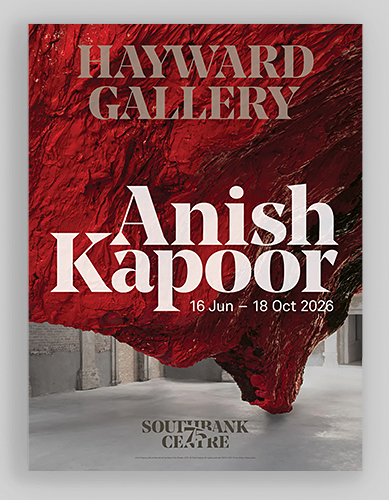
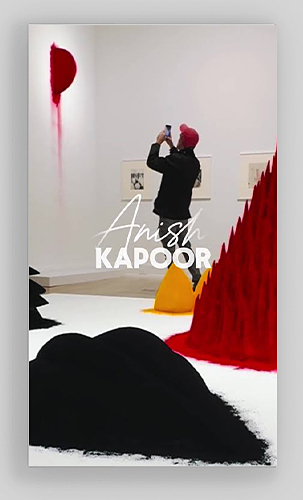
Anish Kapoor is re-examining all the stages of development and change in his artistic career through a conceptual deepening and a Post-Minimalist perspective. With his spectacular exhibition at the Hayward Gallery, the artist summarises creative phases such as Pigment, Emptiness, Mirror, Darkness and Body; he enables us to assess, alongside his new works, which take on an increasingly grotesque form and are shaped by mystical connections, a process that gains momentum through themes of illusion and reflection, and is crowned by large-scale spatial and public installations. (...) In this context, All of Nothing (2026), situated at the entrance to the Hayward Gallery and crafted from red PVC membrane; suspended from the ceiling, the work Mount Moriah at the Gate of the Ghetto (2022), on display for the second time and representing an inverted mountain, along with the colossal installation Ha Makom (2026), which also depicts a mythological mountain peak, serve as claustrophobic installations illustrating the new situation that has been reached.

This exhibition, which brings together Anish Kapoor’s large-scale installations and his gleaming stainless steel sculptures, reflects a remarkable body of work in terms of material possibilities, illusion and a magical aura. Indeed, this architecturally conceived environment, designed as a space for both physical and psychological meditation and reflecting Kapoor’s current practice involving wax, silicone and paint, focuses on a fundamental spatial tension.

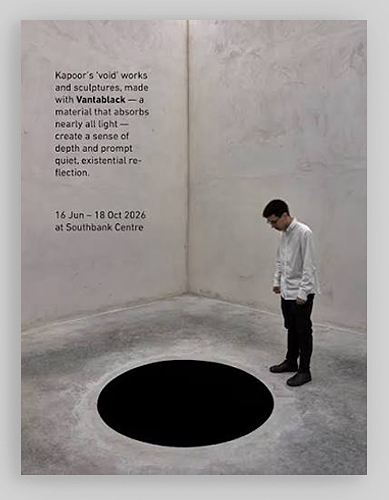
The exhibition brings together Anish Kapoor’s early pigment sculptures and his more recent works created using Vantablack, a nanotechnological material that absorbs almost all light. In this way, it showcases Kapoor’s skilful play on perception, drawing on the psychological effects of colour and its absence, as well as the allure of objects that seem to defy their own material nature.

 ANISH KAPOOR at Saglamart (ENGLISH)

gülay yaşayanlar: mount moriah at the gate of the ghetto

Anish Kapoor

gülay yaşayanlar: all of nothing: elliptical fluid-blood pockets that contain the waste products of the soul

mümtaz saglam: anish kapoor: kütle, yanılsama ve boşluk

mümtaz saglam: anish kapoor 2

mümtaz saglam: anish kapoor 3

ANISH KAPOOR at Saglamart (TURKISH)

Anish Kapoor Mount Moriah

gülay yaşayanlar: mount moriah at the gate of the ghetto

Anish Kapoor

gülay yaşayanlar: all of nothing: ruhun atıklarını barındıran eliptik sıvı-kan torbaları

Anish Kapoor

mümtaz saglam: anish kapoor: kütle, yanılsama ve boşluk

Anish Kapoor

mümtaz saglam: anish kapoor 2

Anish Kapoor

mümtaz saglam: anish kapoor 3

NEW WORKS 

Anish Kapoor

Mount Moriah at the Gate of the Ghetto

Anish Kapoor, Mount Moriah at the Gate of the Ghetto, 2022 Mixed media / Karışık teknik (silikon, reçine ve yoğun kırmızı pigment), 13.8x6.8x3.9 cm. Photograph: Attilio Maranzano ©Anish Kapoor. All rights reserved, DACS, 2026.

Mount Moriah at the Gate of the Ghetto (2022) is a monumental and jarring work that engages with themes and concepts such as matters of faith, sacrificial rituals, and the inner nature or sublimity of the human body. It evokes feelings of both fear and awe in the viewer. It takes the form of an inverted mountain suspended from the ceiling to the floor in a manner that defies gravity. This installation, which appears as though molten lava or blood is dripping from it, has an abject connotation and resembles freshly cut meat and internal organs. The work takes its name from the sacred Mount Moriah, to which the Prophet Abraham took his son Isaac to sacrifice him. Here, Kapoor explores the psychological and dark aspects of the act of sacrifice undertaken in the name of pure faith. It was first exhibited in 2022 during the Venice Biennale at Palazzo Manfrin, situated directly opposite the entrance gate to the Jewish Ghetto. In 2026, it was re-exhibited as one of the key pieces in the retrospective held at the Hayward Gallery in London.

READ MORE
Gülay Yaşayanlar: Mount Moriah at the Gate of the Ghetto (English), saglamart.com, August 2026.

All of Nothing

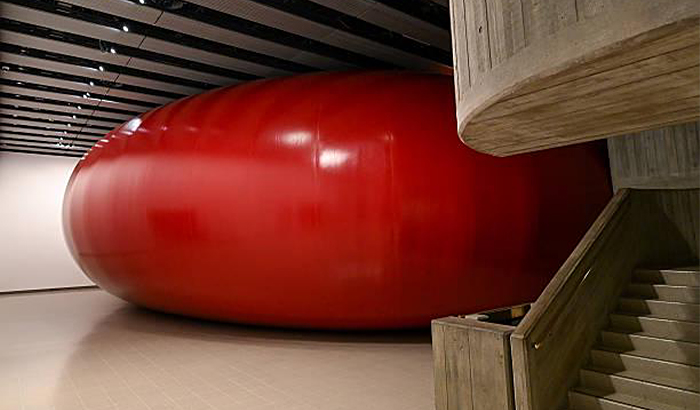
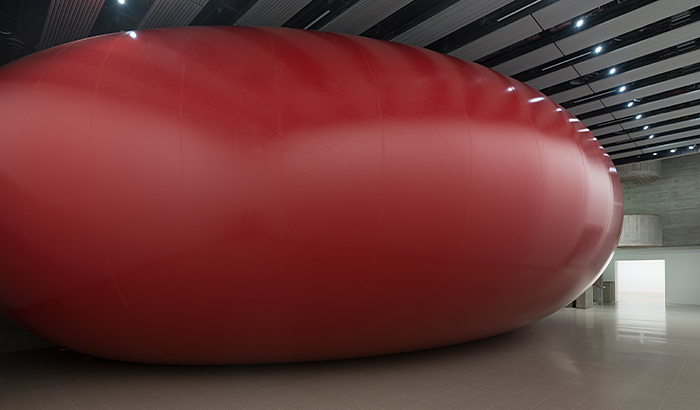
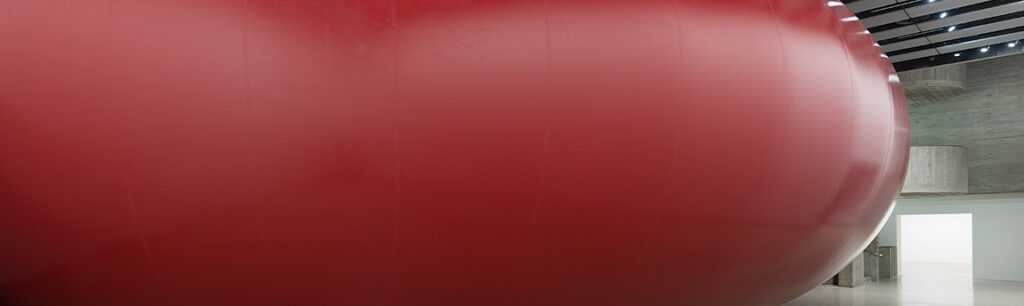
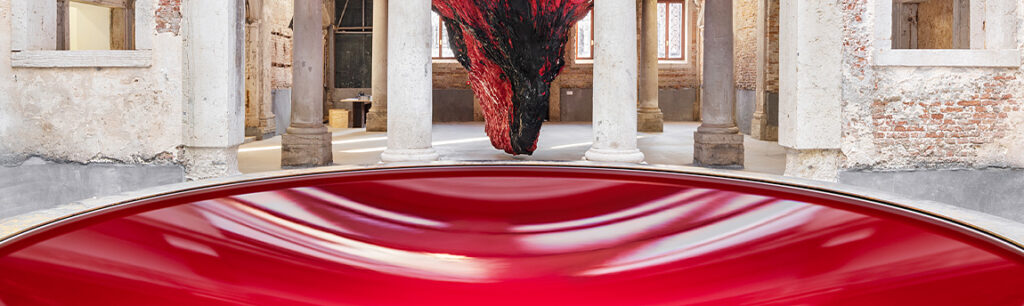
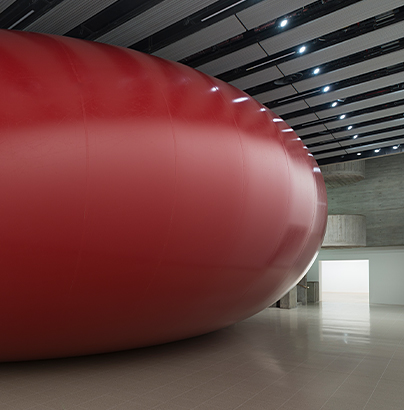
Anish Kapoor, All of Nothing, 2026, (Installation view), Şişirilebilir kırmızı PVC membran, Kalınlık: 0,6 cm. (image: Installation view of Anish Kapoor, All of Nothing (2026). Photo: Dave Morgan. Courtesy of the Hayward Gallery and the artist. © Anish Kapoor. All rights reserved, DACS, 2026)

In All of Nothing, where Anish Kapoor’s intervention in the void takes the form of a postmodern game, it is clear that a complex set of motivations is created through the perception of the body, to which a direct connection is established. Here, first and foremost, within the void, which envelops a central narrative and transforms into an intellectual diagram, giant balloons, suspended in a cramped arrangement and with a sense of tension whilst examining conflicting concepts such as violence, desire, freedom and death, are rendered as images of truth. Furthermore, these elliptical sacs of fluid and blood, which harbour the dregs of the soul, have evolved into colossal masses of dark matter, brimming with secrets due to accumulated sensitivities linked to social violence, and appearing as though they might burst at any moment.

READ MORE
Gülay Yaşayanlar: All of Nothing: ruhun atıklarını barındıran eliptik sıvı-kan torbaları, saglamart.com, August 2026.

READ MORE
Gülay Yaşayanlar: All of Nothing: ruhun atıklarını barındıran eliptik sıvı-kan torbaları, saglamart.com, August 2026.

Anish Kapoor

Ha Makom

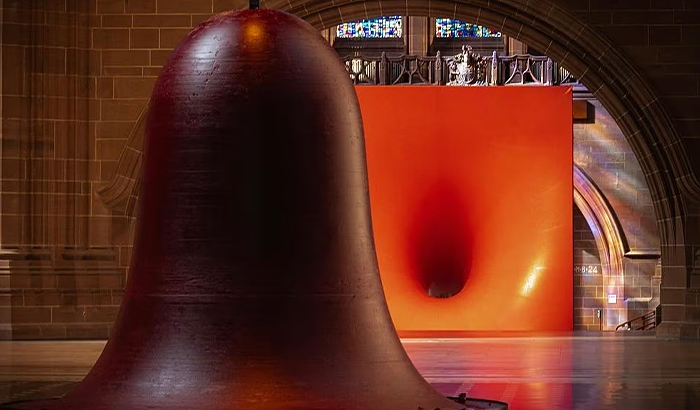
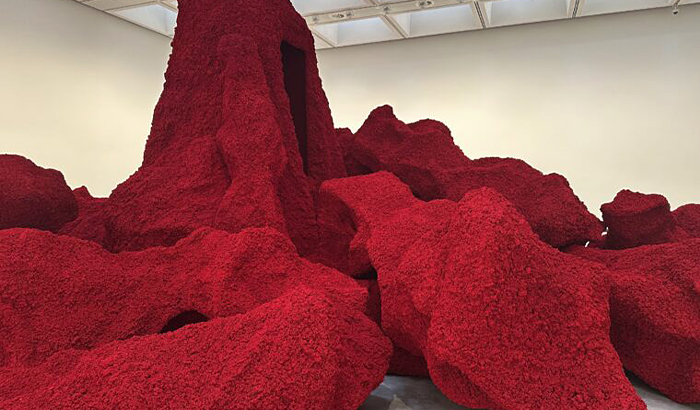
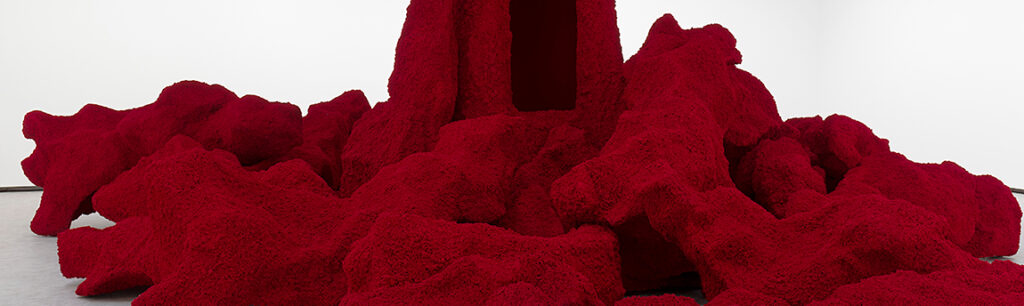
Anish Kapoor, Ha Makom, (Mother as a Mountain, My Red Homeland III, As if to Celebrate I Discovered a Mountain Blooming with Red Flowers), 2026, Mixed media and pigment, Dimensions variable © Anish Kapoor. (https://anishkapoor.com/9676/ha-makom) image: Anish Kapoor, Ha Makom, 2026. © Anish Kapoor. All rights reserved, DACS, 2026. Photo: Dave Morgan.

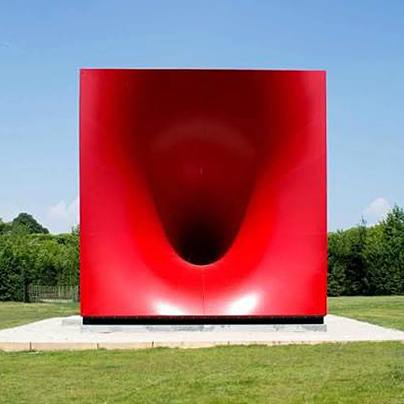
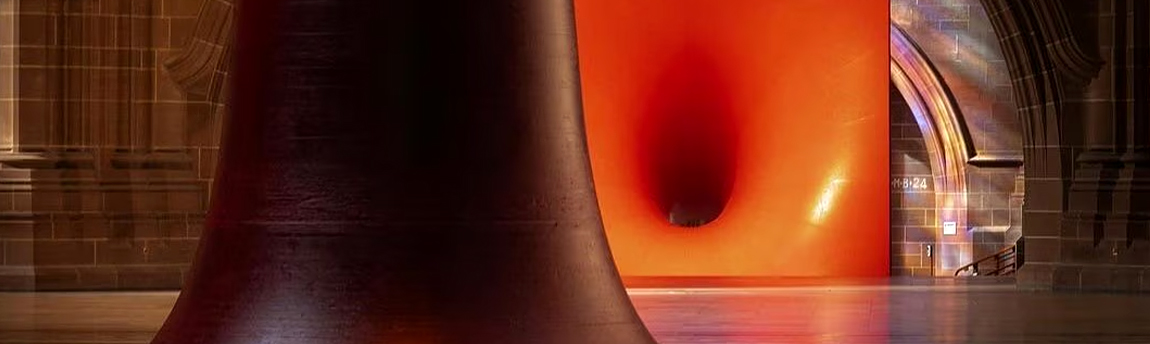
Ha Makom is a monumental and immersive installation executed in red pigment and various materials. Translating to The Place in Hebrew, the term represents both physical space and the divine within the Kabbalistic tradition. Inspired by the famous Uluru rock formation in Australia, the work features a rugged, mountainous, or crater-like landscape appearance, characterised by a dense, vibrant red texture and a deep, mysterious dark portal at its centre. This monumental piece, through which Kapoor aims to make the viewer physically experience 'the presence of the divine in space and time' as well as both the corporeal and the mystical, was first showcased in the comprehensive exhibition held at the Hayward Gallery in London.

HIGLIHGTS 

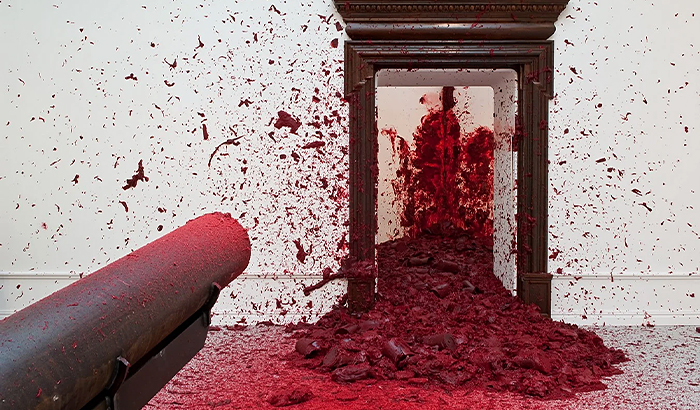
Shooting into the Corner

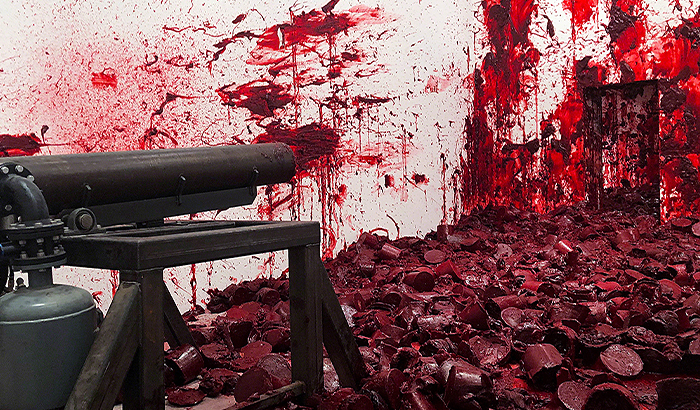
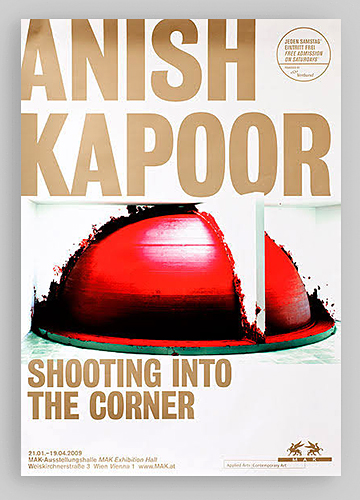
Anish Kapoor RA, Shooting into the Corner, 2008 - 09, Mixed video. Dimensions variable. MAK, Vienna, Austrian Museum of Applied Arts/Contemporary Art. Installed at the Royal Academy of Arts, London, 2009. Photography: Dave Morgan. © Anish Kapoor. All Rights Reserved, DACS 2022.

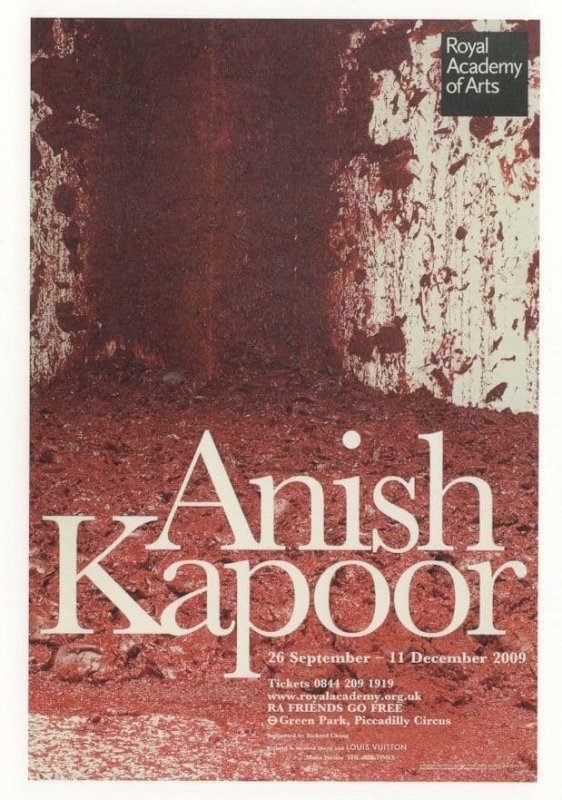
Shooting into the Corner was exhibited at the Royal Academy of Arts in 2009 and subsequently at Palazzo Manfrin in 2022. Receiving critical acclaim, this work stands as one of Kapoor’s most renowned dramatic and performative installations. The apparatus consists of a functional cannon that fires bucket-sized projectiles of blood-red wax at regular intervals. By blasting a dense mixture composed of paint, pigment, wax, and vaseline against the wall, this mechanism creates a painted field of randomly aggregated details on the opposing surface. The physical presence generated by this mixture, replete with scattered viscous stains, residues, and highly adhesive debris, transforms the entire process into an expressionistic performance. Operating primarily through the strategy of automatism, the installation allows the work to actualize itself within a proposed spatiotemporal framework. In this context, the artwork undergoes a semantic shift with each iteration, continuously generating new configurations that evoke situational and fluid meanings.

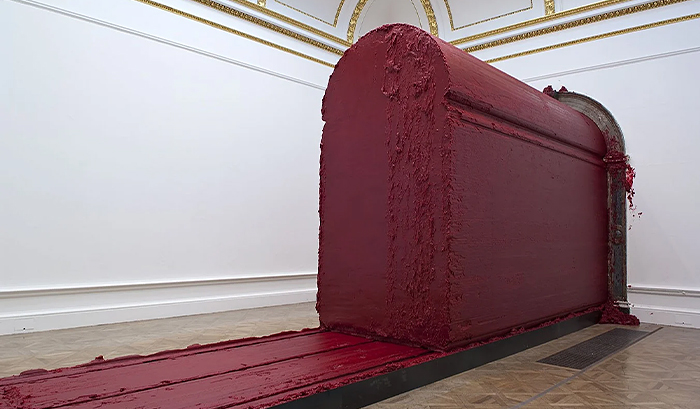
Anish Kapoor, Svayambhu, at the Royal Academy of Arts, London, 2009, Wax and oil-based paint. Dimensions variable © Anish Kapoor. All Rights Reserved, DACS 2022

PALAZZO MANFRIN / ANISH KAPOOR FOUNDATION – VENICE 

Anish Kapoor

Anish Kapoor in Venice: Retrospective, Curator: Taco Dibbits, 2022, Palazzo Manfrin and Gallerie dell'Accademia, Venice. Anish Kapoor, Retrospective, 6 May - 8 August 2026, Palazzo Manfrin, Cannaregio, Venice.

Following an extensive restoration process of the Palazzo Manfrin, which he acquired in 2018, Anish Kapoor staged two large-scale exhibitions concurrent with the Venice Biennale. Curated by Taco Dibbits, Director of the Rijksmuseum, the first retrospective exhibition, titled Anish Kapoor in Venice and organised in tandem with the Gallerie dell'Accademia in 2022, serves as a comprehensive compendium of the artist's career. Exhibited here are two of his renowned installations: Mount Moriah at the Gate of the Ghetto, a monumental amorphous structure featuring red and black silicone and paint trickling down from the ceiling, and Shooting into the Corner (2008–2009). Furthermore, this exhibition marked the debut of his void and aperture sculptures executed in Vantablack, a material that absorbs almost all light, the exclusive rights to which Kapoor famously acquired.In 2026, Kapoor organised his second exhibition, running simultaneously with the 61st Venice Biennale. On this occasion, he presented one hundred architectural models, a portion of which comprises unrealised projects, alongside his works Taratantara (1999) and Ark Nova (2013). Here, Kapoor prioritises inquiries into the spatial positioning of the object and its potential for space-making. According to the artist, these exhibited drawings and models constitute playful experimentations with scale and form, thereby facilitating the emergence of his original concepts and propositions. Additionally, this exhibition features a new, monumental iteration of his work At the Edge of the World (1998), spanning eight metres in diameter and suspended from the ceiling. Alongside another iconic work, Descent into Limbo (1992), his grotesque and eschatological concrete installations titled Ga Gu Ma (2012), which oscillate between mechanical production and organicity, are housed in separate rooms. Finally, he concludes this presentation with the Vantablack sculptures, composed of pitch-black forms that simultaneously manifest and dissolve before the viewer’s eyes, which he had first exhibited in this very venue in 2022.

BIOGRAPHY

Anish Kapoor

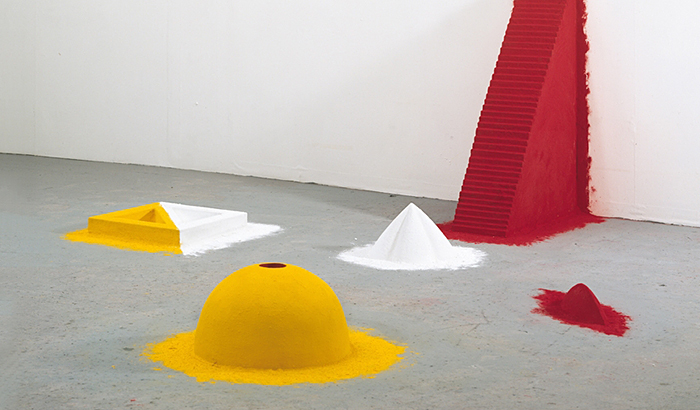
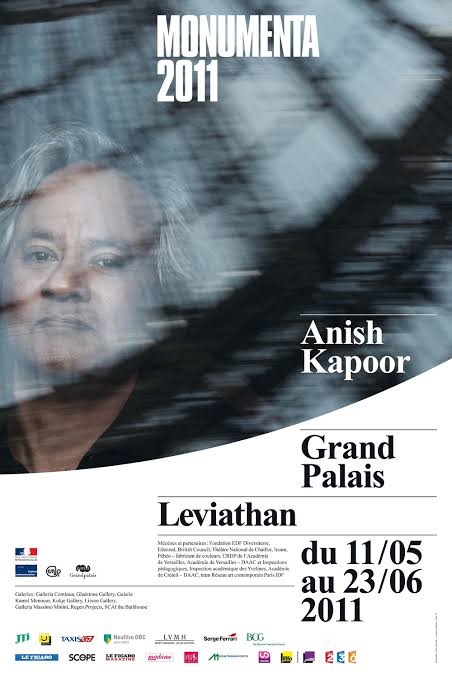
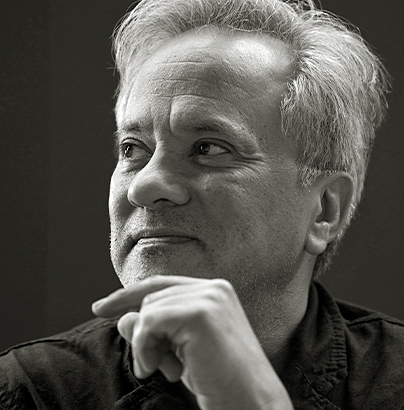
Anish Kapoor (1954, Mumbai) possesses a production practice executed through diverse techniques, dimensions, and materials. He is widely recognized for his monumental sculptural projects that engage with the public sphere, such as Cloud Gate. In both indoor and outdoor settings, he frequently utilizes colossal flayed or inflated PVC membranes integrated with the landscape. The installation titled Marsyas, exhibited at London’s Tate Modern Turbine Hall in 2002, stands as the most prototypical example of this approach. Furthermore, he destabilizes our perception and everyday reality through mirrors that draw the spectator into their dizzying concavity. With works such as Yellow, which comprise pigmented voids carved into stone or walls, he immerses the observer into a symbolic experience of depth. Since the 2000s, Kapoor has continued to blur the boundary between architecture and sculpture through grotesque installations and a performative sequence of self-manifesting artworks centered around concepts such as presence and absence, which he keeps at the forefront of the contemporary agenda through a Post-Minimalist stance. (Anish Kapoor portrait photo by Jillian Edelstein)

İZMİR - LONDON

saglamart; dinamik bir anlayış ile hareket eden, kültür-sanat ortamındaki olay ve olgulara, sanatçı tavırlarına, yapıtlara ve yayınlara odaklanan bağımsız bir yayın etkinliğidir. Tüm hakları saklıdır. Görüntü ve yazılar izinsiz kullanılamaz. / saglamart is an independent publishing initiative driven by a dynamic vision, focusing on events and developments in the cultural-artistic landscape, artist perspectives, works, and publications. All rights reserved. Images and texts cannot be used without permission.

Copyright ©
Can Sağlam - Gülay Yaşayanlar Mümtaz Sağlam, 2025.