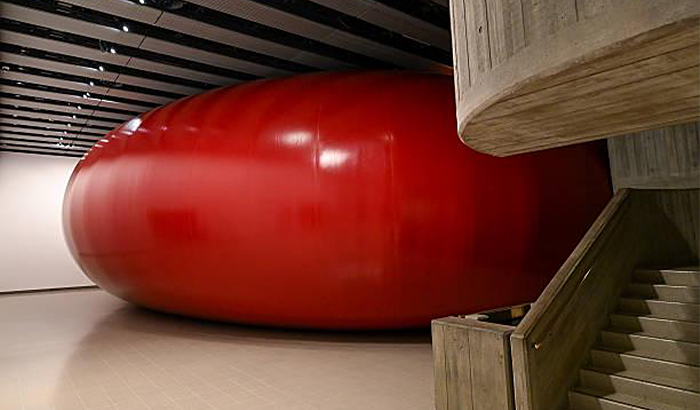
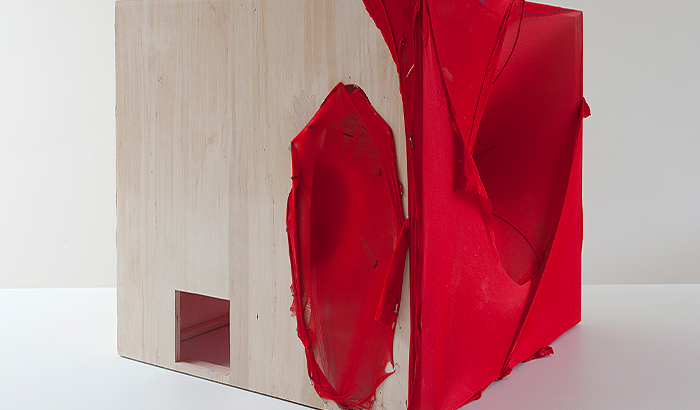
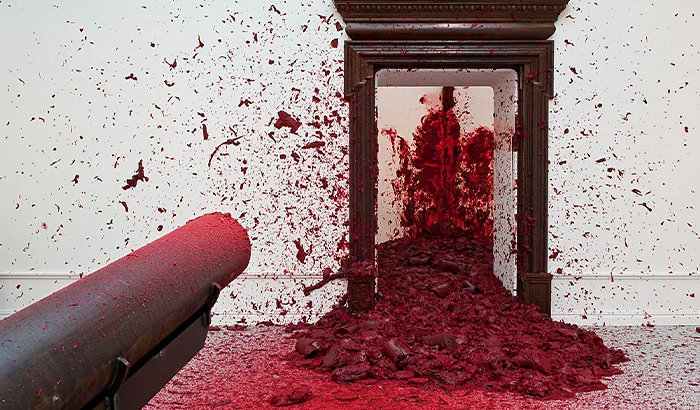
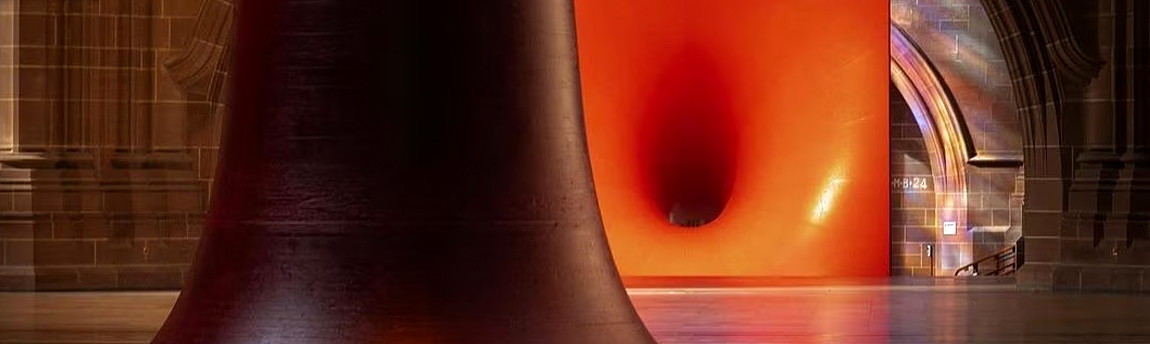
Anish Kapoor’s artistic approach is, in its most recent phase, undergoing a radical shift toward the non-object. Complex formations, difficult to envisage or define, are giving way to dense, large-scale installations that appear coarse, even absurd. In this process, Kapoor, pushing at the limits of the conceptual and the experimental, turns directly toward the materiality of the body, orienting his newest constructions around an excess bound up with abject elements such as blood, flesh, viscera, and wound. Strange as it may appear, this abject representation, shaped by a material coarseness and density that hovers between revulsion and fascination, can equally be described as a practice that extends across the broad cultural history and reality of social and political trauma. Made from silicone, resin, and wax combined with red pigment, in a consistency that neither melts nor sets at room temperature, this body of work evidently completes an increasingly feral and organic imaginary.
decayed residues: a site of linguistic memory
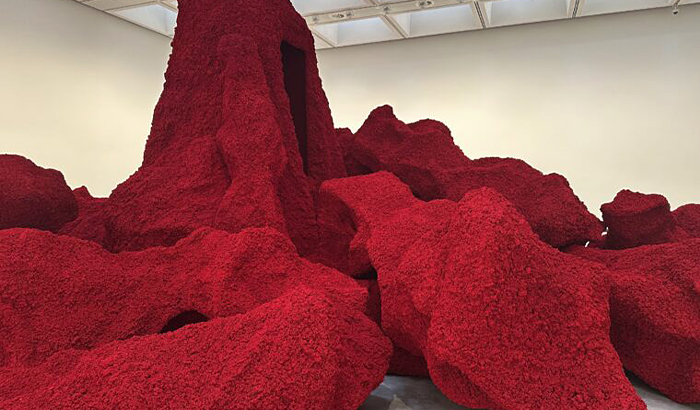
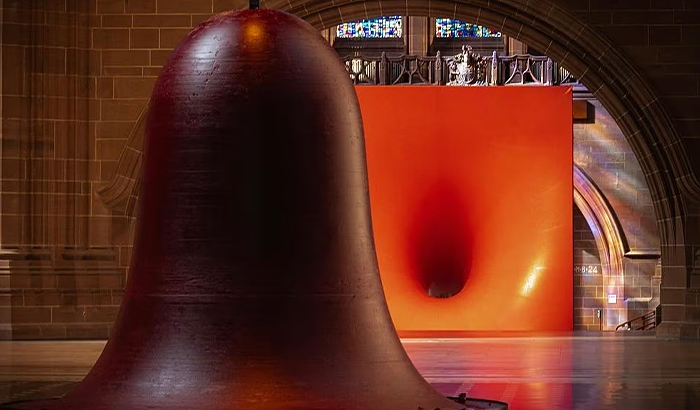
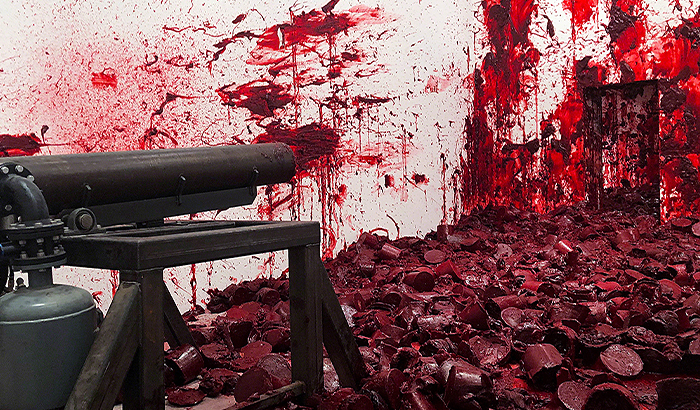
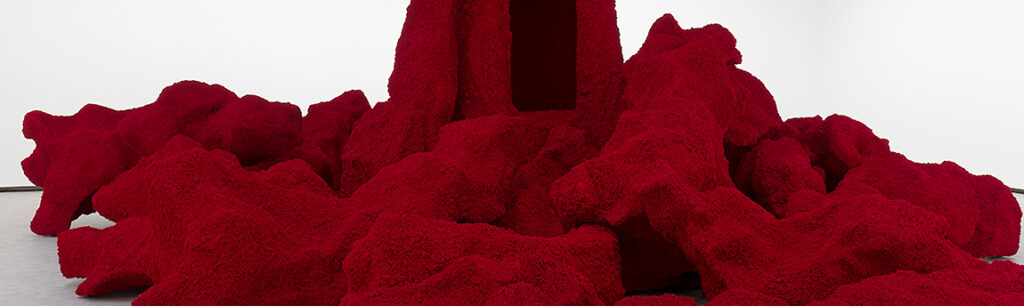
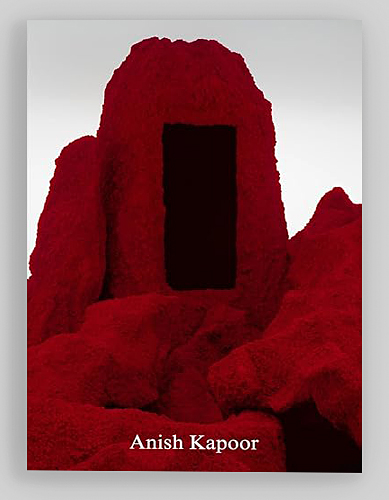
Ha Makom (2026), a large-scale environmental installation, offers a clear index of the shift under discussion. With the open gate-like void positioned at its summit binding its references directly to debates on faith, this work is not merely a dark, pigment-coated depiction of a peak but a strange plastic density that generates a sense of tension and danger. Likewise, the series Ritual Expiation (2025-26), a set of floor sculptures containing forms that resemble internal organs, similarly stages representations built around religious reference in repellent trays, to a degree capable of provoking fear, disgust, and even nausea.
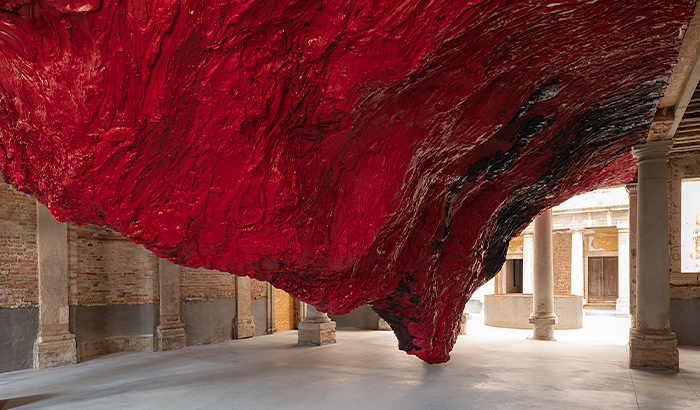
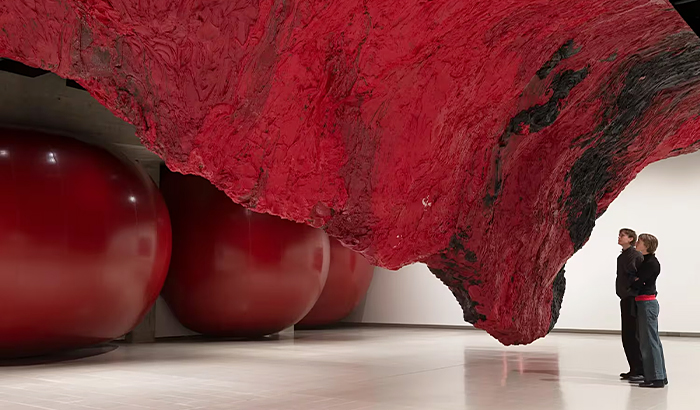
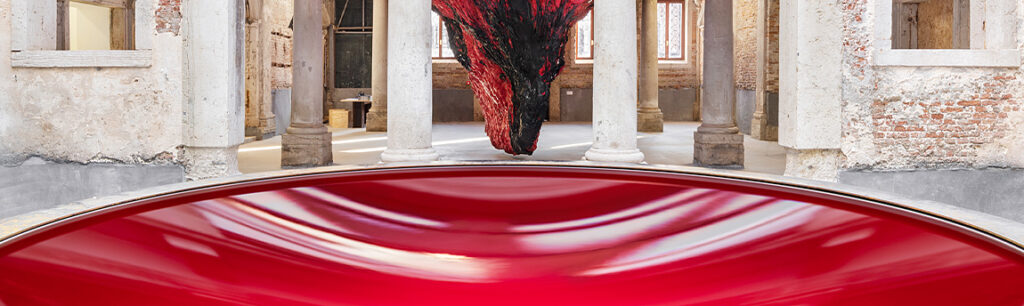
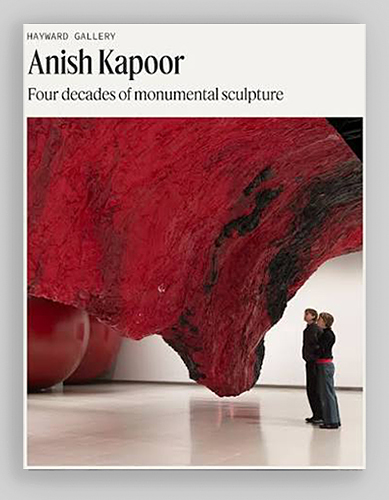
Kapoor’s blood-red dark-landscapes, increasingly symbolic in character and formless in appearance, are wrought from a strikingly rendered visuality composed of dramatically decayed residues that reveal the more violent and grotesque products of the imagination. In binding blood, sandstone, and earth to one another in this way, the artist emerges with a capacity for spiritual obscenity that is anything but ironic. In this context, Mount Moriah at the Gate of the Ghetto (2022), a site-specific installation first exhibited in 2022 in the entrance hall of the Palazzo Manfrin in Venice, gives the impression of a volcano and a mass of lava seeming to pierce the ceiling and hang down toward the floor. Appearing as though it might collapse at any moment, this enormous mass is positioned so that its peak nearly touches the gallery floor. In inverting the curve of the mountain, Kapoor seeks to underscore the unnatural character of the mythological narrative, the act of sacrifice, attached to this place named in scripture. The overturning of the mountain is, for this reason, not merely a physical gesture but a reversal of the natural order, of gravity, and even of divine command itself.
Ultimately, it is fitting to regard this series of red sculptures, the product of a transcendent imagination, as works that in their present form, unified by red, black, and purple and textured to resemble clotted blood, move along the boundaries of abject representation and become entangled with the politics of the body. These installations, presented within a grotesque structure and carrying the quality of a psychoanalytic experiment, ought to be read as among the most intense images of blind faith, political violence, and bodily fragility. It is therefore unsurprising that the experience of making sense of this dark productive universe, undertaken most often within a cross-cultural, historical, and contemporary phenomenological context, comes to terms with this well-constructed, timeless formal excess, one that draws on a measured mysticism and emphasizes the startling coherence of a cosmic fabric.

Prof. Mümtaz Sağlam, Copyright © Ağustos 2026, Tüm Hakları Saklıdır.
REFERENCES
1- Jonathan Jones, Anish Kapoor review this gutsy, gore-splattered show is a divine bloodbath, The Guardian, June 15, 2026, https://www.theguardian.com/artanddesign/2026/jun/15/anish-kapoor-review-hayward-gallery
2- Dale Berning Sawa, ‘I have a naughty schoolboy attitude’: Anish Kapoor reveals his latest epic creations, The Guardian, Sun 14 Jun 2026 https://www.theguardian.com/culture/2026/jun/14/anish-kapoor-hayward-gallery-interview
3- Raphy Sarkissian, “Anish Kapoor”, The Brooklyn Rail, Dec/Jan 2023–24, https://brooklynrail.org/2023/12/artseen/Anish-Kapoor/
4- Michael Brennan, “Tony Smith ve Anish Kapoor”, The Brooklyn Rail, July 2004. https://brooklynrail.org/2004/07/artseen/tony-smith/
5- Rebecca Mead, “Anish Kapoor’s Material Values”, The NewYorker, 15 August 2022. https://www.newyorker.com/magazine/2022/08/22/anish-kapoors-material-values
6- Adrian Searle, “Anish Kapoor: A Very Fine Mess”, The Guardian, September 21, 2009, https://www.theguardian.com/artanddesign/2009/sep/21/anish-kapoor-royal-academy
7- Louisa Buck, “Anish Kapoor: Just because a thing is big, it doesn’t mean it’s of any interest or even good”, The Art Newspaper, 15 Haziran 2026, https://www.theartnewspaper.com/2026/06/15/anish-kapoor-just-because-a-thing-is-big-it-doesnt-mean-its-of-any-interest-or-even-good
8- Baume, Nicholas, ed. Anish Kapoor: Past, Present, Future. Cambridge: The MIT Press, 2008.
9- See. https://www.dssel.com/blog/art-and-sculpture/the-cloudgate-sculpture-chicago/
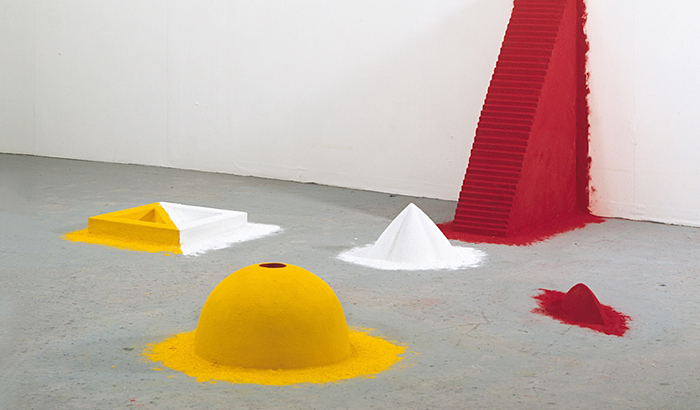
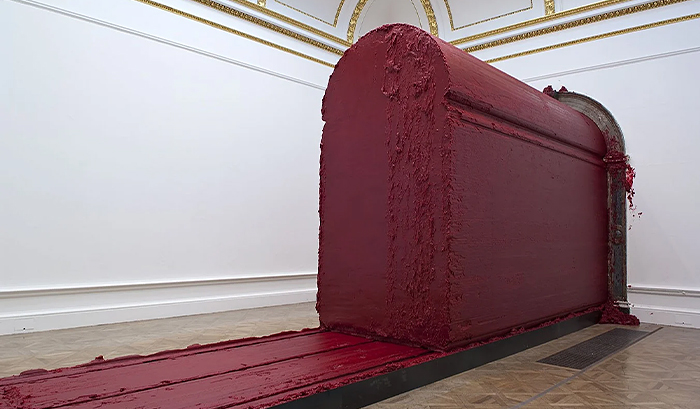
1 This process of change can be traced back to Svayambhu (2007): in Sanskrit, this means self-born/self-formed. In this iconic installation, a massive block made of blood-red beeswax, carried by a motorised mechanism moving along tracks laid out between the spaces,is slowly guided through the gallery’s doors and arches. As the block passes through the doors, it is shaved down, leaving behind crushed, shapeless remnants of beeswax.
2 See. https://www.lissongallery.com/exhibitions/anish-kapoor–13
3 Anish Kapoor, Ha Makom, (Mother as a Mountain, My Red Homeland III, As if to Celebrate I Discovered a Mountain Blooming with Red Flowers), 2026, Mixed media and pigment, Dimensions variable © Anish Kapoor. (https://anishkapoor.com/9676/ha-makom) image: Anish Kapoor, Ha Makom, 2026. © Anish Kapoor. All rights reserved, DACS, 2026. Photo: Dave Morgan.
4 Anish Kapoor, Mount Moriah at the Gate of the Ghetto (2022), Mixed Media and pigment; 13,8 × 6,8 × 3,9 metre. (image: Mount Moriah at the Gate of the Ghetto 2022, Photograph: Attilio Maranzano ©Anish Kapoor. All rights reserved, DACS, 2026.
5 See. Louisa Buck, “Anish Kapoor: Just because a thing is big, it doesn’t mean it’s of any interest or even good”, The Art Newspaper, 15 Haziran 2026. (https://www.theartnewspaper.com/2026/06/15/anish-kapoor-just-because-a-thing-is-big-it-doesnt-mean-its-of-any-interest-or-even-good)
CURRENT EXHIBITIONS / 2025 – 2027
ANISH KAPOOR at Saglamart (ENGLISH)
gülay yaşayanlar: mount moriah at the gate of the ghetto
gülay yaşayanlar: all of nothing: elliptical fluid-blood pockets that contain the waste products of the soul
mümtaz saglam: anish kapoor 2
mümtaz saglam: anish kapoor 3
ANISH KAPOOR at Saglamart (TURKISH)
gülay yaşayanlar: mount moriah at the gate of the ghetto
gülay yaşayanlar: all of nothing: ruhun atıklarını barındıran eliptik sıvı-kan torbaları
mümtaz saglam: anish kapoor: kütle, yanılsama ve boşluk
RECENT WORKS
HIGHLIGTS
PALAZZO MANFRIN / ANISH KAPOOR FOUNDATION – VENICE
SELECTED BOOKS AND POSTERS
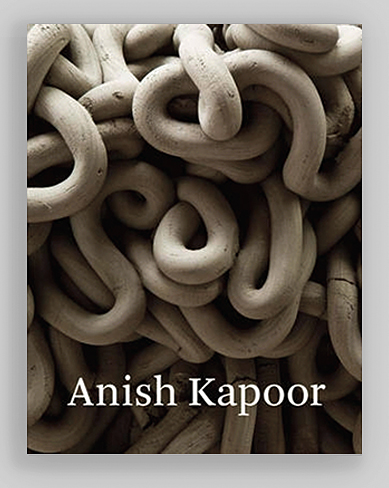
Anish Kapoor
Texts by Ralph Rugoff; Anish Kapoor; Nancy Spector; Julia Kristeva; Sandhini Poddar, Exhibition catalogue, Hayward Publishing, London, 2026
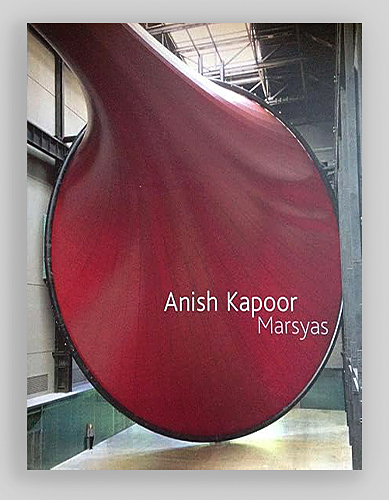
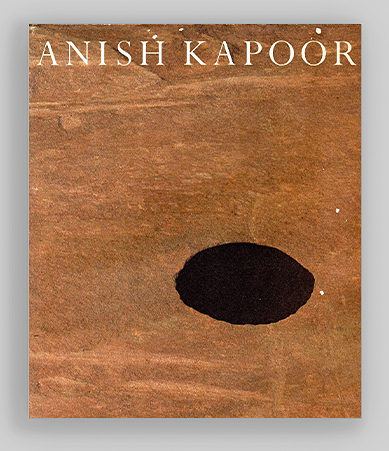
Anish Kapoor: Marsyas
Texts by Donna de Salvo and Cecil Balmond, Exhibition catalogue, Tate Publishing, 2002, ISBN 9781854374417
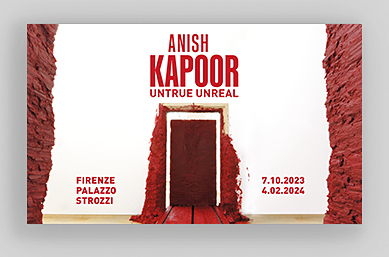
Anish Kapoor: Untrue Unreal, Texts by Arturo Galansino, Daeio Donetti, Tommaso Maozzati. Francesca Borgo, Racel Boyd, Morgan Ng, Diane H. Bodart, Exhibition catalogue, Italian and English editions, Marsillio Editori, Venezia, Italy, 2023
Anish Kapoor: Flashback
Texts by Michael Bracewell and Andrew Renton
Exhibition catalogue, Hayward Publishing, 2011
ISBN 9781853322884
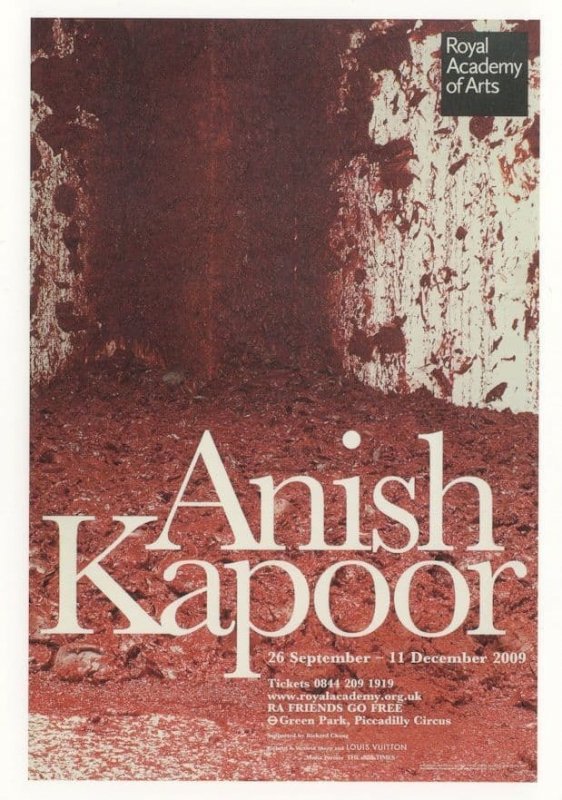
Anish Kapoor
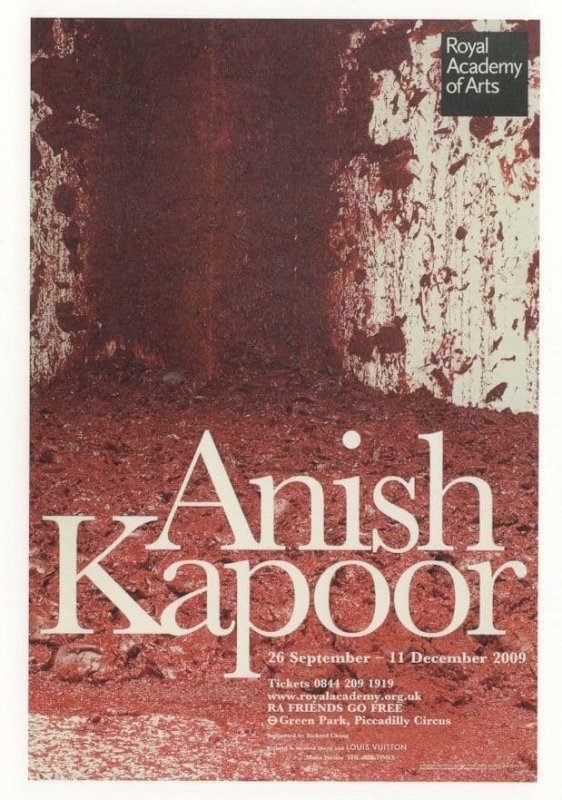
Texts by Homi K. Bhabha, Jean de Loisy and Norman Rosenthal, Exhibition catalogue, Spanish and English editions, Royal Academy of Arts, London, 2009. ISBN 9781905711512
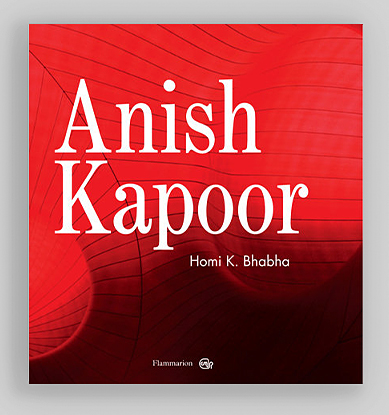
Anish Kapoor
Text by Homi K. Bhabha, Contributions by Homi Bhabha, Introduction by Jean de Loisy, Hardcover, Flammarion, 2011
ISBN 9782080200839
BIOGRAPHY
ANISH KAPOOR 2026 – MAIN PAGE
saglamart; dinamik bir anlayış ile hareket eden, kültür-sanat ortamındaki olay ve olgulara, sanatçı tavırlarına, yapıtlara ve yayınlara odaklanan bağımsız bir yayın etkinliğidir. Tüm hakları saklıdır. Görüntü ve yazılar izinsiz kullanılamaz. / saglamart is an independent publishing initiative driven by a dynamic vision, focusing on events and developments in the cultural-artistic landscape, artist perspectives, works, and publications. All rights reserved. Images and texts cannot be used without permission.