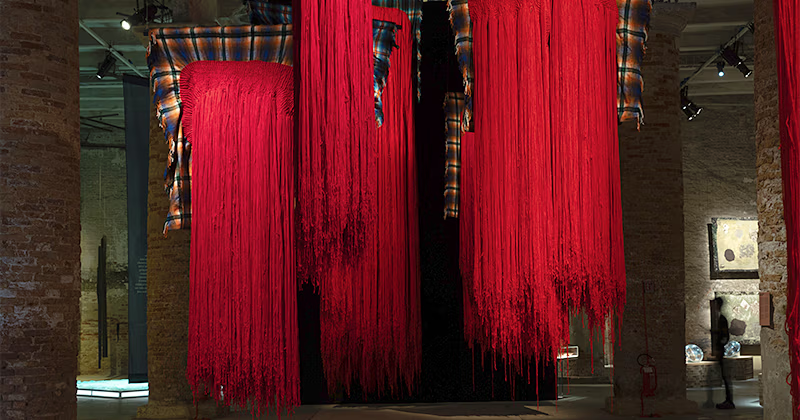
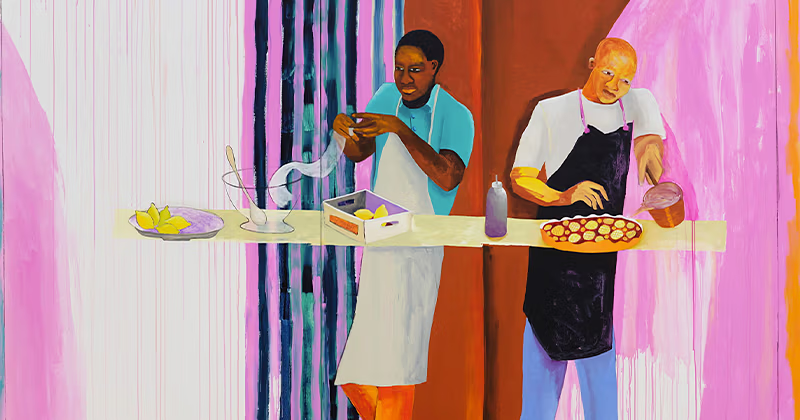
Dyson Torkwase, Tougaloo, 2026, (Detail), Installation: acrylic, graphite, glass on board with immersive sound, 61. Esposizione Internazionale d’Arte – La Biennale di Venezia, In Minor Keys, 61st International Art Exhibition – La Biennale di Venezia, In Minor Keys, Photo by Luca Zambelli Bais, Courtesy: La Biennale di Venezia

in minor keys

a black diasporic energy

BY GÜLAY YAŞAYANLAR

"

KOYO KOUOH, WHILST PROBLEMATISING THE INVISIBLE ASPECTS OF THIS TRAUMATIC PROCESS THAT REMAIN BENEATH THE SURFACE, INTEGRATES FRAGMENTED LINGUISTIC ELEMENTS, MAKING SPACE FOR THE CHARACTERISTIC EMPHASES THAT BRING THE REPRESSED TO LIGHT BY DRAWING THEM INTO THE ARTISTS’ SPHERE OF ACTION. FURTHERMORE, BY ANTICIPATING SUCH COMPLEX INSTALLATION PRACTICES, HE SETS IN MOTION THE DESTRUCTIVE INNER FORCES ANCHORED DEEP WITHIN, WHILST MAGICALLY RENDERING VISIBLE HIS STATEMENTS REGARDING THE POWER OF A DIASPORIC ENERGY THAT REPRESENTS DIFFICULT TIMES.

Carolina Caycedo

Carolina Caycedo, When You Take From Mother Earth You Can Give Back By Sprinkling Tobacco (Ella), 2023, Jacquard weaving, UV acrylic printed cotton twill, wood, loose tobacco,Tapestry: 127 × 91.4 cm; wood table: 10.2 × 116.8 × 116.8 cm, 61st International Art Exhibition – La Biennale di Venezia, In Minor Keys, Photo by Luca Zambelli Bais, Courtesy: La Biennale di Venezia 

The possibility that the semantic range of In Minor Keys, designated as the central theme of Biennale Arte 2026, might undergo a linguistic transformation foregrounding individuality and local connections, and thereby become capable of expressing itself with a synthesizing spirit, confronts us with a phenomenon shaped by new psychogeographic inquiries. The conceptual coherence that Koyo Kouoh consciously establishes through the lens of female and Black identity, alongside shared registers of language and meaning, lends the constructed intellectual framework a new aesthetic dimension and generates a fresh current of energy.

We find ourselves at a juncture where artistic practices, particularly those that have come to the fore in recent years as forms of political action and production, are positioned as the sensitive outcomes of consistent experiences and relational efforts that have crystallized into a form of collective resistance. This is evident in the many instances where artistic practices grounded in states of vulnerability and precarity are woven into the narratives of production as acts of sensory engagement and as stimuli of memory within the emerging conceptual map of Biennale Arte 2026.

branching minor phantasms

It is genuinely remarkable that a Black diasporic energy should constitute the biennale’s spirit, one that resonates across every space of the Arsenale, and that it should produce the coherence of a profound collective installation conceived as a field of experience. Equally noteworthy, within this same context, is the way in which singular yet intimate spaces, structured within an entirely complex order and contaminating one another, are transformed into what might be called “representations of distilled thought.” Here, the local markers of belonging, composed predominantly of woven and textile works as products of labor and kept alive through cultural connection, visibly reflect a resistance that has been symbolically elevated in the name of visibility. Such primordial things, which carry the secret of the exhibited works, their bond with truth, their authenticity, and their causality, become fragments of a depth concerned with the representation of belonging. In this context, Koyo Kouoh has, it seems, orchestrated a metaphysical sublimation by departing from the presence and sanctity of a Black energy, and has evidently taken care to allow the psychotic qualities latent within the works to surface through this process. In this way, within a field of struggle engaged with minor things, a potential distribution of intensity is achieved through concept-images that have become autonomous and enter into collision, and the protestatory and nihilistic character of a tendency toward togetherness is brought compellingly into view. The minor phantasms that reverberate through the Arsenale thus branch and proliferate within themselves, projecting outward the erased or lost images that have been pushed into the depths. In this process, the presence and diversity of imaginative possibilities concerning how depressive images, which attach themselves to a shared unconscious and are transformed into objects of representation, might cling to a chain of originary memory, is of particular importance.

Koyo Kouoh’s capacity for empathy precedes, at its core, a collective adhesion that clarifies the positions of the paradoxical and libidinal deviation reached in the details. In this respect, it is inevitable that In Minor Keys should become a dense accumulation of multiple images, assuming the guise of an object-representation that deepens from within while at times becoming estranged from its own domain. At precisely this point, the constitutive elements of the art object are perhaps obliged to contaminate or adhere to an ambiguous signifier through the meaning-components they generate. It is therefore not at all surprising that certain object-representations within the biennale, those that exceed Kouoh’s conceptual registers, should devolve into a brutally labor-intensive form in which only surfaces are patterned.

a critical and ironic imaginary

It is worth noting, moreover, that in the production of art as a form of political action, dramatic dance and processional performances enriched by spiritual impetus reveal the emotional and introverted dimensions of this field of experience, one that is collectively constituted and rapidly drawn toward a speculative expressivity. A space has thus been created here in which socio-cultural and provocative ethical values are enacted in accordance with Kouoh’s critical and ironic imaginary, in which differing modes of thought that interrogate prevailing strategies of representation are given visual form, and in which a great deal shaped by the pursuit of a transforming imagination is shared.

In this post-traumatic environment, where debates on identity and belonging are inflamed by what is expressed and signified, the emphasis placed on vulnerability and precarious times is of particular significance. The fact that a general emotionality, born of hesitant and tense living, at times evolves into new narrative forms through the presence of a layered diasporic fragility, is plainly apparent in this context.

As Koyo Kouoh problematizes the invisible dimensions of this traumatic process that remain submerged, she integrates fragmented linguistic elements and creates space for the characteristic emphases of artists, drawing them into the field of action and bringing the repressed to light. Furthermore, by anticipating such complex installative practices, she sets into motion the destructive interiorities lodged deep within, while making visible, in an almost enchanting manner, her declarations concerning the power of a diasporic energy that represents times of hardship.

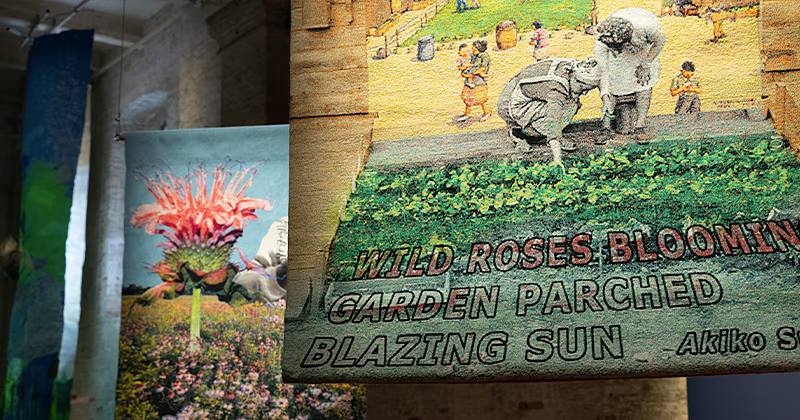
Prof. Gülay Yaşayanlar  / Copyright © June 2026, All rights reserved.

IN MINOR KEYS: a great work created through collectIve ImagInatIon

The curatorial text penned by Koyo Kouoh is an invitation to confront the fleeting physical, meteorological and environmental conditions you encounter, to slow down, and to attune yourself to the frequencies of minor keys. For, although they are often lost amidst the clamour of the chaos currently ravaging the world; the songs of those who create beauty despite tragic events, the melodies of survivors emerging from the ruins, and the harmonies of those mending wounds and worlds continue. In music, the minor key points to both the structure of a song and its emotional impact. It is such a rich concept that it swiftly transcends its technical definition and overflows with metaphors. It evokes moods, dialogue, lament, allegory and whispers. It comes to life in quiet tones, low frequencies, murmurs, the solace of poetry, and the doors of improvisation that open onto another and the other world. Minor keys demand a listening that stirs emotions and supports them reciprocally.

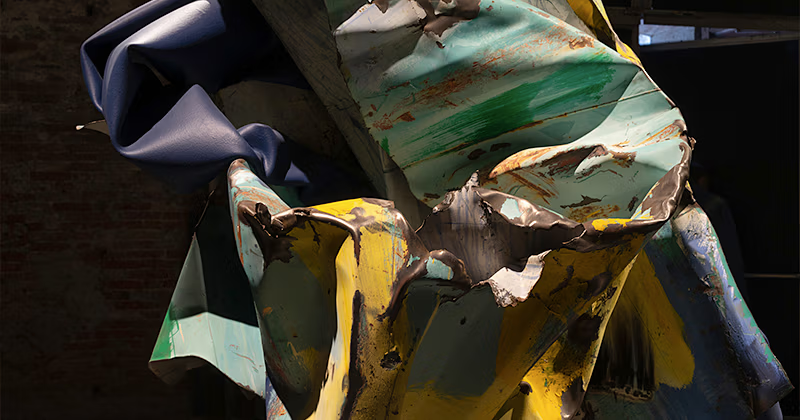
1– Senzei Maresela, (South Africa), Wall Reefs 104, Detail, 1995-2025, Arsenale, Photo by Luca Zambelli Bais  2- Valid Raad, Far from quieting – Kuwait, Detail, Arsenale, Photo by Marco Zorzanello  3– Marcia Kure, Roadkill III, 2025-2026, Detail, Arsenale, Photo by Andrea Avezzù  4– Kenedy Yanko (USA), Disciples of joy in the material world, 2025, Detail, Arsenale, Photo by Luca Zambelli Bais  5- Sahrap Hura, (India), Things Felt But Not Quite Expressed and Timeless, 2026, Installation view, Arsenale-Giardini, Photo by Andrea Avezzù  6- Georgina Maxim, (Zimbabwe) Borrowed books and underlined statements, 2023-2026, Detail, Arsenale-Giardini, Photo by: Marco Zorzanello, © 61st International Art Exhibition, La Biennale di Venezia, In Minor Keys, Courtesy of La Biennale di Venezia

LA BIENNALE DI VENEZIA 61ST INTERNATIONAL ART EXHIBITION, “IN MINOR KEYS” BY KOYO KOUOH

La Biennale di Venezia, 61st Internation Art Exhibition (Main Page)
la biennale di venezia, in minor keys by koyo kouoh (press release summary)​
in minor keys by koyo kouoh (press release summary) a monumental work built through collective imagination​

3 essays on Kouoh’s curatorIal approach

GÜLAY YAŞAYANLAR / in minor keys by koyo kouoh: a black diasporic energy
GÜLAY YAŞAYANLAR / in minor keys by koyo kouoh: complex and fragile formations that unsette the present
MÜMTAZ SAĞLAM / in minor keys: on new ways of thinking and creating, or the possibilities of fragile connections

NATIONAL PARTICIPATIONS AND SELECTED TWO PAVILIONS

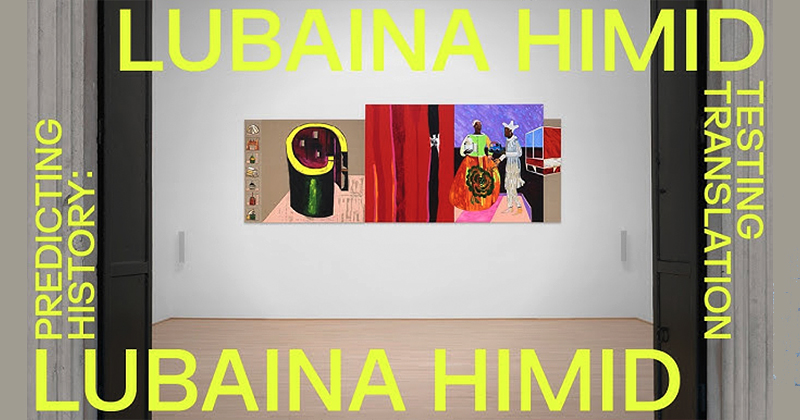
british pavilion: lubaine himid: predicting history: testing translation ​
Lubaina Himid Prediction History Testing Translation 1
GÜLAY YAŞAYANLAR / british pavilion: lubaine himid: predicting history: testing translation
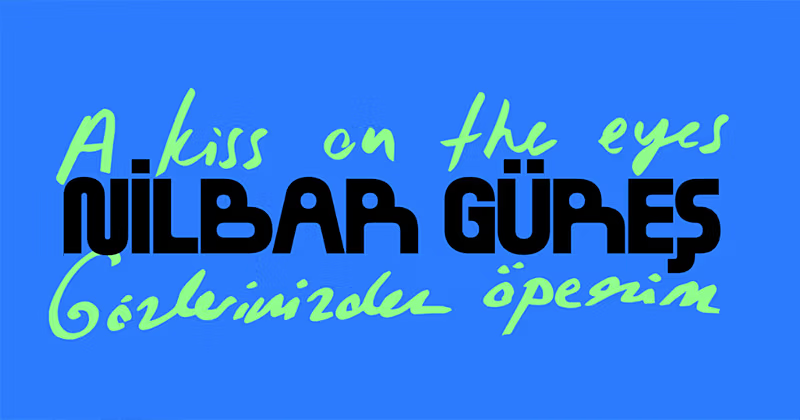
Nilbar Güreş: Land
GÜLAY YAŞAYANLAR / türkiye pavilion: nilbar güreş: A kiss on the eyes: land​

AROUND VENICE / COLLATERAL EVENTS  

NATIONAL PARTICIPATIONS / ULUSAL KATILIMLAR

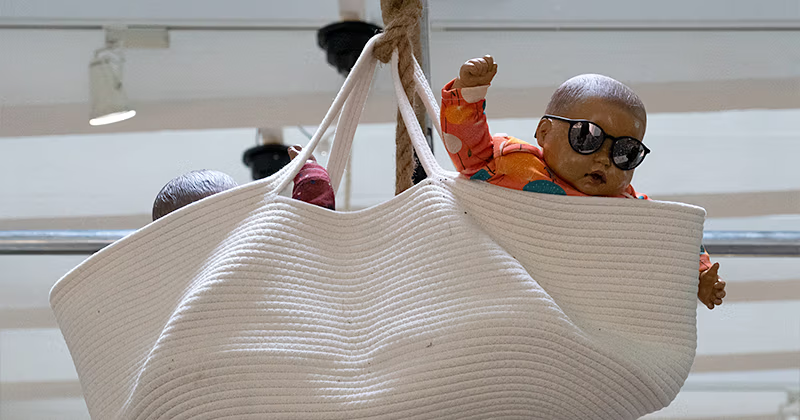
1– Ei Arakawa-Nash, Grass Babies, Moon Babies, 2026, Installation View, Japan Pavilion, Giardini, Photo by Luca Zambelli Bais  2– Florentina Holzinger, Seeworld Venice, 2026, Installation View, Austria Pavilion, Giardini  3- Lubaina Himid, (British Pavilion), Chefs, Detail, Acrylic and charcoal on linen, 2025, Giardini 4Henrike Naumann and Sung Tieu, Ruin, 2026, Installation View, Germany Pavilion, Giardini  5- Oriol Vilanova Los Restos, Installation View, Spain Pavilion, Giardini, Photo by Jacopo Salvi  6- Roberto Diago, Hombres Libres, 2025, Installation View, Cuba Pavilion, Giardini, Photo by Clelia Cadamuro,  © 61st International Art Exhibition, La Biennale di Venezia, In Minor Keys, Courtesy of La Biennale di Venezi

Launched in 2026 under the title ‘In Minor Keys’, the exhibition brings together artists, collectives and national pavilions that reflect forms of coexistence, memory, fragility, and the relationships shaped by sound, material and lived experience. The national pavilions, the majority of which are located in the Giardini, with others in the Arsenale and various locations across the city of Venice, offer thoughtful perspectives linked to more contemporary concerns. Whilst national pavilions remain an official exhibition format through which each country presents its culture, artistic vision and perspective on global issues via its appointed official curator and selected artists, they have increasingly evolved into more independent, grandiose and immersive installations.

CATALOGUE

The official catalogue of the 61st Venice Biennale is a significant publication comprising two distinct sections: one dedicated to the international exhibition curated by Koyo Kouoh, and the other to national contributions and parallel events. The pages devoted to the artists feature sketches and images documenting the creative process, which convey the ideas behind the exhibited works, as well as a comprehensive short essay. The essays on artistic practices further enrich this publication with diverse perspectives. Eight original articles addressing current issues regarding thematic contexts and curatorial practices (written by Tandazani Dhlakama, Adrienne Edwards, Stefanie Hessler, Miguel A. López, Hélio Menezes, Wanda Nanibush, Oluremi C. Onabanjo and Françoise Vergès) are included. Meanwhile, five original articles by Ken Bugul, Teju Cole, Natalie Diaz, Frieda Ekotto and Abdaljawad Omar, which contribute to the intellectual coherence of the exhibitions, also attract particular attention.

Biennale Arte 2026, In Minor Keys, Catalogue / English, 2 Volumes, 21 X 27 Cm, Pages: Vol. I 720 Ca. / Vol. Ii 254 Ca., Paperback, Graphic Design: Clarissa Herbst And Alex Sonderegger.

Biennale Arte 2026, In Minor Keys, Short Guide / English, 15 X 20 Cm, Pages: 552 pages, paperback, Graphic Design: Clarissa Herbst And Alex Sonderegger. 

BIOGRAPHY

Koyo Kouoh. Photo- Mirjam Kluka

Koyo Kouoh, Photo by Mirjam Kluka

KOYO KOUOH

(24 December 1967, Cameroon – 10 May 2025, Switzerland)

For many years, he served as director and chief curator of the Zeitz Museum of Contemporary African Art (Zeitz MOCAA) in Cape Town. Prior to this role, he served as founding artistic director of the RAW Material Company in Dakar, Senegal, which has become a hub for art, knowledge and community. He was also a member of the curatorial teams for documenta 12 (2007) and documenta 13 (2012). Kouoh is the recipient of the 2020 Meret Oppenheim Grand Prize, Switzerland’s most prestigious art award, which honours achievements in the fields of art, architecture, criticism and exhibition curation. She has organised contemporary and influential exhibitions such as *Body Talk: Feminism, Sexuality and the Body in the Works of Six African Women Artists* (2015, Wiels, Brussels). During her tenure at Zeitz MOCAA, she organised significant solo exhibitions focusing on African and African-descended artists. In this context, she curated exhibitions featuring artists such as Otobong Nkanga, Johannes Phokela, Senzeni Marasela, Abdoulaye Konaté, Tracey Rose and Mary Evans. She divides her time and work between Cape Town, Dakar and Basel.

LA BIENNALE DI VENEZIA / yeni düşünme ve üretme biçimleri ya da kırılgan temas olasılıkları üzerine

İZMİR - LONDON

saglamart; dinamik bir anlayış ile hareket eden, kültür-sanat ortamındaki olay ve olgulara, sanatçı tavırlarına, yapıtlara ve yayınlara odaklanan bağımsız bir yayın etkinliğidir. Tüm hakları saklıdır. Görüntü ve yazılar izinsiz kullanılamaz. / saglamart is an independent publishing initiative driven by a dynamic vision, focusing on events and developments in the cultural-artistic landscape, artist perspectives, works, and publications. All rights reserved. Images and texts cannot be used without permission.

Copyright ©
Can Sağlam - Gülay Yaşayanlar Mümtaz Sağlam, 2026.