Image: Venice © Peggy Guggenheim Collection, Venice. Photo: Matteo De Fina
María Magdalena Campos-Pons + Kamaal Malak, Anatomy of the Magnolia Tree for Toni Morrison, 2026, Installation view, Aches archival paper, inkjet print, watercolour, ink, gouache on 4, framed panels, 335 × 305.3 × 4 cm. ©Venice Biennale 2026. Photo by Andrea Avezzù.jpg
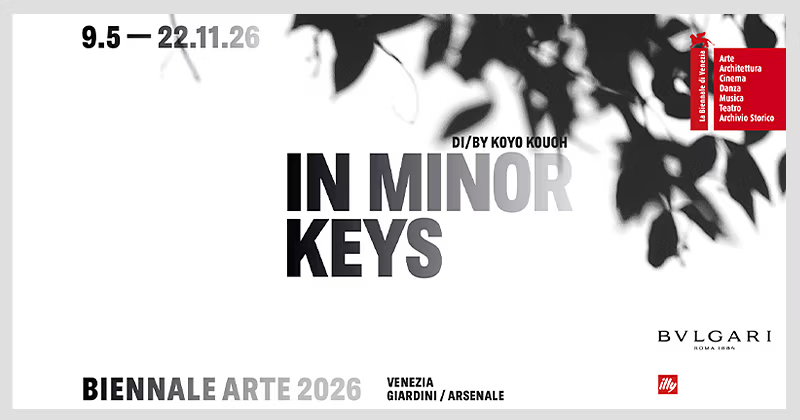
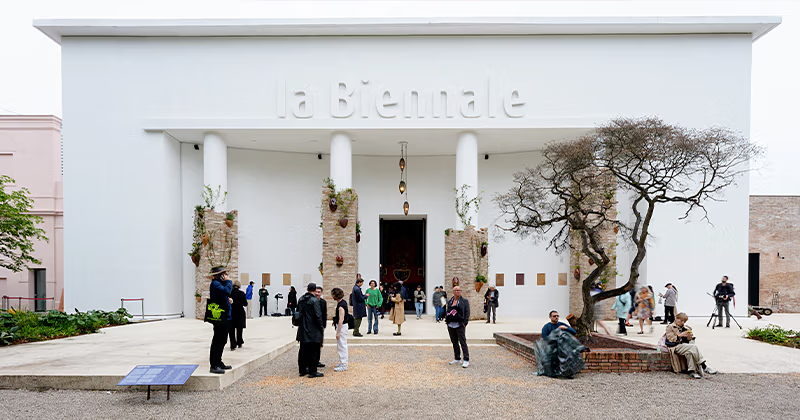
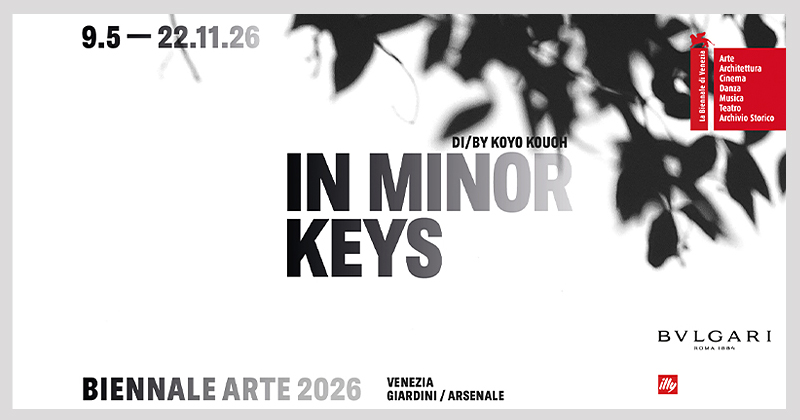
The 61st International Art Exhibition of the Venice Biennale opened on 9 May 2026. The exhibition, which will run through 22 November 2026 across the Giardini, the Arsenale, and various venues throughout Venice, was realized by the curatorial team in accordance with the vision of curator Koyo Kouoh, who passed away in 2025. For the 61st International Art Exhibition, Kouoh invited 110 artists and collectives from numerous geographies and regions, selected with an attention to resonances and affinities rather than potential inconsistencies between practices. Through her inquiry into how their creativity, the breadth of their material experiments, and their visionary ideas simultaneously forge connections with other artists and movements, Kouoh worked toward the idea of a relational geography made possible through a shared spirit.
theoretical framework: in minor keys
Appointed as Artistic Director in November 2024, Koyo Kouoh developed the curatorial project, defined its theoretical framework, selected the artists and works, appointed the catalogue authors, and determined both the graphic identity of the exhibition and the architecture of the exhibition spaces. As stated in Kouoh’s curatorial text, the title she chose for the 61st International Art Exhibition was In Minor Keys. In order to structure the exhibition, motifs and foundations were established upon which it would be built; enchantment, seeding, conviviality, and generative practices inviting collectivities were foregrounded as the organic concepts and concerns that would serve as its carriers. The exhibition took shape through an intensive, multilayered, and deeply shared process, enriched by the collective construction efforts of the curatorial team.
The pages of the publication titled In Minor Keys, which Kouoh prepared and submitted to the Biennale’s administration, offer a striking perspective on curatorial practice and articulate, with crystalline clarity, her vision of exhibition-making. Kouoh presents this concept through the idea of planting seeds. This is an exhibition filled with spirit and with the sacred; it returns the human being, existence itself, to the heart of all things, rediscovering the meaning of being in the world by honoring all earthly elements, regaining a sense of proportion, and once again looking toward the sky. It invites us to see that small things can simultaneously be great things, great enough to serve as the measure of everything. It also offers a series of keys that return us to the earth, to our bodies, and to our senses.
Kouoh predetermined the various concepts guiding the exhibition, motifs distilled from a body of art with a profound effect on spirit and mind. Among these, Shrines surpass any retrospective impulse; ceremonial gatherings are present; so too is enchantment as a counterpoint to skepticism about what art can do; and Shrines represent the spiritual and physical rest opened by artists’ universes, conceived as keys or small islands. Kouoh’s commitment to artist-centered institution building, or Schools, occupies a distinct place in this sequence; here, available energy and resources are directed toward a social purpose. Schools thus emerge as ecosystems rooted in local contexts yet operating on an international scale. Conceived as spaces of encounter, knowledge-sharing, and learning and renewal that remain independent of market forces, the concept of Schools is foregrounded and valued, integrated into the exhibition as a whole.
the international exhibition: a grotesque and carnivalesque dimension
Meanwhile, the procession motif, rendered emphatic through the international exhibition and drawing inspiration from carnival choreographies and Afro-Atlantic encounters, articulates a dynamic spatial language in which joining the crowd is a necessary and implied element rather than a matter of mere observation. Within this carnivalesque dimension, capable of suspending and overturning hierarchies, numerous artistic practices challenge archives and canons, reinterpret established symbols, and demystify dominant narratives through transhistorical, speculative, or rigorous approaches.
Themes such as the plantation, colonial settlement, environmental catastrophe, and geological memory extend to other works that confront seismic events and their traces through radical and liberatory methods. At the same time, gardens and courtyards, conceived as spaces of self-sufficiency born under conditions of constraint, become places of rest, reconnection, and engagement with non-human forms of life, both literally and metaphorically. The exhibition ultimately reflects the possibility of stepping back from the encyclopedic impulse and opening space for rest, contemplation, and deep listening. Sensory installations, alongside performances, invite visitors to slow down and allow themselves to be transformed by experience, encouraging dreaming and enchantment. With its oases evoking studios, courtyards, and spaces of learning, In Minor Keys conveys the freedom of a project spirit that brings together collaboration, generosity, and trust in relation to the multidimensional dimensions of humanity.

NOTES
♠
This text is a summary of the press release issued by the Biennale Committee. See. https://www.labiennale.org/en/news/biennale-arte-2026-minor-keys-0
♠♠
In early 2025, Cape Town-based Wolff Architects was commissioned by Koyo to design and curate the exhibition layout for In Minor Keys. The team focused on the transformative spatial power of the threshold as a gateway to alternative understandings and experiences. The ingenuity of their design lies in its generosity toward each artist’s universe and the sensory experience that can unfold within the constellations of practice. In the Central Pavilion at the Arsenale and in the Giardini, thresholds are marked by vast indigo drapes that reach up to the beams and touch the floor, calming the senses at the culmination of one phase and marking the opening of another.
Notes
1- La Biennale di Venezia 61st International Art Exhibition, “In Minor Keys” by Koyo Kouoh, Venice (Giardini – Arsenale) May 9 – November 22, 2026, Venice.
2- Curatorial team: Gabe Beckhurst Feijoo, Marie Hélène Pereira ve Rasha Salti (Art advisors), Siddhartha Mitter (Chief editor) ve Rory Tsapayi (Research assistant).
3- As enchantment, seeding, commoning and generative practices that invite collectivities.
Prepared by Gülay Yaşayanlar & Mümtaz Sağlam / Copyright © June 2026, All rights reserved.
IN MINOR KEYS: a great work constructed through collectIve ImagINatIon
The curatorial text penned by Koyo Kouoh is an invitation to confront the fleeting physical, meteorological and environmental conditions you encounter, to slow down, and to attune yourself to the frequencies of minor keys. For, although they are often lost amidst the clamour of the chaos currently ravaging the world; the songs of those who create beauty despite tragic events, the melodies of survivors emerging from the ruins, and the harmonies of those mending wounds and worlds continue. In music, the minor key points to both the structure of a song and its emotional impact. It is such a rich concept that it swiftly transcends its technical definition and overflows with metaphors. It evokes moods, dialogue, lament, allegory and whispers. It comes to life in quiet tones, low frequencies, murmurs, the solace of poetry, and the doors of improvisation that open onto another and the other world. Minor keys demand a listening that stirs emotions and supports them reciprocally.
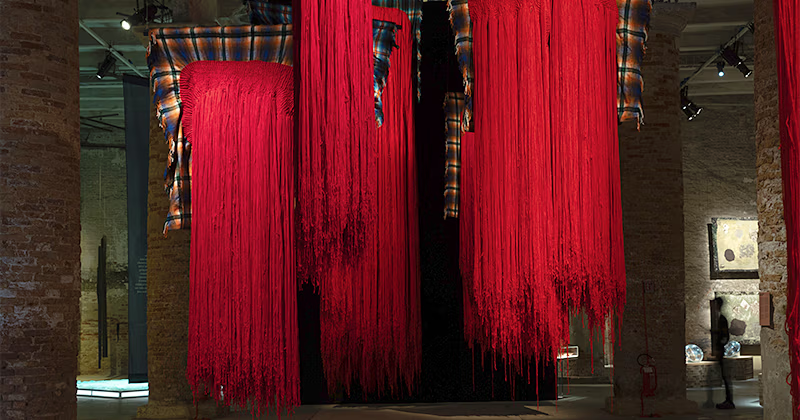
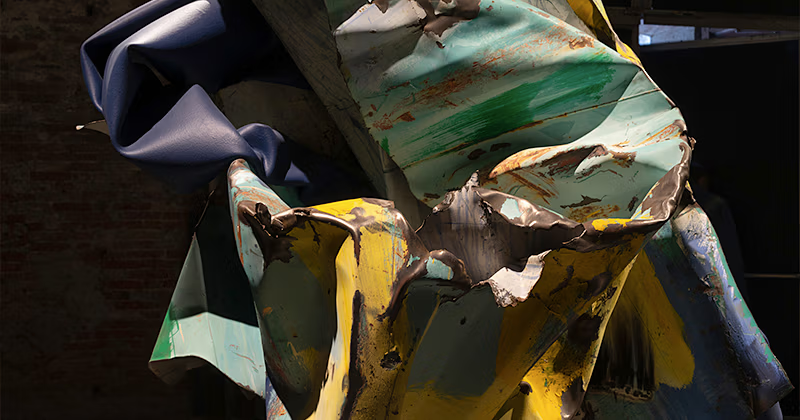
1– Senzei Maresela, (South Africa), Wall Reefs 104, Detail, 1995-2025, Arsenale, Photo by Luca Zambelli Bais 2- Valid Raad, Far from quieting – Kuwait, Detail, Arsenale, Photo by Marco Zorzanello 3– Marcia Kure, Roadkill III, 2025-2026, Detail, Arsenale, Photo by Andrea Avezzù 4– Kenedy Yanko (USA), Disciples of joy in the material world, 2025, Detail, Arsenale, Photo by Luca Zambelli Bais 5- Sahrap Hura, (India), Things Felt But Not Quite Expressed and Timeless, 2026, Installation view, Arsenale-Giardini, Photo by Andrea Avezzù 6- Georgina Maxim, (Zimbabwe) Borrowed books and underlined statements, 2023-2026, Detail, Arsenale-Giardini, Photo by: Marco Zorzanello, © 61st International Art Exhibition, La Biennale di Venezia, In Minor Keys, Courtesy of La Biennale di Venezia
LA BIENNALE DI VENEZIA 61ST INTERNATIONAL ART EXHIBITION, “IN MINOR KEYS” BY KOYO KOUOH
NATIONAL PARTICIPATIONS AND SELECTED TWO PAVILIONS
AROUND VENICE / COLLATERAL EVENTS
READ MORE
CATALOGUE
The official catalogue of the 61st Venice Biennale is a significant publication comprising two distinct sections: one dedicated to the international exhibition curated by Koyo Kouoh, and the other to national contributions and parallel events. The pages devoted to the artists feature sketches and images documenting the creative process, which convey the ideas behind the exhibited works, as well as a comprehensive short essay. The essays on artistic practices further enrich this publication with diverse perspectives. Eight original articles addressing current issues regarding thematic contexts and curatorial practices (written by Tandazani Dhlakama, Adrienne Edwards, Stefanie Hessler, Miguel A. López, Hélio Menezes, Wanda Nanibush, Oluremi C. Onabanjo and Françoise Vergès) are included. Meanwhile, five original articles by Ken Bugul, Teju Cole, Natalie Diaz, Frieda Ekotto and Abdaljawad Omar, which contribute to the intellectual coherence of the exhibitions, also attract particular attention.
Biennale Arte 2026, In Minor Keys, Catalogue / English, 2 Volumes, 21 X 27 Cm, Pages: Vol. I 720 Ca. / Vol. Ii 254 Ca., Paperback, Graphic Design: Clarissa Herbst And Alex Sonderegger.
Biennale Arte 2026, In Minor Keys, Short Guide / English, 15 X 20 Cm, Pages: 552 pages, paperback, Graphic Design: Clarissa Herbst And Alex Sonderegger.
BIOGRAPHY
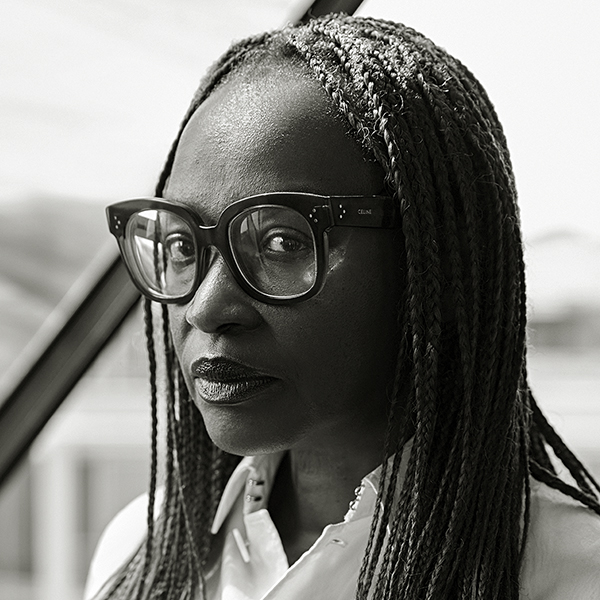
Koyo Kouoh, Photo by Mirjam Kluka
KOYO KOUOH
(24 December 1967, Cameroon – 10 May 2025, Switzerland)
For many years, he served as director and chief curator of the Zeitz Museum of Contemporary African Art (Zeitz MOCAA) in Cape Town. Prior to this role, he served as founding artistic director of the RAW Material Company in Dakar, Senegal, which has become a hub for art, knowledge and community. He was also a member of the curatorial teams for documenta 12 (2007) and documenta 13 (2012). Kouoh is the recipient of the 2020 Meret Oppenheim Grand Prize, Switzerland’s most prestigious art award, which honours achievements in the fields of art, architecture, criticism and exhibition curation. She has organised contemporary and influential exhibitions such as *Body Talk: Feminism, Sexuality and the Body in the Works of Six African Women Artists* (2015, Wiels, Brussels). During her tenure at Zeitz MOCAA, she organised significant solo exhibitions focusing on African and African-descended artists. In this context, she curated exhibitions featuring artists such as Otobong Nkanga, Johannes Phokela, Senzeni Marasela, Abdoulaye Konaté, Tracey Rose and Mary Evans. She divides her time and work between Cape Town, Dakar and Basel.
saglamart; dinamik bir anlayış ile hareket eden, kültür-sanat ortamındaki olay ve olgulara, sanatçı tavırlarına, yapıtlara ve yayınlara odaklanan bağımsız bir yayın etkinliğidir. Tüm hakları saklıdır. Görüntü ve yazılar izinsiz kullanılamaz. / saglamart is an independent publishing initiative driven by a dynamic vision, focusing on events and developments in the cultural-artistic landscape, artist perspectives, works, and publications. All rights reserved. Images and texts cannot be used without permission.