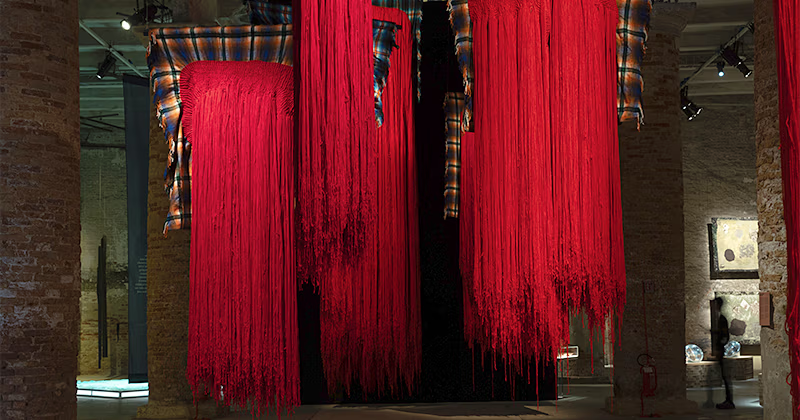
Image: Wangechi Mutu, SimbiSiren, 2026, Exhibition view, 61st International Art Exhibition-La Biennale di Venezia, In Minor Keys, Arsenale, Photo by Marco Zorzanello, Courtesy: La Biennale di Venezia
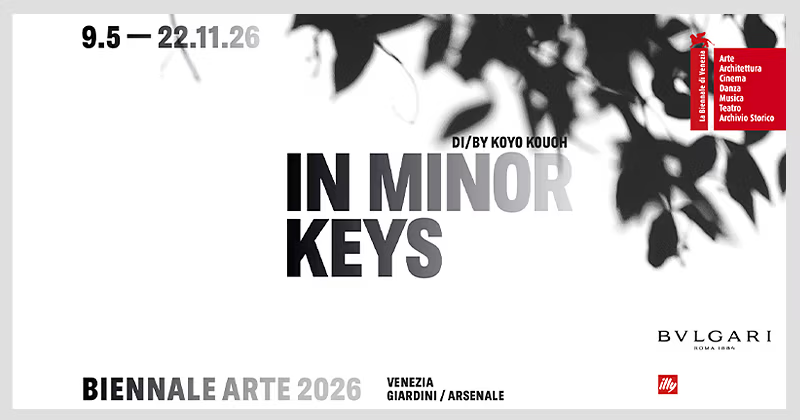
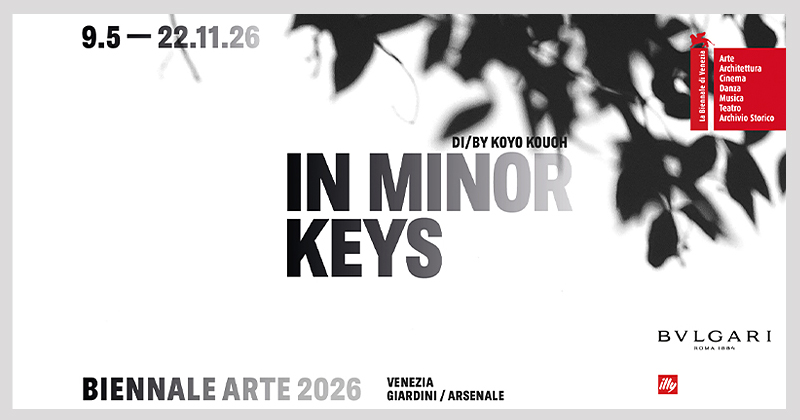
The visual identity and catalogue design for Biennale Arte 2026, created in collaboration with Clarissa Herbst and Alex Sonderegger, draws inspiration from the Japanese term komorebi, which expresses the shifting and mottled effect of light filtering through leaves to convey the sense of relaxation felt in the shade of a tree. Rendered in shades of gray with subtle tonal transitions that balance ephemerality and permanence, the design appears to possess a clarity and impact that evokes natural and cosmic modes of perception across posters, signage, and moving textile banners.
In Minor Keys is an invitation to confront the immediate physical, meteorological, and environmental conditions we encounter, to shift into a slower tempo, and to attune ourselves to the frequencies of minor tonalities. For even if they are so often lost in the noise of the chaos that ravages the world, the songs of those who produce beauty in the face of tragic developments, the melodies of those who have escaped the rubble, and the harmonies of those who mend wounds and worlds, continue to sound.
In music, the minor key refers both to the structure of a composition and to its emotional effects. It is so rich an idea that it rapidly exceeds its technical definition and overflows with metaphor. It evokes moods, antiphony, lament, allegory, and whisper. Keeping its distance from ostentation, it comes alive in quiet resonances, low frequencies, murmurs, the consolations of poetry, and the doorways that improvisation opens onto other and otherworldly realms. Minor tonalities call for a listening that moves emotions and sustains them in reciprocity.
Minor tonalities also define small islands and worlds possessing ecosystems of singular and inexhaustible richness, shaping social lives within the framework of political and ecological concerns. An exhibition attuned to minor tonalities is a production that invites us to listen to the enduring signals of the earth and of life, and to connect with the frequencies of the spirit. While in music minor tonalities are generally associated with strangeness, melancholy, and grief, here their joy, consolation, hope, and transcendence also make themselves felt. They carry the rhythms, melodies, and silences of worlds that resonate on the basis of sound and sensation; these worlds come together to form a polyphonic artistic community, gathering and communicating within a joyful collectivity, and making felt the void of alienation and conflict.
mixing languages and expressions that share a common proposition
Biennale Arte 2026 is, in this context, grounded in a deep conviction that artists are vital interpreters of the social and spiritual condition and catalysts for new relationships and possibilities. The compositional structure of the exhibition consists of artistic practices understood as free and informal, encouraging relationships and connections and developing concept and form. The intended effect here is to mix, in the manner of improvisation, the consonance and dissonance of communities that share a common proposition. It is to offer visitors, through relationship, sharing, and transcendence, and across methods, scales, senses, and forms, an experience that is more sensory, more renewing, and more empowering for future work.
The 61st International Art Exhibition, moreover, seeks to render visible the possibilities residing in in-between spaces by encouraging the connecting of all the senses and the wandering from one universe to another within a visual and meditative process. It proposes the forging of radical connections between art’s natural environment and its role in society in response to ongoing crises alongside new developments in the world. In Minor Keys therefore contains exhilarating sequences of journeys that address the emotional dimensions of experience, inviting visitors to meditate, to dream, to take pleasure, to reflect, and to communicate.
In conclusion, it is evident that the dominance of capital and power dismisses indigenous and worldly knowledge as imaginary, and rejects co-produced artistic practices by viewing them as handicrafts designed for decoration or religious ritual. The civilizing projects that have been imposed demolish everything through contempt. It is precisely for this reason that the time has come to refuse the spectacle of horror enacted in this process; to listen to the minor tonalities, to lend a quiet ear to whispers and low frequencies; and to find the oases or islands where the dignity of all living beings is preserved.

♠
This text is a summary of In Minor Keys, written by Koyo Kouoh in 2025 and chosen as the title for Biennale Arte 2026. See… https://universes.art/en/venice-biennale/2026/in-minor-keys
Not
1- Koyo Kouoh, “In Minor Keys I – II”, In Minor Keys by Koyo Kouoh, Biennale Arte 2026, Short Guide, La Biennale di Venezia, First Edition, May 2026, Venice. pg. 23-37.
Prepared by Gülay Yaşayanlar & Mümtaz Sağlam / Copyright © june 2026, All rights reserved.
IN MINOR KEYS: a great work constructed through collectIve ImagINatIon
The curatorial text penned by Koyo Kouoh is an invitation to confront the fleeting physical, meteorological and environmental conditions you encounter, to slow down, and to attune yourself to the frequencies of minor keys. For, although they are often lost amidst the clamour of the chaos currently ravaging the world; the songs of those who create beauty despite tragic events, the melodies of survivors emerging from the ruins, and the harmonies of those mending wounds and worlds continue. In music, the minor key points to both the structure of a song and its emotional impact. It is such a rich concept that it swiftly transcends its technical definition and overflows with metaphors. It evokes moods, dialogue, lament, allegory and whispers. It comes to life in quiet tones, low frequencies, murmurs, the solace of poetry, and the doors of improvisation that open onto another and the other world. Minor keys demand a listening that stirs emotions and supports them reciprocally.
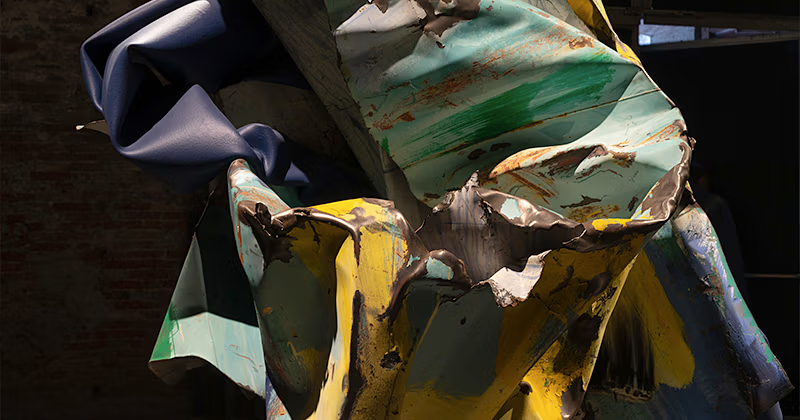
1– Senzei Maresela, (South Africa), Wall Reefs 104, Detail, 1995-2025, Arsenale, Photo by Luca Zambelli Bais 2- Valid Raad, Far from quieting – Kuwait, Detail, Arsenale, Photo by Marco Zorzanello 3– Marcia Kure, Roadkill III, 2025-2026, Detail, Arsenale, Photo by Andrea Avezzù 4– Kenedy Yanko (USA), Disciples of joy in the material world, 2025, Detail, Arsenale, Photo by Luca Zambelli Bais 5- Sahrap Hura, (India), Things Felt But Not Quite Expressed and Timeless, 2026, Installation view, Arsenale-Giardini, Photo by Andrea Avezzù 6- Georgina Maxim, (Zimbabwe) Borrowed books and underlined statements, 2023-2026, Detail, Arsenale-Giardini, Photo by: Marco Zorzanello, © 61st International Art Exhibition, La Biennale di Venezia, In Minor Keys, Courtesy of La Biennale di Venezia
LA BIENNALE DI VENEZIA
61ST INTERNATIONAL ART EXHIBITION, “IN MINOR KEYS” BY KOYO KOUOH
NATIONAL PARTICIPATIONS AND SELECTED TWO PAVILIONS
AROUND VENICE / COLLATERAL EVENTS
READ MORE
CATALOGUE
The official catalogue of the 61st Venice Biennale is a significant publication comprising two distinct sections: one dedicated to the international exhibition curated by Koyo Kouoh, and the other to national contributions and parallel events. The pages devoted to the artists feature sketches and images documenting the creative process, which convey the ideas behind the exhibited works, as well as a comprehensive short essay. The essays on artistic practices further enrich this publication with diverse perspectives. Eight original articles addressing current issues regarding thematic contexts and curatorial practices (written by Tandazani Dhlakama, Adrienne Edwards, Stefanie Hessler, Miguel A. López, Hélio Menezes, Wanda Nanibush, Oluremi C. Onabanjo and Françoise Vergès) are included. Meanwhile, five original articles by Ken Bugul, Teju Cole, Natalie Diaz, Frieda Ekotto and Abdaljawad Omar, which contribute to the intellectual coherence of the exhibitions, also attract particular attention.
Biennale Arte 2026, In Minor Keys, Catalogue / English, 2 Volumes, 21 X 27 Cm, Pages: Vol. I 720 Ca. / Vol. Ii 254 Ca., Paperback, Graphic Design: Clarissa Herbst And Alex Sonderegger.
Biennale Arte 2026, In Minor Keys, Short Guide / English, 15 X 20 Cm, Pages: 552 pages, paperback, Graphic Design: Clarissa Herbst And Alex Sonderegger.
BIOGRAPHY
Koyo Kouoh, Photo by Mirjam Kluka
KOYO KOUOH
(24 December 1967, Cameroon – 10 May 2025, Switzerland)
For many years, he served as director and chief curator of the Zeitz Museum of Contemporary African Art (Zeitz MOCAA) in Cape Town. Prior to this role, he served as founding artistic director of the RAW Material Company in Dakar, Senegal, which has become a hub for art, knowledge and community. He was also a member of the curatorial teams for documenta 12 (2007) and documenta 13 (2012). Kouoh is the recipient of the 2020 Meret Oppenheim Grand Prize, Switzerland’s most prestigious art award, which honours achievements in the fields of art, architecture, criticism and exhibition curation. She has organised contemporary and influential exhibitions such as *Body Talk: Feminism, Sexuality and the Body in the Works of Six African Women Artists* (2015, Wiels, Brussels). During her tenure at Zeitz MOCAA, she organised significant solo exhibitions focusing on African and African-descended artists. In this context, she curated exhibitions featuring artists such as Otobong Nkanga, Johannes Phokela, Senzeni Marasela, Abdoulaye Konaté, Tracey Rose and Mary Evans. She divides her time and work between Cape Town, Dakar and Basel.
saglamart; dinamik bir anlayış ile hareket eden, kültür-sanat ortamındaki olay ve olgulara, sanatçı tavırlarına, yapıtlara ve yayınlara odaklanan bağımsız bir yayın etkinliğidir. Tüm hakları saklıdır. Görüntü ve yazılar izinsiz kullanılamaz. / saglamart is an independent publishing initiative driven by a dynamic vision, focusing on events and developments in the cultural-artistic landscape, artist perspectives, works, and publications. All rights reserved. Images and texts cannot be used without permission.