robert morris

a sculptural practice acquiring an immanent dimension

"

ROBERT MORRIS INHABITS, IN A SENSE, AN APPROACH THAT CHALLENGES THE CONVENTIONAL CLASSIFICATIONS AND MOVEMENTS OF ART HISTORY. IT IS EVIDENT THAT HE REGARDS HIS ARTISTIC PRACTICE AS A SINGLE, COHERENT BODY OF WORK, A CONTINUOUS PROJECT, AND A SUSTAINABLE PHILOSOPHICAL AND ARTISTIC EXPERIMENT. ALL OF HIS WORKS, REGARDLESS OF THE MEANS EMPLOYED, AIM TO CREATE A COMPLEX, AT TIMES PARADOXICAL, FIELD, ONE THAT RESTORES TO THE VIEWER EXPERIENCES AND PERCEPTUAL PROCESSES THAT TODAY SEEM BEYOND REACH. IN ESSENCE, THESE WORKS, CONCERNED WITH THE RELATIONSHIP BETWEEN WHAT IS SEEN AND WHAT IS KNOWN, ARE SHAPED BY PHILOSOPHICAL SKEPTICISM, PRIORITIZING A VARIABLE MODE OF REPRESENTATION GROUNDED IN EXPERIMENTAL PROPOSITIONS. DESPITE THEIR METHODICAL RIGOR, MORRIS'S PRACTICE IS FOR THIS REASON PROFOUNDLY SUBJECTIVE, FILLED WITH AN INTENSE INTERIORITY AND AN EMPHATIC ORIENTATION TOWARD THE SEARCH FOR SELFHOOD.

Robert Morris is one of the most influential figures in post-war American art. He radically simplified and advanced the understanding of minimalism that emerged in New York in the early 1960s. Beginning his career as a painter, he adopted a new style consisting of sculptural arrangements and contributed to the definition of the minimalist movement through a series of published essays.

repetition, derivation, and chance

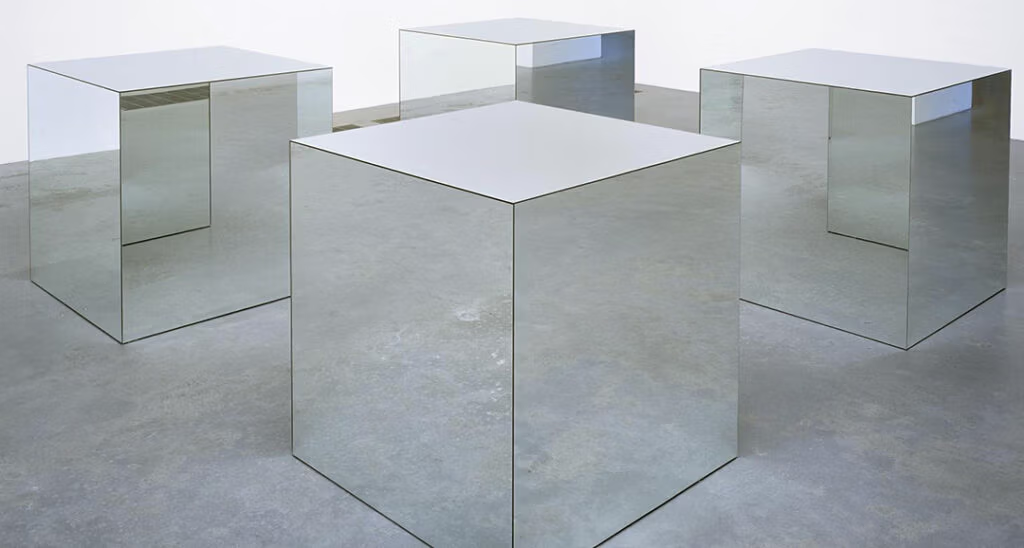
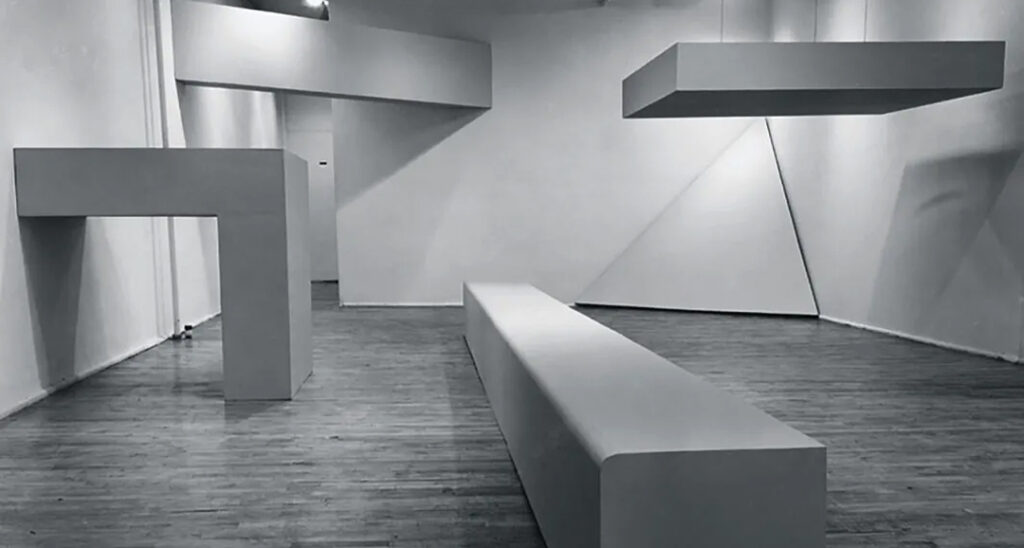
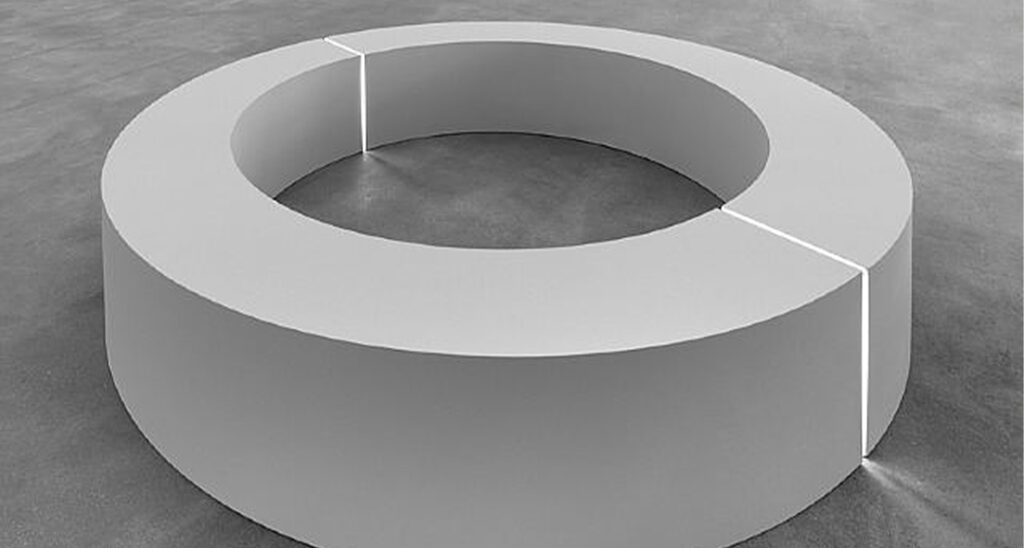
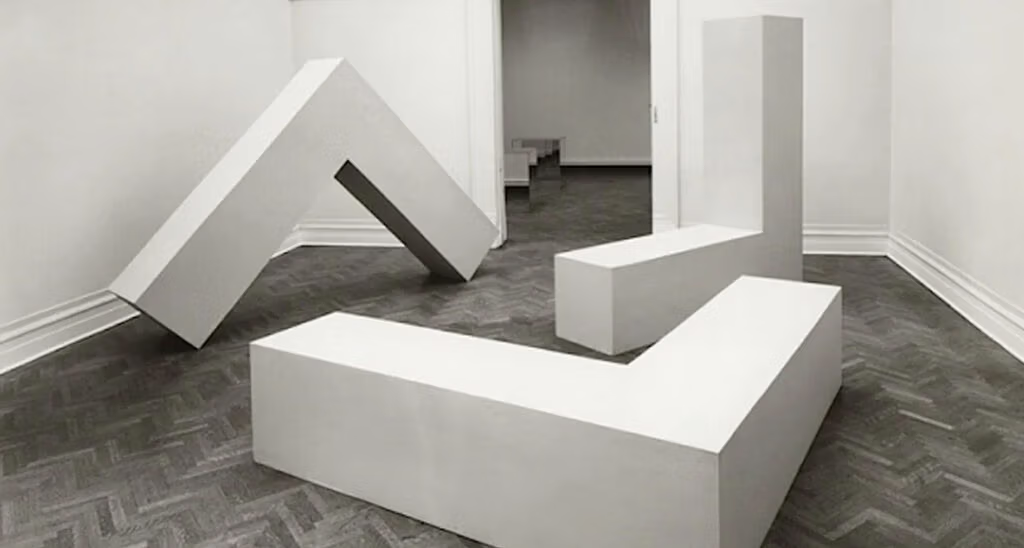
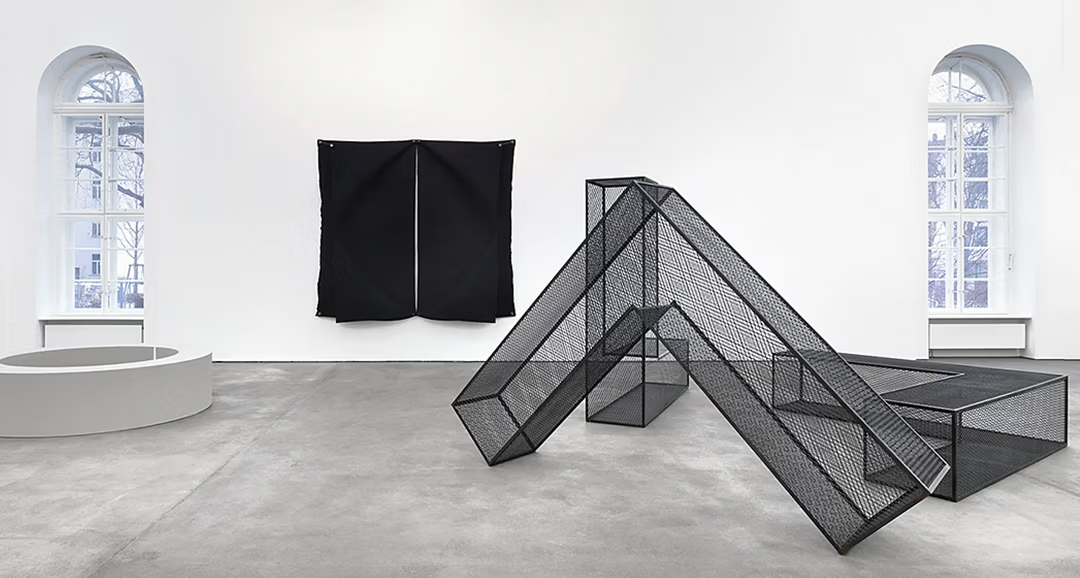
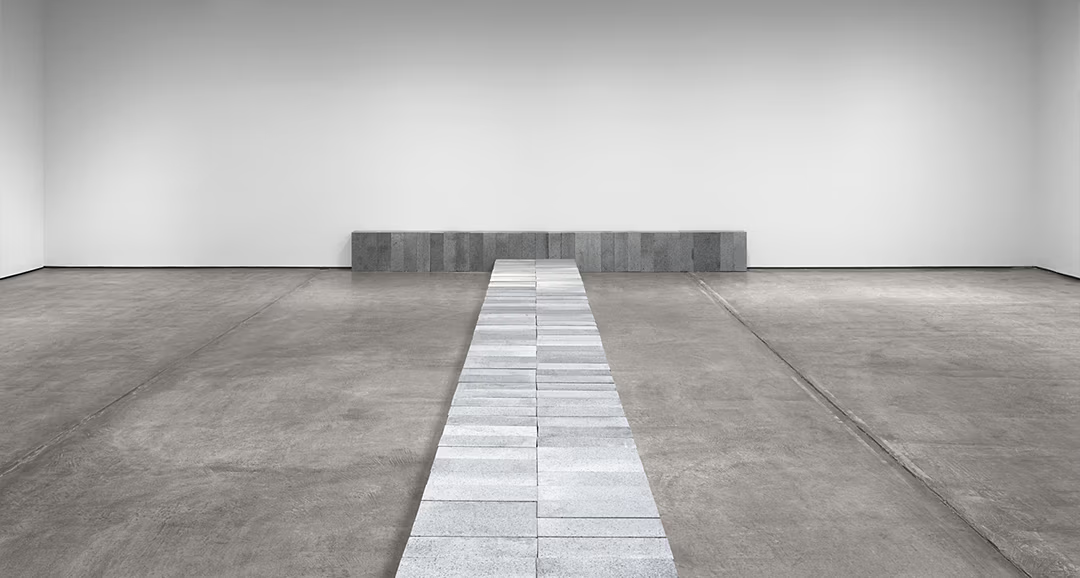
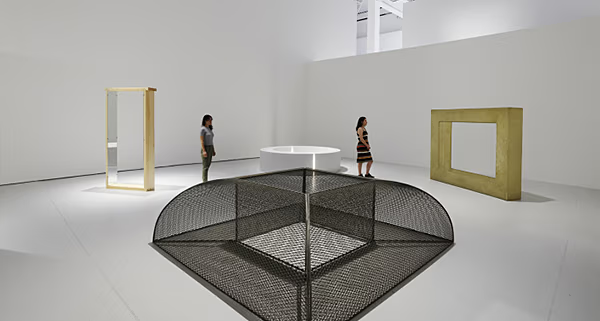
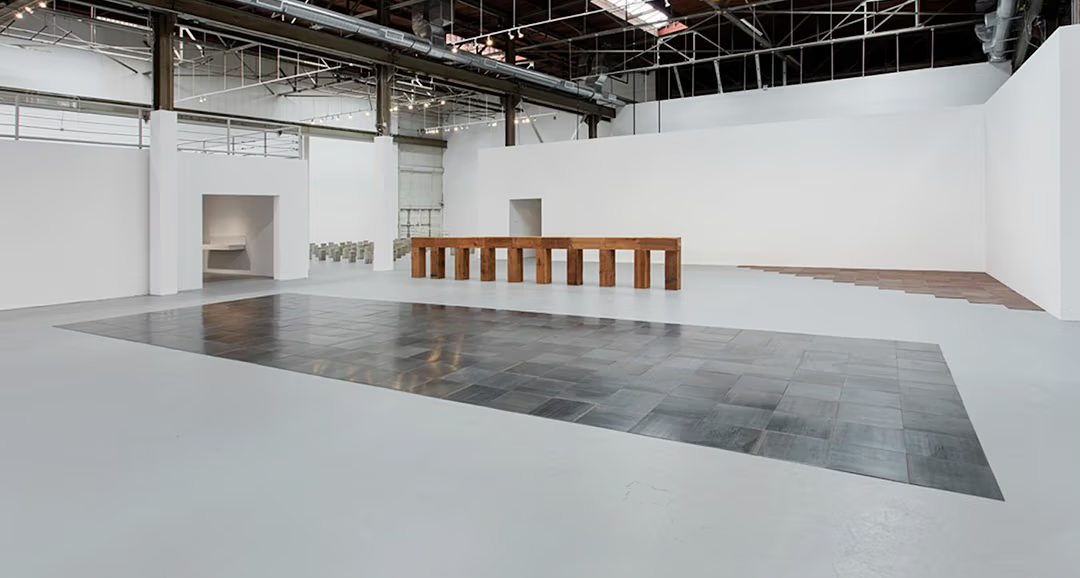
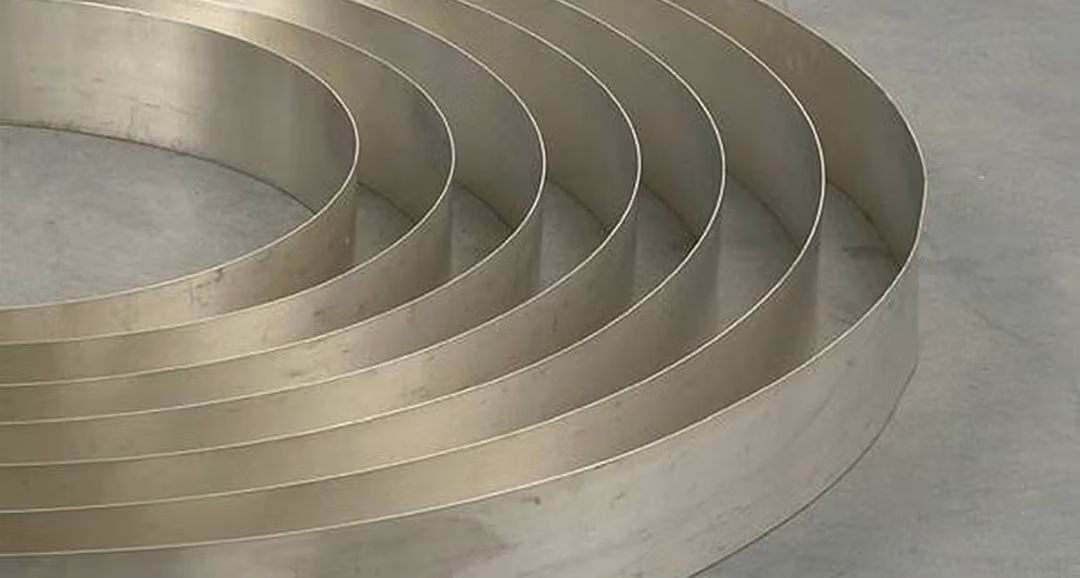
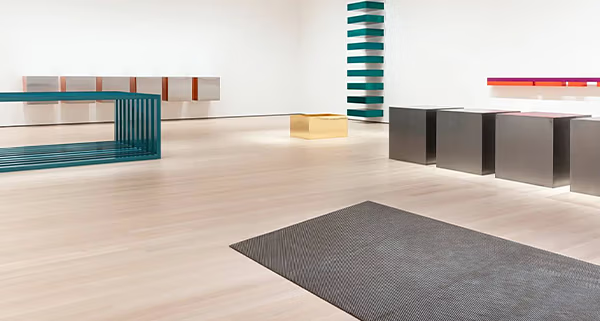
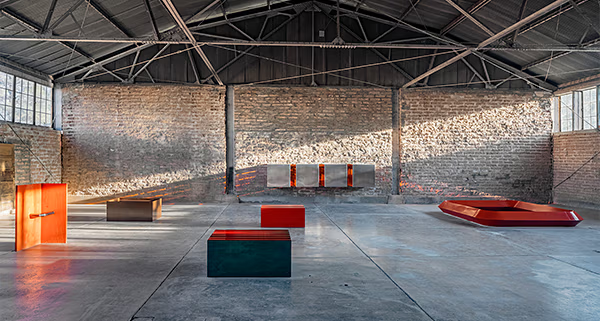
Morris, who exhibited large, monochromatic geometric sculptures produced in the first half of the 1960s by grouping them within specific spatial relationships, exerted a considerable influence on the minimalist movement, which sought to reduce art to its essence by eliminating personal expression and historical reference.(1) In this context, he avoids the compositional conventions of modern abstraction by employing objects and construction materials placed directly on the floor and occupying space, working instead on pieces grounded in the principles of repetition, derivation, and chance. To give an example, his 1977 work Untitled (Portland Mirrors) is a large-scale mirror installation that simultaneously invokes and subverts the principle of single-point perspective, presenting a broad illusion of multiple spaces.(2) In works such as Three L-Beams (1965), Mirror Cubes (1965), and Lit Ring (1965/66), which also intersect with a performative sensibility, he deliberately stages particular moments of perceptual confusion, demanding that the viewer continuously recalibrate their various sensory experiences. In his later works, Morris employs flexible and malleable materials such as plywood, steel mesh, and felt, establishing an equilibrium on the threshold between form and anti-form.

In his celebrated essay Notes on Sculpture, Parts 1 and 2, he addresses the complex relationship between minimalism and the discourse of late modernism. (3) Diverging from Donald Judd on this point, Morris holds that the illusionistic quality of sculpture carries no particular meaning or significance, and that the sculpture’s own autonomous and authentic character is of primary importance.(4) The unitary forms of minimalism present the existential reality of the object; the sculptural form in this sense constitutes a specific object, coinciding with the fundamental qualities of sculpture only within this framework.

What may appear to be a complex debate is, in essence, an effort to define minimalist sculpture within a late-modernist context in every instance. It attempts to account for the sculpture’s narrowing, or more precisely its contraction, toward the pure object, while simultaneously explaining its expansion and extension in the other direction. It is equally an effort to conceptualize the transformation occurring in the reception of sculpture and the change that defines the specific domain of sculpture’s new boundaries. This debate seems to unfold as though in pursuit of definitions such as minimal form, specific unit, specific object, or anti-form. Rosalind Krauss’s theory and formulation of the expanded field also points, in this context, to the factual transformation of sculpture, a transformation integrated with contradictory positions and reliant on the dialectics of space. In every case, minimal art strives to apprehend the object as it is, to discover it, and to reflect it through its structural character. The understanding of reduction and direct transmission as an experience of transcendence already rests on the idea of imparting an immanent dimension to these minimalist practices. (6)

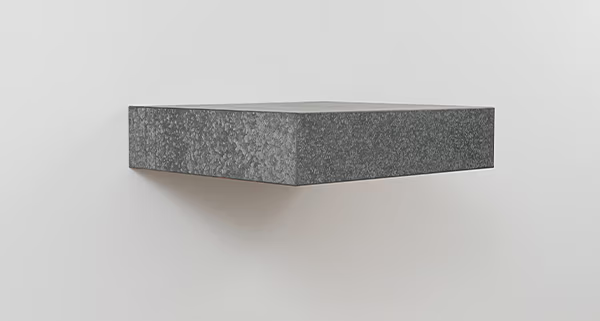
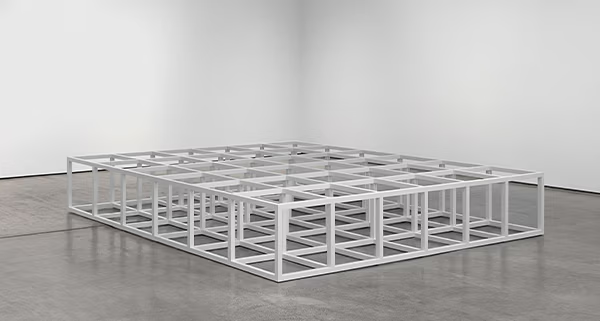
Morris advocates the value of forms in which wholeness prevails over any tendency toward fragmentation, and persistently proposes the use of simple forms. He regards the shift in sculpture from internal dynamics to external relationships as a transition from an intimate, private mode of experience to a more public and self-conscious one. His works consist of simple rectangular structures reminiscent of Gestalt form. Many of them rest on the floor. He generally produces L-shaped block structures, rendering these static forms visible in a dynamic manner. (7Morris’s mode of placing colored block rectangles and occupying space carries a particularly powerful and convincing visual presence.

Conceiving and almost consecrating the question of non-hierarchical, non-compositional structuring as a foundational principle of formation, Morris extends the scope of the part-whole relationship as a form of syntax. Material that preserves morphological consistency is brought forth with a simple, resolute, and repeatable directness and immediacy. (8)

minimalism 1 yatay 9

anti-form: toward a vew process and understanding

In certain works, Morris partially intervenes in formal integrity, creating a phenomenological movement between observation and the form implied by expectation. Referring to the possibilities of variable structuring, Morris draws attention to his divergence from Carl Andre, preparing the ground for more dynamic formal sequences through a discussion of possibility. In this respect, during the second half of the 1960s, Morris can be seen to exist within a set of relationships that diversify through possible variations, continuously renew the overall arrangement, and evolve toward a final state through spatial and perceptual shifts. Through this change in understanding, which foregrounds the intrinsic qualities of material, Morris moves in a sense beyond minimalist propositions and orients himself toward a new process and understanding designated as anti-form.

Robert Morris inhabits, in a sense, an approach that challenges the conventional classifications and movements of art history. It is evident that he regards his artistic practice as a single, coherent body of work, a continuous project, and a sustainable philosophical and artistic experiment. (8All of his works, regardless of the means employed, aim to create a complex, at times paradoxical, field, one that restores to the viewer experiences and perceptual processes that today seem beyond reach. In essence, these works, concerned with the relationship between what is seen and what is known, are shaped by philosophical skepticism, prioritizing a variable mode of representation grounded in experimental propositions. Despite their methodical rigor, Morris’s practice is for this reason profoundly subjective, filled with an intense interiority and an emphatic orientation toward the search for selfhood. (9)

notes

See. https://www.britannica.com/biography/Robert-Morris-American-sculptor 

2  See. https://mamc.saint-etienne.fr/en/exhibition/robert-morris

3  Robert Morris, “Note on Sculpture”, 4 Part, Artforum, 1966-1969.

4   Hal Foster, Gerçeğin Geri Dönüşü / The Return of the RealTranslation: Esin Hoşsucu, Ayrıntı Publication, May 2009, İstanbul. sf. 76.

5   Hal Foster, Ibid, pg. 79.

6  See. David Batchelor, Modernizm, Translation: Tüles Üresin, Hayalperest Publication, İstanbul, 2025. pg. 20-21.

Rosalind Krause, Modern Heykelin Dehlizleri / Passages in Modern Sculpture, Translation: Sibel Erduran, Everest Publishing, October 2021, İstanbul.

See. David Batchelor, Modernizm, Translation: Tüles Üresin, Hayalperest Publication, İstanbul, 2025. pg. 20-21.

9  David Batchelor, Modernizm, Ibid, pg. 47-49.

Prepared by Gülay Yaşayanlar & Mümtaz Sağlam  Copyright © March 2026, All Rights Reserved.

Two Important exhIbItIons

Body, DIstance, NegotIatIon

When Robert Morris speaks of real space, he refers to the space within the three-dimensional minimalist work itself. He asks the viewer not to look into an illusory depth, but to attend to the physical space they actually inhabit. The involvement of the body means that time acquires dimension and the experience of viewing extends beyond the purely visual. To make this possible, he produces gray geometric forms at a scale close to, or slightly larger than, the human figure.

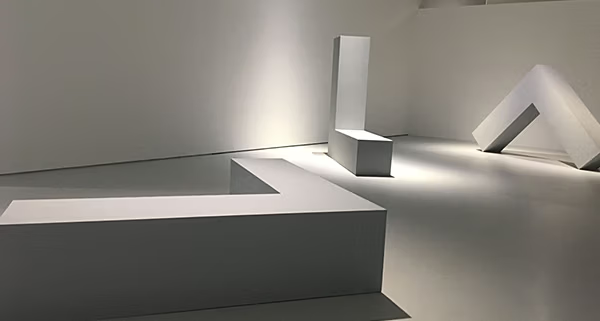
The L-shaped forms first exhibited in the 1960s are positioned so as to occupy the gallery floor and share the same space as the viewer. Rather than stepping back to observe the work from a distance, the viewer is compelled to stand alongside it, to exist in its proximity or move around it. The purpose of this compulsion is to transform the distance between viewer and work, the space between them, not into an aesthetic preference but into a site of bodily negotiation.

Morris’s geometric forms are produced, as a requirement of this demand for negotiation, at a scale deliberately close to or slightly exceeding that of the human body. They are also directly related to the principle of Gestalt. Every form at human scale therefore exists in a relationship of tension and negotiation with the viewer. Morris formulates this idea through the concept of the unitary form, that is, a form that is integrated, singular, and indivisible. The viewer does not decompose the form into parts and reassemble it; they apprehend the whole directly. And this apprehension is not intellectual but bodily. It is felt as a relationship of scale, weight, distance, and space. Here the work as a whole is grasped before its parts; the viewer is released from the act of reading the work and begins, rather, to live it. Moreover, analysis gives way to personal and bodily experience. And yet, Robert Morris’s 1971 exhibition at the Tate Gallery reveals, in a telling manner, the difficulty this understanding eventually encountered.

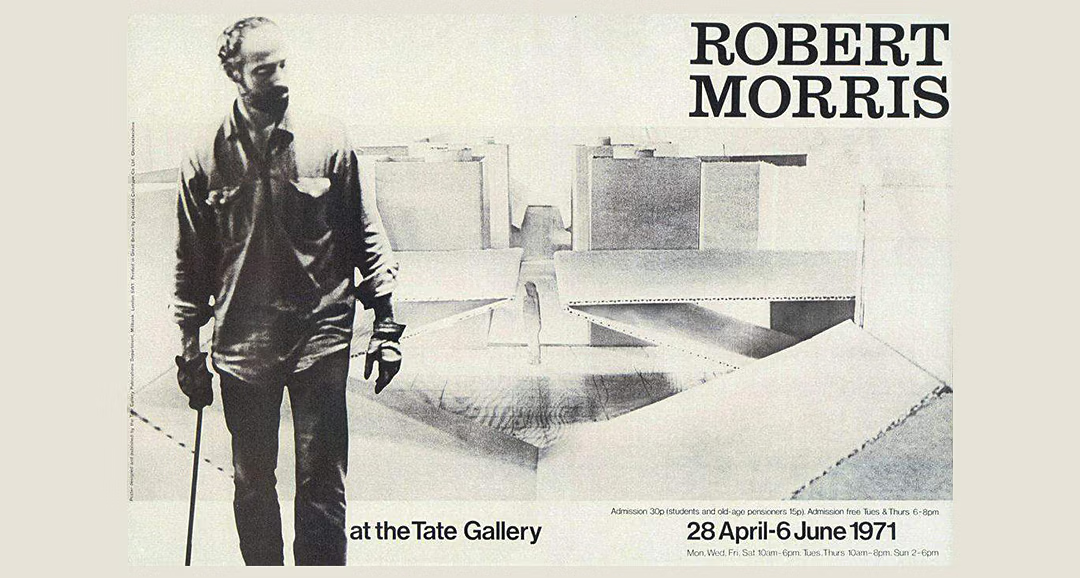
Robert Morris’s solo exhibition at the Tate Gallery (Tate Britain) in London in 1971, comprising interactive works that visitors could sit on and walk through, was deemed a safety risk and closed after the first four days. The cancellation of this event -which had been planned to last five weeks and proposed a radical experience based on physical participation and spatial relationships- and the subsequent developments are particularly intriguing. The exhibition in question was recreated thirty-eight years later (in 2009), in collaboration with Morris, adhering to the original plans but designed as a single work. This time, the exhibition -titled Bodyspacemotionthings and originally planned to last just four days- was held at the Tate Modern Turbine Hall and remained open for three weeks. The temporal gap between the abbreviated original exhibition and its extended counterpart provided an opportunity to compare the two versions of the artwork; it has acquired historical significance in that it offered a chance to demonstrate how much museums, audiences and ideas about art had changed in the intervening period. Bkz. Jonah Westerman https://www.tate.org.uk/research/publications/performance-at-tate/perspectives/robert-morris

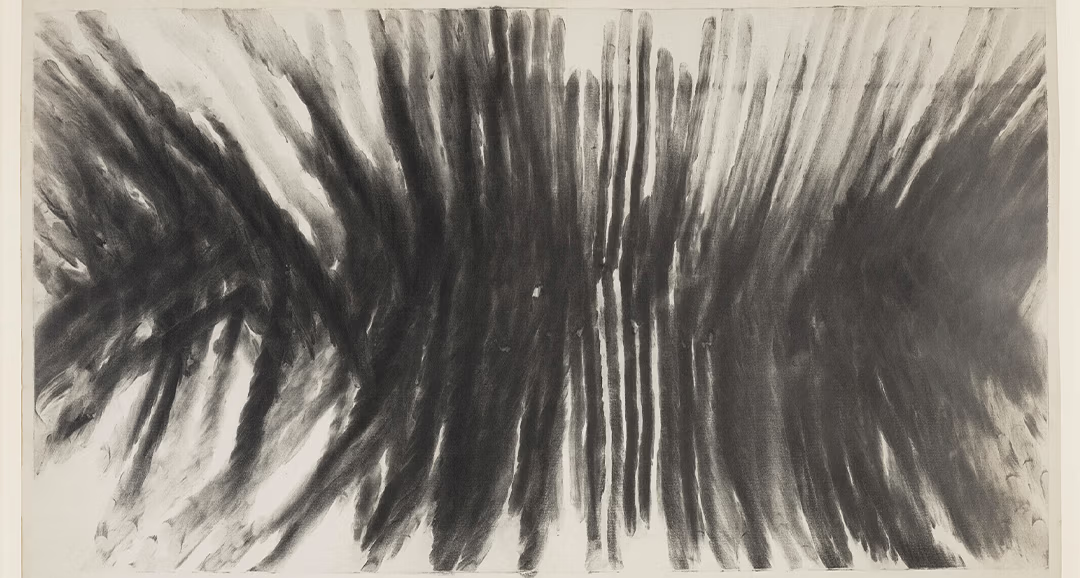
One of the works at the heart of Robert Morris’s artistic practice is the Bilind Time Drawings. He began these drawings in 1973, creating them with his eyes closed on large sheets of paper using raw materials (including graphite powder and iron oxide). He works by moving the paper with his bare hands, following instructions marked with an estimated duration. He brings together the accidents of automatism and the subtleties of traditional drawing, without belonging to either extreme. The body’s place within the paper’s limited space; a mark as an indicator of passing time: by refusing to see, yet accepting these other factors and the conditions of production, Morris sought to make us rethink and feel drawing as a historical tool. The Blind Time Drawings series also brings to light the themes of revelation and concealment present in the artist’s wider body of work.

BOOKS AND POSTERS

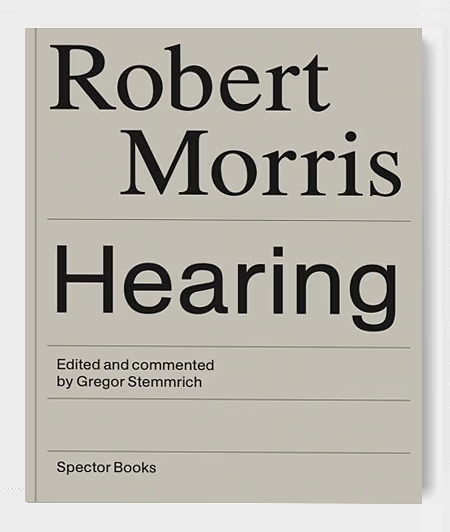
Robert Morris 1 Book

Robert Morris, Hearing: Edited and  Commented by Gregor Stemmich, Spector Books, English, Paperback, 148 pages, September, 2013

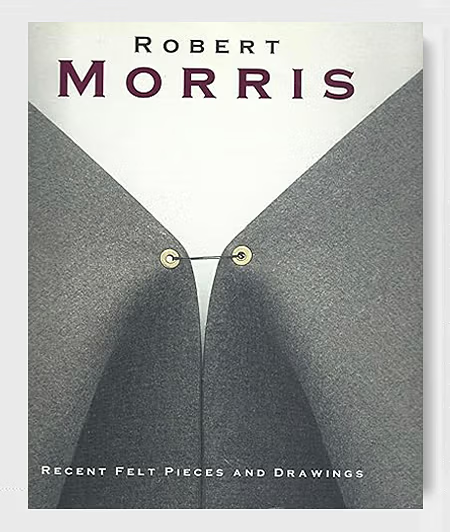
Robert Morris 3 Book

Robert Morris: Recent Felt Pieces and Drawings, 1996-1997, Association L.A.C. (Lieu d’art contemporain) Sigean, Paperback, English, French, German, Publisher: Henry Moore Sculpture Trust, 120 pages, 1997.

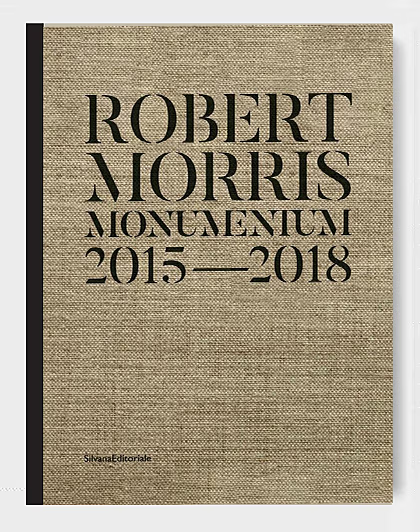
Robert Morris 7 Book

Robert Morris: Monumentum 2015-2018, by Saretto Cincinelli (Editor), Robert Morris (Artist), Silvana Editoriale, Hardcover, 208 pages, October 2020.

Robert Morris 6 Book

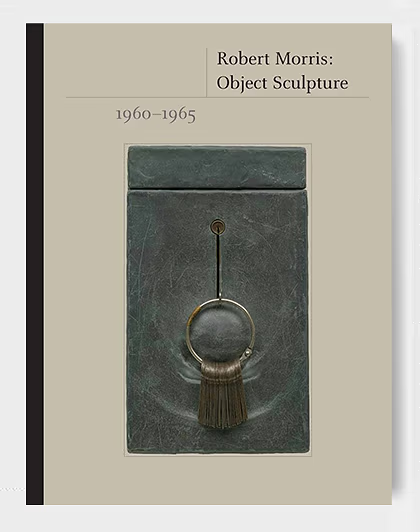
Robert Morris: Object Sculpture 1960-1965, Editors: Davies, Claire & Jeffrey Weriss, English, Hardcover, 320 pages, New Haven & London: Yale University Press with Castelli Gallery, New York, 2013. 

Robert Morris 2 Book

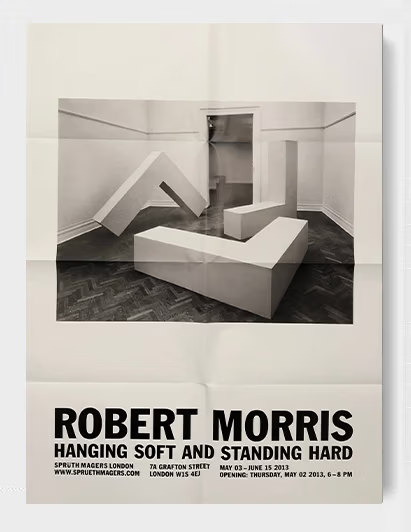
Robert Morris: Hanging Soft and Standing Hard, Exhibition Poster, Publisher: Sprüth Magers Gallery London, May 2013.

Robert Morris 5 Book

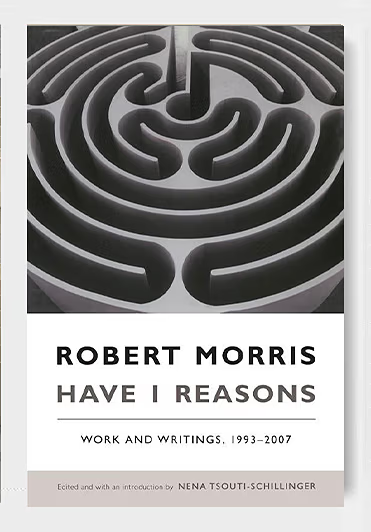
Robert Morris: Have I Reasons, Work and Writings, 1993-2007, by Robert Morris (Author), Nena Tsouti Schillinger (Editor), Paperback, 288 pages, English, Duke University Press, March 2008.

 
Robert Morris 5 Book

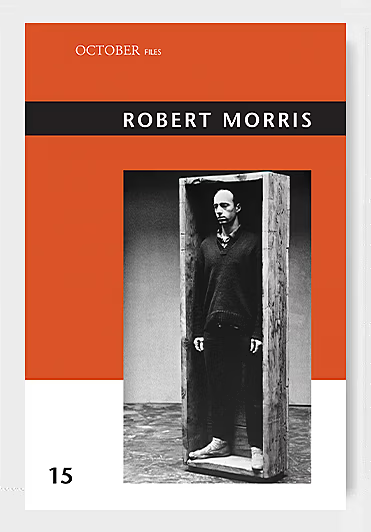
Robert Morris, October Files, 15, Julia Bryan-Wilson (Editor), The MIT Press, Paperback, 224 pages, English, August, 2013.

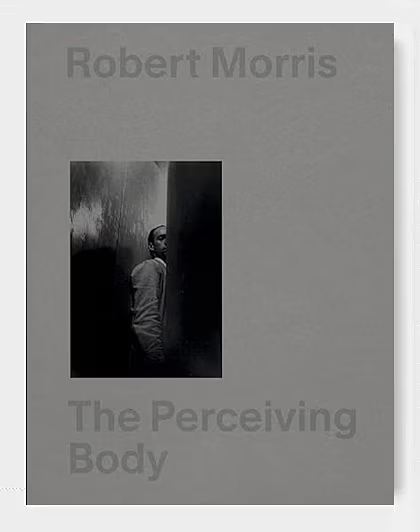
Robert Morris 1 Book 8

Robert Morris: The Perceiving Body, Texts by B. Ceysson, C. Fiske, S. Forti, C. A. Jones, A. Quoi and Jeffrey Weiss, English and French, 224 pages, Co-edition: Mudam Luxembourg – Musée d’Art Moderne Grand-Duc Jean, Musée d’art moderne et contemporain de Saint-Étienne Métropole (MAMC+) and Mousse Publishing, August 2020.

BIOGRAPHY

Robert Morris 1-20

Robert Morris (1931–2018) choreographed a series of significant works in the early 1960s. This experience played a key role in his development as one of the pioneers of minimalist sculpture. He focused his work on the viewer’s perception and experience of objects and space. Maintaining a prolific practice as both an artist and a writer, he produced numerous paintings, drawings, installations and sculptures. Between 1966 and 1969, he published four separate essays titled Notes on Sculpture in Artforum magazine, in which he explored the ideas he addressed in his artworks.

RELATED CONTENTS

İZMİR - LONDON

saglamart; dinamik bir anlayış ile hareket eden, kültür-sanat ortamındaki olay ve olgulara, sanatçı tavırlarına, yapıtlara ve yayınlara odaklanan bağımsız bir yayın etkinliğidir. Tüm hakları saklıdır. Görüntü ve yazılar izinsiz kullanılamaz. / saglamart is an independent publishing initiative driven by a dynamic vision, focusing on events and developments in the cultural-artistic landscape, artist perspectives, works, and publications. All rights reserved. Images and texts cannot be used without permission.

Copyright ©
Can Sağlam - Gülay Yaşayanlar Mümtaz Sağlam, 2025.