
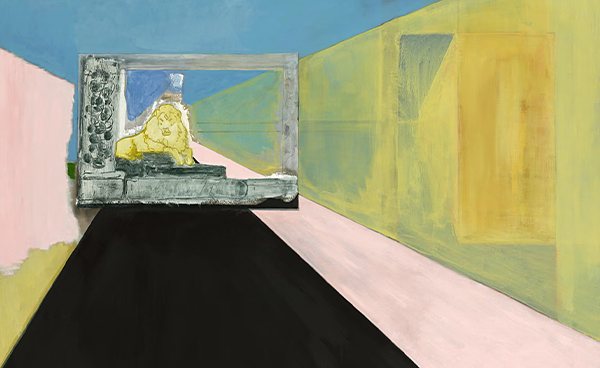
Peter Doig, Chopped Hand, 2017, (Detail), Oil on canvas, 27 x 35 cm. ©Michael Werner Gallery New York and London. ( https://www.michaelwerner.com/exhibitions/peter-doig8/selected-works)
peter doig
house of music
BY MÜMTAZ SAĞLAM
"
HOUSE OF MUSIC IS, IN ESSENCE, A SPACE DESIGNED TO MAKE HEARD VOICES SHAPED BY SENSITIVITY AND RESPONSIVENESS WITHIN A SOUND AND IMAGE-DRIVEN ENVIRONMENT. IT ATTEMPTS TO INTERPRET DOIG'S PAINTING PRACTICE WITHIN A SYSTEM CONNECTED, ALMOST ORGANICALLY, TO THE ACT OF GENERATING AUDITORY SENSATION. FOR THE POSSIBILITY IS CONSIDERABLE THAT THE SOUND SOUGHT AND DESCRIBED HERE IS A MATTER OF A SPATIAL DIMENSION WITH FANTASTIC AND DYSTOPIAN CONNECTIONS. AT THE SAME TIME, THIS ARRANGEMENT, WHICH APPEARS IN SOME MEASURE MYSTERIOUS AND UNNERVING IN THE ABSENCE OF SONIC SUPPORT, EFFECTIVELY DYSTOPICANIZES THE ENVIRONMENT, RENDERING IT A POWERFUL SOURCE OF DREAD THAT DESTABILIZES THE REAL.
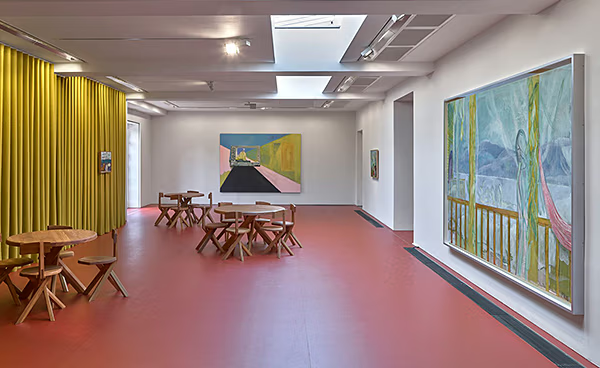
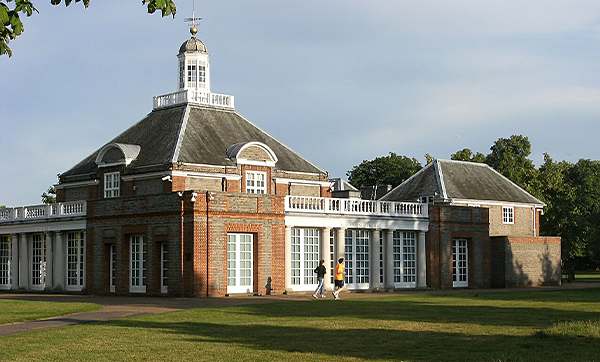
Peter Doig: House of Music, Serpentine South, 10 Ekim 2025 – 8 Şubat 2026. Fotoğraf: Prudence Cuming Associates, © Peter Doig. Tüm Hakları Saklıdır ve Serpentine’e aittir.
Peter Doig has long been in pursuit of an approach that both upholds and develops the conventions of traditional painting – using it as a vehicle for a mysterious inner world, one nourished by the wild imaginaries of different geographies. This stylistic sensibility, enriched by references to the dynamic, intense and expressionist realities of the 1980s, does not hesitate to turn toward a symbolic, and at times obscurely shadowed, figuration. A dimensionality that seems bound to historical events and local narratives leans directly on cultural difference, on a displaced, primordial and authentic mode of expression. For stories rendered as desolate scenes, it constructs an uncanny ground through strange and unlikely connections. What emerges, then, is a language and register that is at once inward and occasionally exuberant, tragic and ironic in equal measure. Precisely as in his 2025 London exhibition, House of Music.
an installation built on the connections between memory, sound and imagination
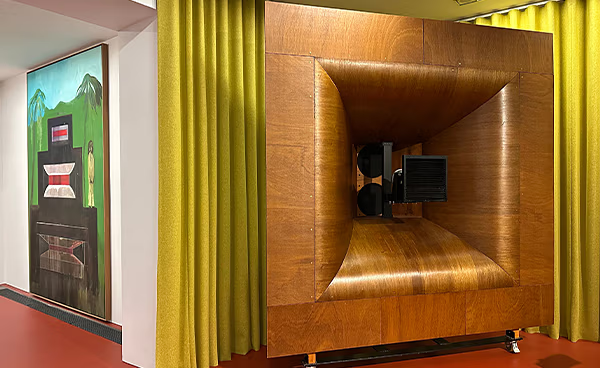
In this exhibition, Doig creates a singular spatial arrangement around a vintage sound system, an original Western Electric / Bell Labs apparatus. This practice, which brings the viewer into a new interior environment where music and painting converge, continues to reflect the cultural traces of the life he led in Trinidad between 2002 and 2021, while simultaneously envisioning a distinct visual and auditory experience. As if carried by an estranging affect, following the thread of a different story of existence, the artist brings traditional culture into dialogue with contradictory psychological meanings that intensify the stylistic quality of visual expression.
The works in House of Music, integrated with sound, consist of paintings that are powerful and visible in their reinforcement of spatial and environmental evocation. Two large speakers, used in the cinema and film industry of the 1930s and capable of producing tremendous sound, are incorporated into the exhibition context with considerable technical mastery. These monumental devices, calm in their silence, become, in Jonathan Jones’s words, mystical objects heralding both creation and destruction. An opportunity is seized to add new dimensions, through the idea of installation, into the connective tissue of sound, memory and imagination. A shared listening space is sought, something resembling a domestic environment, a place for contemplation and dialogue. In this way, the musical world opened by the paintings invites us into an anxious, primitivism-adjacent naturalness of a serene and spiritual illusion. The hallucinatory mode of animation, which ages and blurs the image within this context, preserves the unsettling sense of exterior and remote space.
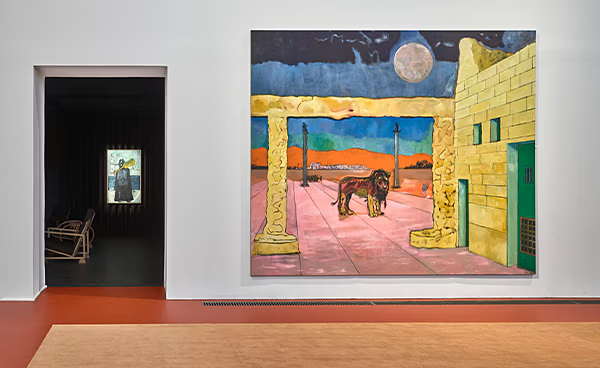
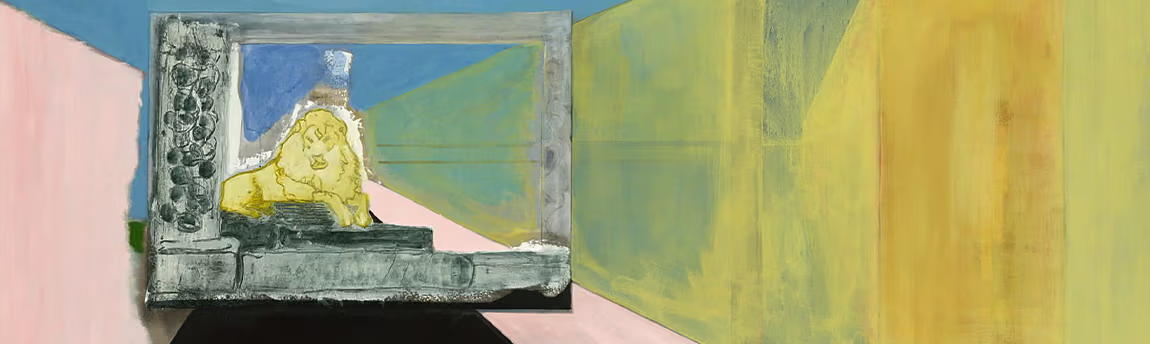
In sum, through this vision, Doig situates local figurative characters within a particular psychogeography, narrating cultural references within a framework of established belief and symbolic, conceptual structure. In this exhibition, for instance, the lion positioned across the canvases is made to wander through its own uncanny territory, bound by transcendent meanings and connections to memory and history. The image is drawn into metaphors of music and festivity, while simultaneously descending into the search for freedom and the colonial past. Finding an aperture within the cultural history of a particular geography, Doig reinterprets the lion figure as a symbol not only of power and dominion, but of an enduring search for hope.
a spatial dimension shaped by fantastic and dystopian connections
House of Music is, in essence, a space designed to make heard voices shaped by sensitivity and responsiveness within a sound and image-driven environment. It attempts to interpret Doig’s painting practice within a system connected, almost organically, to the act of generating auditory sensation. For the possibility is considerable that the sound sought and described here is a matter of a spatial dimension with fantastic and dystopian connections. At the same time, this arrangement, which appears in some measure mysterious and unnerving in the absence of sonic support, effectively dystopicanizes the environment, rendering it a powerful source of dread that destabilizes the real.
And yet House of Music may, in any case, be understood as a contribution to the continuity of Doig’s painting and thematic practice. Though it appears to deviate somewhat from his path in pursuit of adding a new visual dimension and intellectual space to his paintings, he is clearly seeking to reach more powerful emotional responses. Through different references sensed in the presence of music, he designs a complete void-space that reconstructs meaning on its own terms. It is for this reason that the exhibition atmosphere, touched with rare delicacy, presents itself as a subtler and more deeply layered stage for local, historical and cultural articulation.
(1) Peter Doig: House of Music, 10 October 2025 – 8 February 2026, Curatorial Team:Natalia Grabowska, Lizzie Carey-Thomas, Alexa Chow and Art Director Hans Ulrich Obrist, Serpentine South, Sound system: Laurence Passera / DSP London. https://www.serpentinegalleries.org/whats-on/peter-doig-house-of-music/
(2) “Transforming the gallery into a listening space, House of Music integrates sound into Doig’s later paintings for the first time. The exhibition features two rare and restored sets of analog speakers, originally designed for cinemas and large auditoriums. Music selected from the artist’s extensive archive of records and cassettes, amassed over decades, is played through high-quality wooden Klangfilm Euronor speakers from the 1950s.” See. https://www.serpentinegalleries.org/whats-on/peter-doig-house-of-music/
(3) Bkz. Jonathan Jones, “Peter Doig: House of Music review – intoxicating paintings with a banging soundtrack”, Guardian, 9 October 2025.
Mümtaz Sağlam, © Copright, April 2026, All Rights Reserved
TWO SOUND SYSTEM
KLANGFILM EURONOR JUNIOR SPEAKERS, CA. 1950’s
Klangfilm, like Western Electric in America, is a German company specializing in cinema sound and film audio technology. Klangfilm Euronor loudspeakers were widely used in cinemas in Germany and Western Europe in the mid-twentieth century. They are still appreciated today for their high sound quality and exceptional design. (See. Peter Doig: House of Music, Exhibition Brochure, Publisher: Serpentine, English, 8 pages, 2025, London, p. 7.)
WESTERN ELECTRIC AND BELL LABS SPEAKERS, CA. 1920s–30s
At the heart of the House of Music is an original Western Electric and Bell Labs sound system used for the first “sound films” of the 1920s and 1930s. This is an extremely rare sound system. It consists of vacuum tube amplifiers and highly sensitive “mains-powered field coil” loudspeakers. These loudspeakers were supplied by Laurence Passera, a London-based expert in historical sound technology, who collaborated with Doig on this project. Besides their technical excellence, the loudspeakers offer a unique listening experience, positioning them as pioneers of modern high-quality sound. (See Peter Doig: House of Music, Exhibition Brochure, Publisher: Serpentine, English, 8 pages, 2025, London, p. 7.)
Two Important exhIbItIons
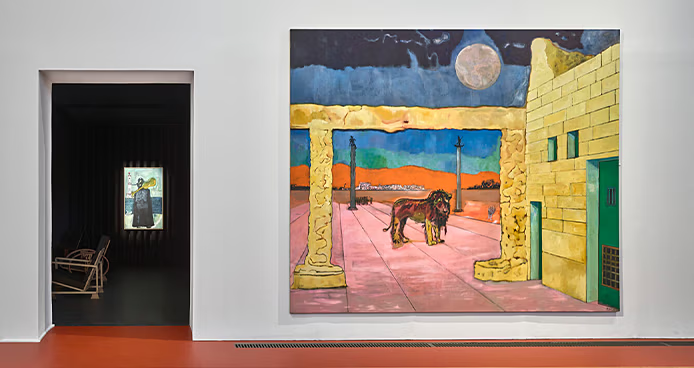
Peter Doig: House of Music, Serpentine South, October 10, 2025 – February 8, 2026. Photo: Prudence Cuming Associates, © Peter Doig. All rights reserved and owned by Serpentine.
SERPENTINE SOUTH / LONDON
Visit Site
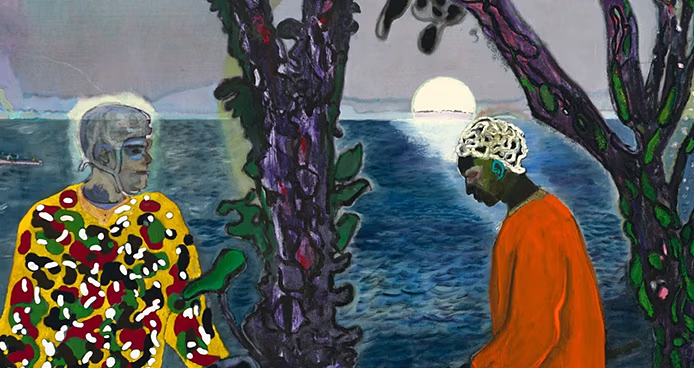
Peter Doig, Two trees, 2017, (Detail), Oil on canvas, 240 × 355 cm, The Metropolitan Museum of Art, New York Don de George Economou, en célébration du 150e anniversaire du musée, 2018 © Peter Doig. All Rights Reserved, DACS/ ADAGP, Paris, 2023
TWO WORKS
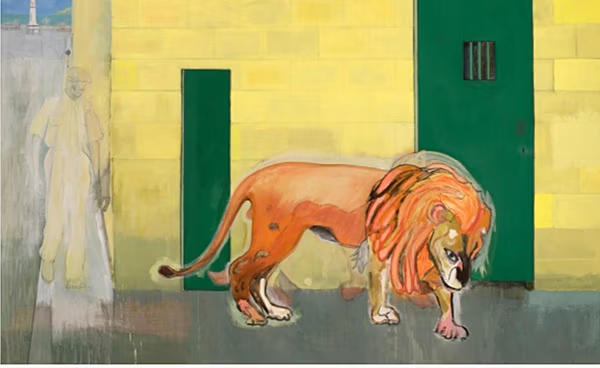
Peter Doig, Rain in the Port of Spain (White Oak), 2015, Distemper on Linen, 301x352 cm., Private Collection.
Rain in the Port of Spain (White Oak), 2015
Peter Doig depicts lions roaming freely in the streets of Trinidad in his paintings. This figure-image alludes to the Lion of Judah, a symbol of pride, resistance, and spiritual strength. Many of these works, including “Rain in the Port of Spain” (White Oak) and “Street Scene” (2017), feature bright yellow walls inspired by a well-known prison in the city center as a backdrop. Doig states that these paintings, which include the lion figure symbolizing the pursuit of freedom, reflect not only Trinidad but also the remnants of imperialism, the oppression of power, and a critical perspective. (See. Peter Doig: House of Music, Exhibition Brochure, Publisher: Serpentine, English, 8 pages, 2025, London, p. 7.)
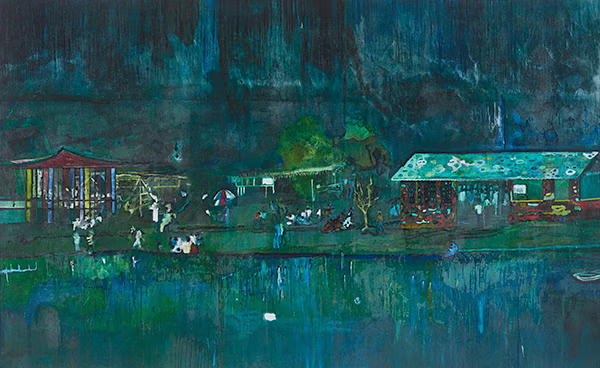
Peter Doig, Music of the Future, 2002–2007, Oil on linen, 201 x 330.5 x 7 cm (unframed), 205.5 x 336 x 7 cm (framed), Louisiana Museum of Modern Art, Humlebaek, Denmark. Acquired with the support of The Danish Ministry of Culture and The Augustinus Foundation.
Music of the Future, 2002–2007,
Trinidad is the birthplace of the steelpan, a primitive musical instrument. Once a symbol of creativity and resistance, steelpan groups are now central to Carnival celebrations across the Caribbean. Resembling a steel drum, the steelpan’s sound is enchanting, creating a hypnotic effect, especially outdoors. This painting depicts a scene Doig witnessed in The Savannah park in Port of Spain. In the dim light, he perceives and paints the intense sounds of the steelpan players almost as if they were a physical presence. As it stands, this work, bringing together personal memories, musical traditions, and diverse colonial-era landscapes, reflects the cultural spirit and heritage of Trinidad. (See. Peter Doig: House of Music, Exhibition Brochure, Serpentine Publication, 2025, London, p.6.)
EXHIBITION CATALOGUE
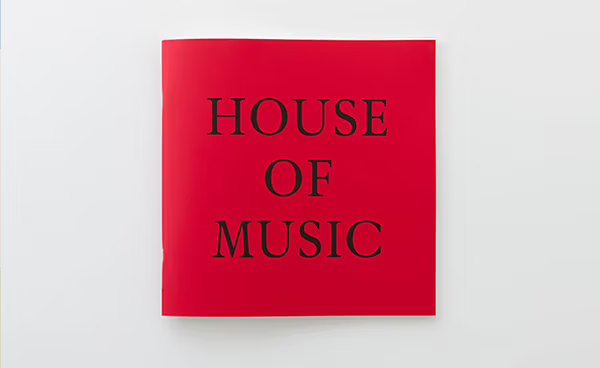
Peter Doig: House of Music, (Catalogue), Edited by: Natalia Grabowska and Alexa Chow, 80 pages, English, Serpentine, London Publisher: Verlag der Buchhandlung Walther und Franz König, Köln. 2026
Peter Doig: House of Music / Designed by the Paris-based studio Faye and Gina, the exhibition catalog includes a text by Michael Bracewell exploring the intersection of music and visual arts; a brief history of the development of sound systems for theatres by Laurence Passera; poems by Linton Kwesi Johnson and Derek Walcott; and an in-depth interview between the artist and Serpentine Artistic Director Hans Ulrich Obrist. The book also contains reproductions of the paintings and installations featured in the exhibition, archival materials, and technical diagrams of the loudspeakers.
BOOKS AND POSTERS
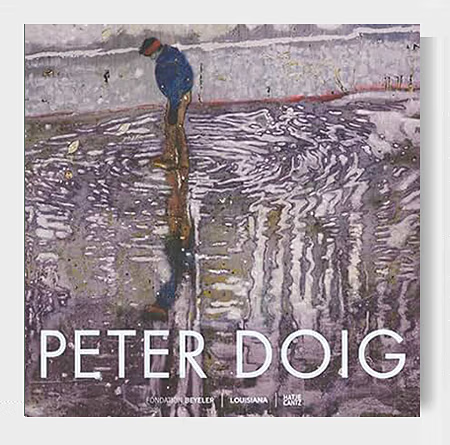
Peter Doig, edited by Ulf Küster on behalf of the Fondation Beyeler. interview of Peter Doig by Ulf Küster ; essay by Richard Shiff, Riehen/Basel, Switzerland : Fondation Beyeler; English, Ostfildern, Germany : Hatje Cantz Verlag, [2014]
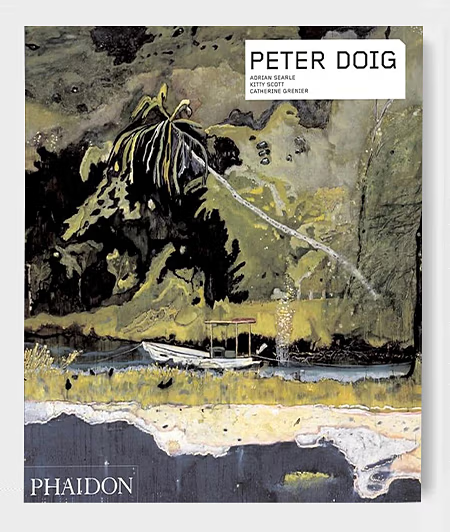
Peter Doig, Authors: Adrian Searle, Kitty Scott, Catherine Grenier, Hannes Schneider, Arnold Fanck, Peter Doig, (Phaidon Contemporary Artists Series), Publisher: Phaidon Press, Paperback,160 pages, English, January, 2007.
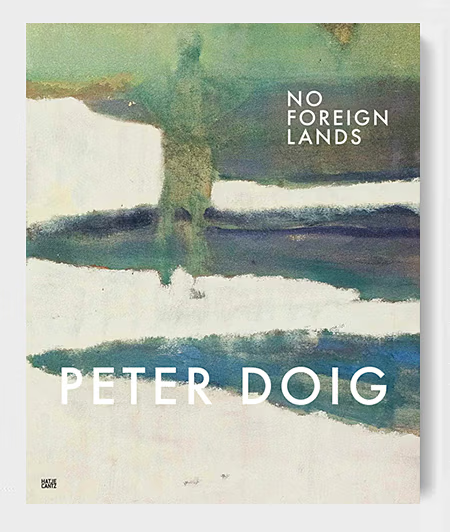
Peter Doig: No Foreign Lands, Editors:Parinaz Mogadassi, Jeff Alford, Michael Werner, Authors: Hilton Als, Stéphane Aquin, Keith Hartley, Angus Cook, Hardcover, 224 pages, English, Publisher: Hatje Cantz, October 31, 2013.
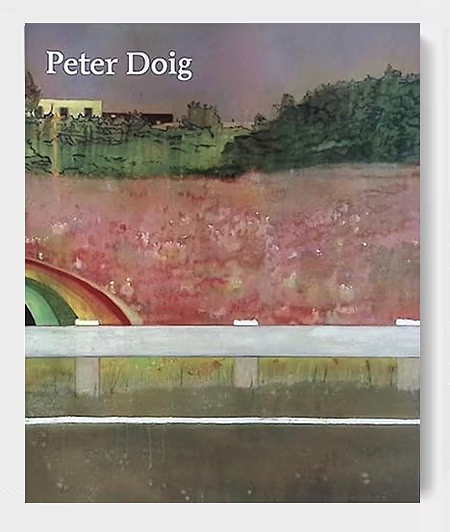
Peter Doig, Editor: Judith Nesbitt, 144 Pages, English, February, Softcover, Published by Tate Publishing, First Edition, 2008.
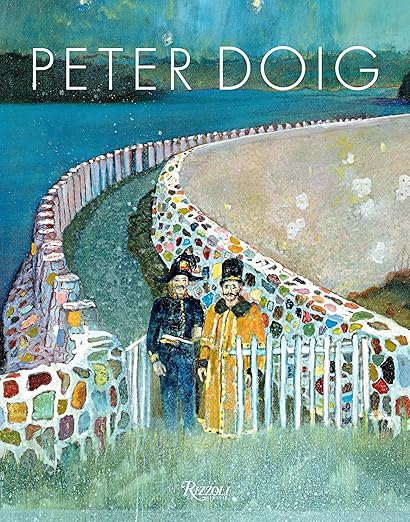
Peter Doig, by Peter Doig (Author), Richard Shiff (Contributor), Catherine Lampert (Contributor), (Rizzoli Classics), 432 pages, English, Hardcover, Rizzoli, Publication, March, 2017.
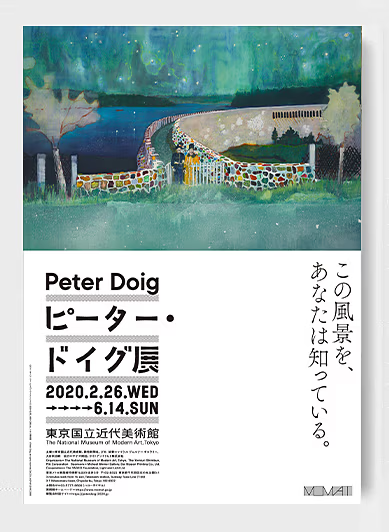
Peter Doig Exhibition Poster, February 6 – June 14, 2020, Image: “Gasthof zur Muldentalsperre 2000-2002”, The National Museum of Modern Art, Dai Nippon Printing, Tokyo.
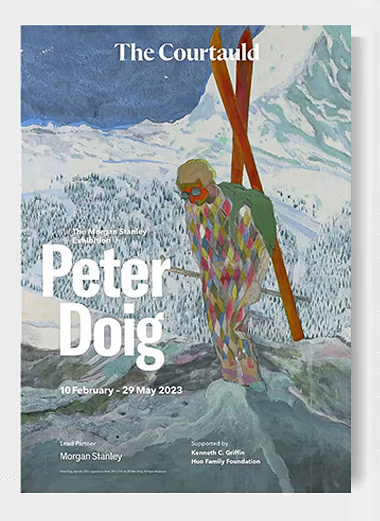
Peter Doig, The Morgan Stanley Exhibition, 10 February- 29 May 2023, The Courtauld Gallery, Poster, A2, 59.4×42 cm.
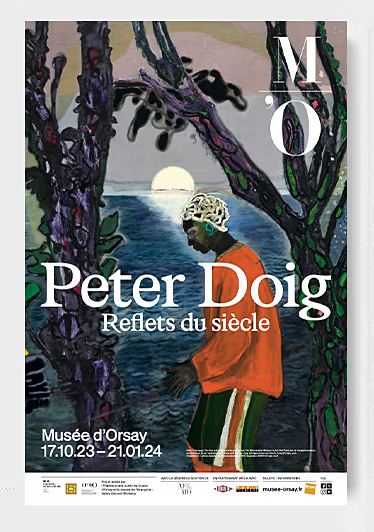
Peter Doig: Reflect in the Century, Exhibition Poster, 2023-2024, Musee d’Orsay, Paris, © Peter Doig. All Rights Reserved, DACS/ ADAGP, Paris 2023 / Mark Woods
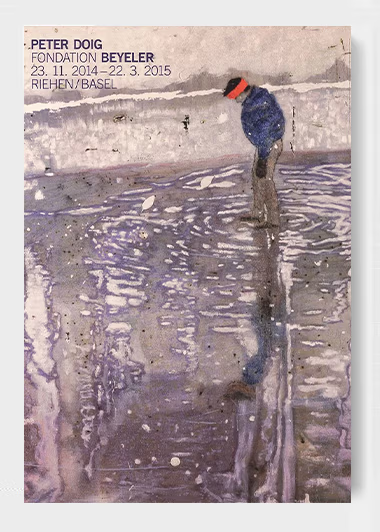
Peter Doig, Poster, 2014 Offset Lithograph poster (detail) from Peter Doig’s Fondation Beyeler exhibition, Switzerland. 42 X 30 cm.
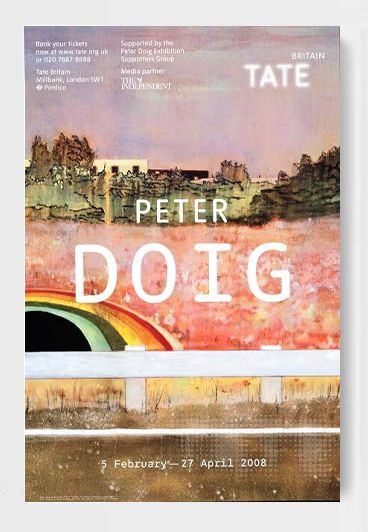
Peter Doig Exhibition Poster at Tate Britain, from 2008. Featuring detail of “Country Rock”, 1998-89, 5 February – 27 April, 2008, Hemp paper.
SERPENTINE / LONDON
BIOGRAPHY
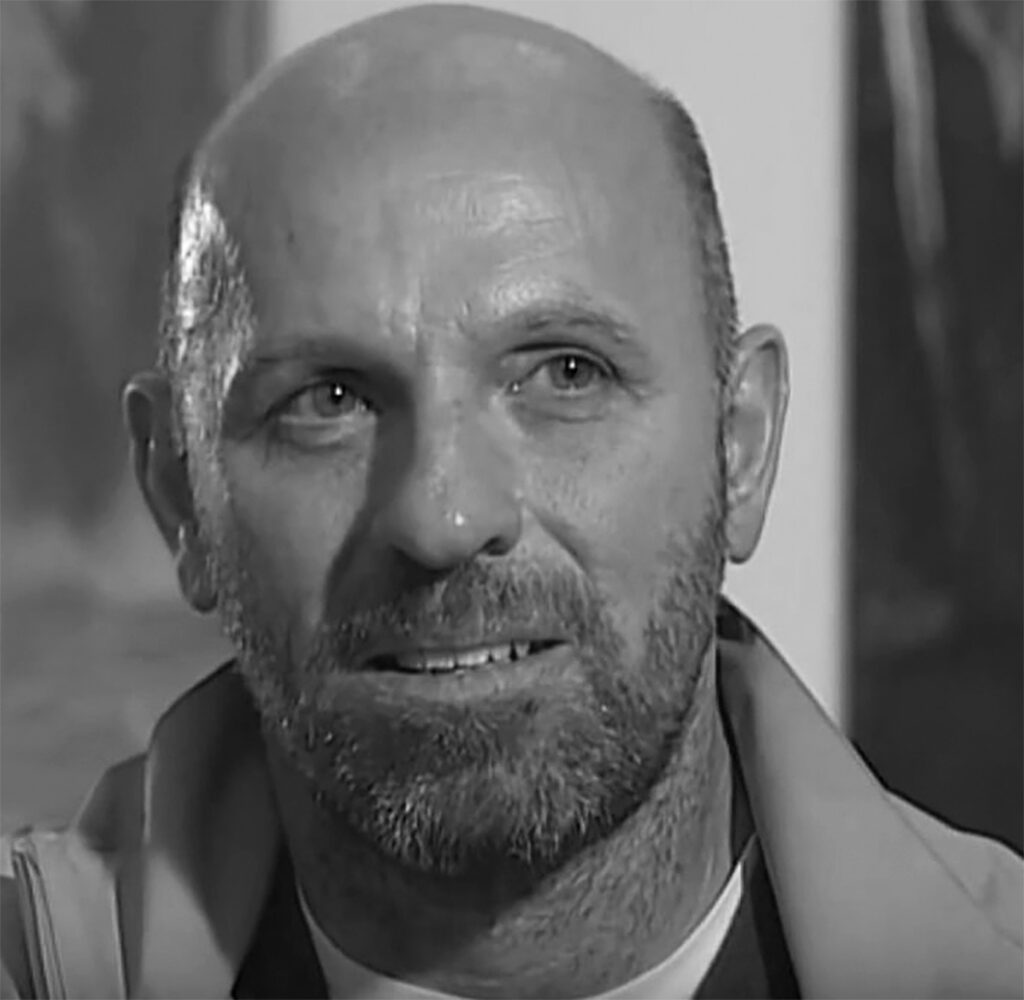
Peter Doig (d. 1959) She grew up in Canada. She moved to London to study at Saint Martin’s School of Art and Chelsea School of Art. Nominated for the Turner Prize in 1994, Doig also received the Wolfgang Hahn Prize from the Ludwig Museum in Cologne in 2008. From 2004 to 2017, she worked at the Düsseldorf Academy of Art in Germany. From 2023-2024, she curated the exhibition “Reflections of the Century” at the Musée d’Orsay. Since 2002, she has lived and worked between London and Trinidad.
RELATED CONTENT / PETER DOIG: HOUSE OF MUSIC 2025-2026
RELATED CONTENT / PETER DOIG 2022



İZMİR - LONDON
saglamart; dinamik bir anlayış ile hareket eden, kültür-sanat ortamındaki olay ve olgulara, sanatçı tavırlarına, yapıtlara ve yayınlara odaklanan bağımsız bir yayın etkinliğidir. Tüm hakları saklıdır. Görüntü ve yazılar izinsiz kullanılamaz. / saglamart is an independent publishing initiative driven by a dynamic vision, focusing on events and developments in the cultural-artistic landscape, artist perspectives, works, and publications. All rights reserved. Images and texts cannot be used without permission.